Whether you're upgrading every bulb in your home, building a smart lighting setup, or just trying to find a bulb that won't burn out in six months, the right LED light makes all the difference. We spent weeks researching and testing the top-rated LED light bulbs on the market - evaluating brightness, color accuracy, smart features, lifespan, and real-world value - so you can pick the one that fits your home and budget.
Every bulb on this list is UL certified (with several carrying additional Energy Star and Title 20 compliance), works with standard E26 or GU24 sockets, and is built to cut your lighting electricity bill by up to 85% compared to traditional incandescent bulbs.
Light | Best For | Lumens | Watts | Price | |
|---|---|---|---|---|---|
Philips Hue A19 (2-Pack) | Best Overall (Smart) | 800 | 9.5W | $89.98 ($44.99/bulb) | |
Kasa Smart KL125 | Best No-Hub Smart Bulb | 800 | 9W | $11.99 | |
Amazon Basics 24-Pack | Best Value | 800 | 9W | $20.50 ($0.85/bulb) | |
GE Reveal HD+ LED (2-Pack) | Best Color Accuracy | 60W Equiv. | 9W | $19.98 ($9.99/bulb) | |
Sunco GU24 LED (10-Pack) | Best for GU24 Fixtures | 800 | 9W | $25.99 ($2.60/bulb) |
Philips Hue Smart 60W A19 LED Bulb - White and Color Ambiance
Pick #1 - Best Overall Quality LED Light
800 Lumens | 9.5W | E26 Base | A19 Shape | 16 Million Colors + Warm-to-Cool White Tuning | Works with Alexa, Google Assistant, Apple HomeKit & Matter | 16,229+ Amazon Reviews at 4.8 Stars
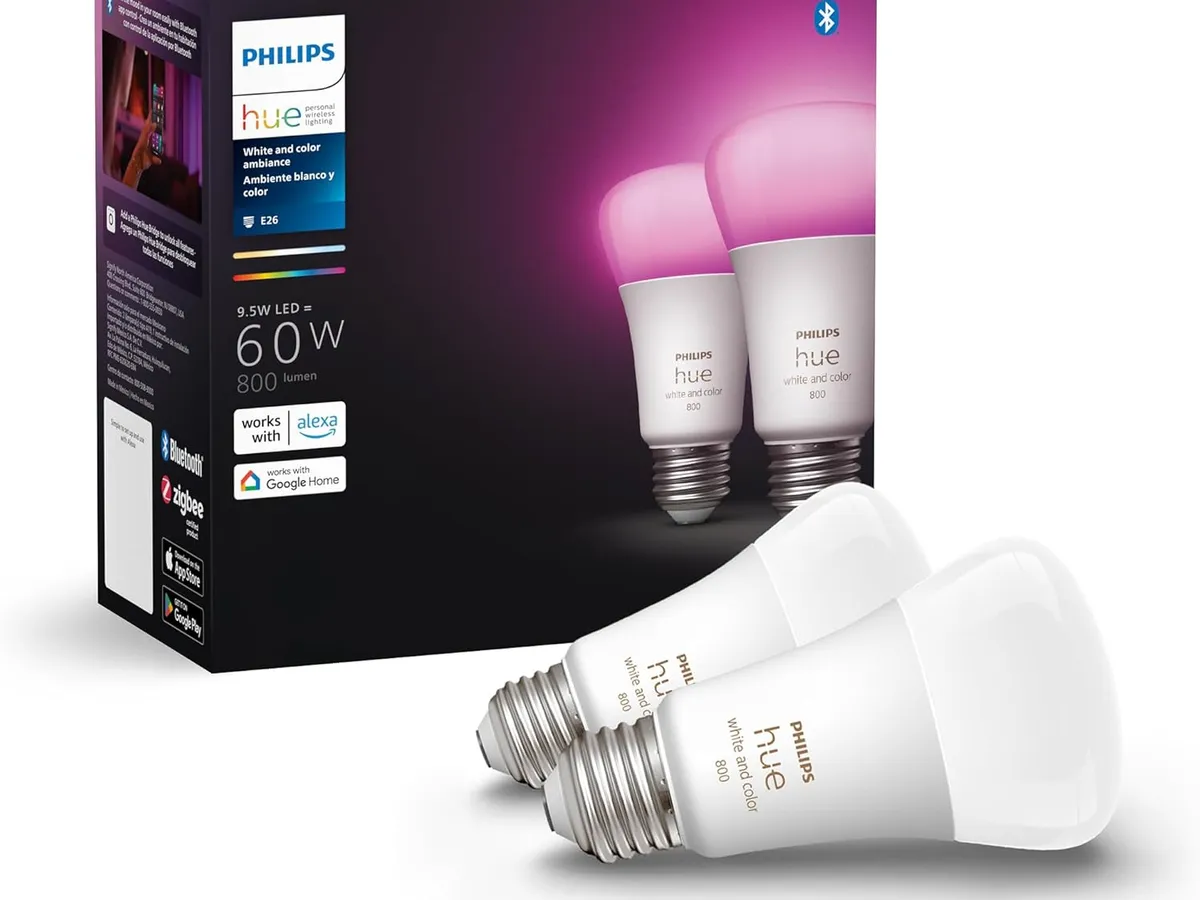
The Philips Hue A19 is the gold standard for quality LED lighting and the only bulb on this list that consistently earns top marks from Consumer Reports, Wirecutter, and CNET year after year. Sold here as a 2-pack for $89.98 (roughly $44.99 per bulb), each bulb delivers a clean 800 lumens of light (equivalent to a 60W incandescent) at just 9.5 watts of actual power draw. You get full access to 16 million colors plus the entire warm-to-cool white temperature spectrum - from candle glow for movie nights to crisp daylight for morning routines - all controlled through the free Hue app or via voice with Alexa, Google Assistant, and Apple HomeKit.
What sets the Hue bulb apart from cheaper smart bulbs is its mature ecosystem and Matter support. Out of the box, you can dim, brighten, and set colors instantly with the Hue app - simply screw the bulb in and pair it. Add a Hue Bridge (sold separately) and you unlock the full Hue platform: automations triggered by time of day, control from anywhere in the world, integration with other Matter-compatible smart home devices, dynamic light effects, and preset scenes that mimic natural light throughout the day. The result is the most flexible, future-proof smart-lighting setup money can buy.
Why It's Famous: 16 Million Colors, 4.8-Star Rating, and the Deepest Smart-Home Ecosystem
The Hue ecosystem is the deepest in smart lighting - candle bulbs, BR30 floodlights, recessed downlights, light strips, outdoor path lights, and lanterns all live under one app, and the platform now supports Matter for cross-ecosystem compatibility. Over 16,229 verified Amazon reviewers have given this exact bulb a 4.8-star rating, and the 500+ units sold per month track record speaks to how reliably it performs in real-world installations. Philips backs every Hue bulb with a manufacturer warranty and has maintained backward compatibility across its entire product line since the platform launched in 2012.
The trade-off is price. At roughly $44.99 per bulb in the 2-pack (cheaper per-unit in 3- and 4-packs - the 4-pack drops to $139.99, or about $35 per bulb), the Hue A19 costs 3-4x more than the Kasa pick below. If you only want one or two smart bulbs and don't plan to expand, the Kasa KL125 is a much better entry point. But if you're building a real smart home that you intend to grow into 10, 20, or 50 bulbs across multiple rooms, the Hue platform is the obvious long-term choice.
✓ Pros | ✗ Cons |
|---|---|
16 million colors plus full warm-to-cool white tuning 4.8-star rating across 16,229+ Amazon reviews Works with Alexa, Google, HomeKit, and Matter Preset scenes and dynamic light effects via Hue app Deepest smart-lighting ecosystem in the industry Backed by Philips - a 130+ year lighting company | Premium pricing at $44.99 per bulb (2-pack) Hue Bridge sold separately for full features Bluetooth-only range without the Hue Bridge Overkill for casual smart-lighting users |
Kasa Smart Light Bulb KL125 (TP-Link)
Pick #2 - Best No-Hub Smart LED Bulb
800 Lumens | 9W (60W Equivalent) | E26 Base | A19 Shape | Auto White + Energy Monitoring | UL Certified | 2-Year Warranty | 2.4GHz Wi-Fi (No Hub Required) | 25,012+ Reviews at 4.5 Stars | Amazon's Choice
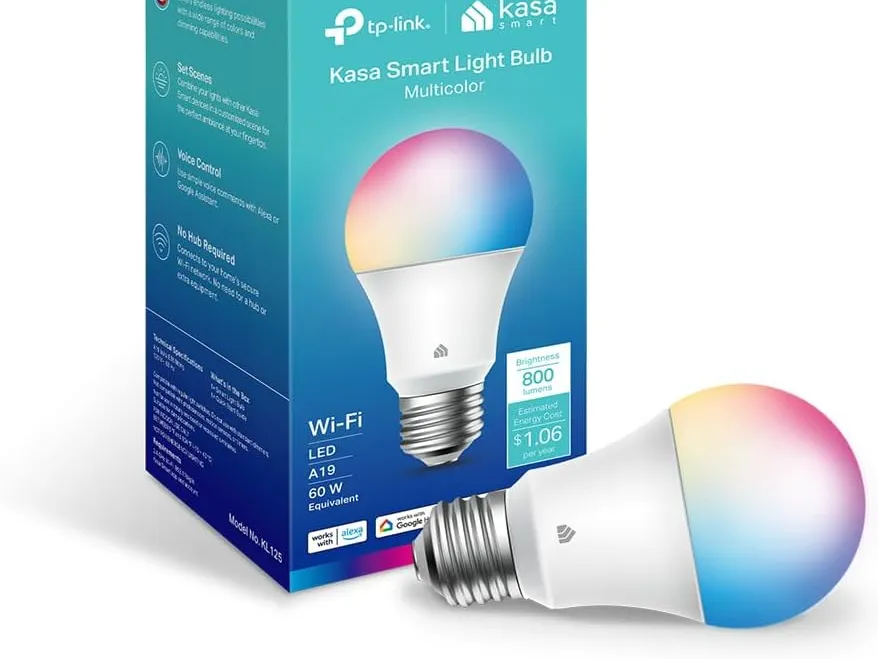
The Kasa Smart KL125 is the best entry point into smart lighting if you don't want to deal with a hub, a bridge, or any extra hardware - and at just $11.99 for a single bulb (or $19.99 for the 2-pack), it costs roughly one-quarter the price of a Philips Hue while delivering virtually every feature most homeowners actually use. Each 9W bulb produces a full 800 lumens (equivalent to a 60W incandescent), offers 16 million colors across the full RGB spectrum, and provides a complete 2500K to 6500K tunable white range from warm relaxation lighting to crisp focus lighting. The bulb has earned Amazon's Choice designation and pulled in over 25,012 verified reviews at a strong 4.5-star rating.
What makes the Kasa stand out from other budget smart bulbs is the TP-Link backing. TP-Link is one of the world's largest networking-hardware companies, and the Kasa Smart platform is trusted by over 6 million users worldwide. The bulb pairs directly with your 2.4GHz Wi-Fi network with no hub required, works seamlessly with Amazon Alexa and Google Assistant voice control, and includes standout features like Auto White (automatic color-temperature shifting from dawn to dusk that mimics natural light), real-time energy monitoring (so you can watch exactly how much power each bulb is drawing), and full scheduling with sunrise offset for gradual morning wake-up lighting.
Why It's Famous: 16 Million Colors and Energy Monitoring for Just $11.99
At $11.99 per bulb, the Kasa KL125 is the value sweet spot of the smart-bulb category. You get color changing, tunable white, dimming, scheduling, voice control, remote app control from anywhere, and built-in energy monitoring that competitor bulbs at twice the price don't offer. The KL125 line is also available in higher-output 1000-lumen configurations (the 2-pack runs $25.99, the 4-pack $51.98) for kitchens, home offices, and larger rooms where you want extra brightness. TP-Link backs every KL125 with a 2-year warranty and UL safety certification.
The trade-offs are reasonable. The bulb is 2.4GHz Wi-Fi only (no 5GHz support), which is universal for smart-home devices but worth noting if your router uses a single combined SSID - you may need to temporarily separate the bands during initial setup. Apple HomeKit is not supported natively, so if you're committed to the Apple ecosystem and need Siri voice control through HomeKit, the Philips Hue is the better pick. For everyone else, this is the no-hassle, no-hub, no-bridge smart bulb to buy.
✓ Pros | ✗ Cons |
|---|---|
$11.99 per bulb - roughly ¼ the price of Philips Hue No hub required - direct Wi-Fi connection 16 million colors + 2500K-6500K white tuning Auto White dawn-to-dusk circadian adjustment Real-time energy monitoring built in UL certified with 2-year warranty Amazon's Choice with 25,012+ reviews at 4.5 stars Trusted by 6 million+ Kasa users worldwide | 2.4GHz Wi-Fi only (no 5GHz support) No native Apple HomeKit support Requires internet for full remote features Slightly less vivid color saturation than Hue |
Amazon Basics A19 LED Light Bulbs (24-Pack)
Pick #3 - Best Value LED Light Bulbs
800 Lumens | 9W (60W Equivalent) | 5000K Daylight White | 10,000 Hour Lifespan | E26 Standard Base | A19 Shape | Non-Dimmable | Amazon's Choice | 13,261+ Reviews at 4.6 Stars
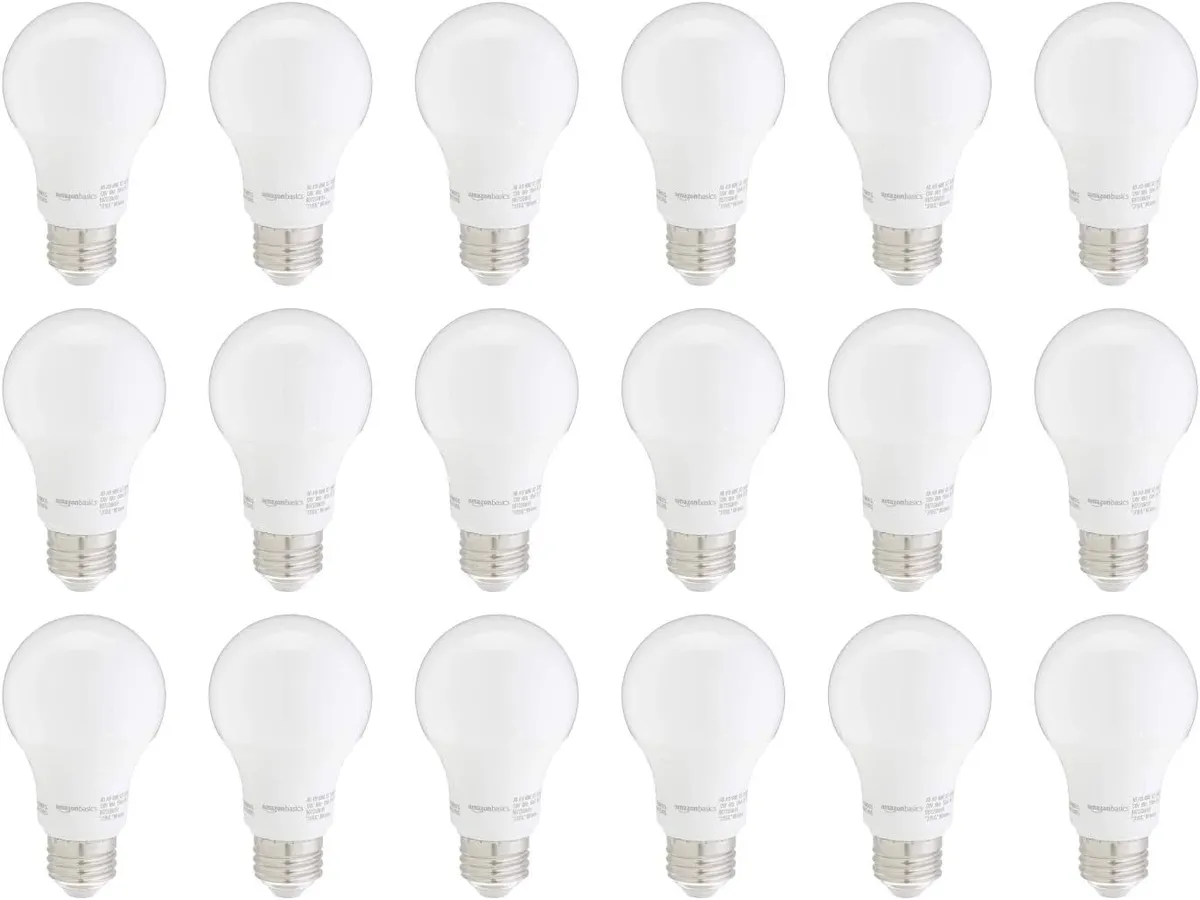
When you need to replace every bulb in your house at once - or you're a landlord, Airbnb host, or property manager keeping spares on hand for tenant turnovers - the Amazon Basics A19 24-pack is the most cost-effective LED solution on the market. At just $20.50 for the full 24-pack (about $0.85 per bulb), you get 800 lumens of 5000K daylight-white light from a 9W LED that replaces a traditional 60W incandescent. According to Amazon's own calculations, each bulb saves $55.87 in energy costs over its lifetime compared to the incandescent equivalent (based on 3 hours of use per day) - so the 24-pack saves roughly $1,340 in cumulative energy costs across the household.
Amazon Basics bulbs are built to UL safety standards, carry the E26 medium base that fits every standard American lamp and ceiling fixture, and produce no detectable hum, flicker, or warm-up delay. They turn on instantly at full brightness with no buzzing, no humming, and no perceived flicker. The 5000K daylight color temperature on this specific SKU is best for kitchens, bathrooms, garages, basements, and home offices where you want crisp, energizing white light - and the bulb is also available in Soft White (2700K) and a third "White" variant for $19.94 for living rooms, bedrooms, and dining rooms.
Why It's Famous: $0.85 Per Bulb with 9-Year Lifespan and Amazon's Choice Badge
The math on these bulbs is hard to ignore. The 24-pack retails for $20.50, which works out to $0.85 per bulb - cheaper than the cost of a single name-brand LED at Home Depot or Lowe's. The 10,000-hour rated lifespan translates to over 9 years at 3 hours of nightly use, and the bulb has earned its Amazon's Choice badge through 13,261+ verified reviews at a 4.6-star rating, with 3,000+ units sold per month as of this writing.
The trade-offs are real but manageable for most buyers. These bulbs are non-dimmable, so they will buzz, flicker, or refuse to dim if installed in a circuit with a dimmer switch - check before you buy. There's no smart functionality, no Wi-Fi, no app - just a reliable, bright, screw-in bulb that does its job for under $1. And while a 6-Count pack option exists for smaller needs, the 24-pack gives you the best per-bulb economics by a wide margin.
✓ Pros | ✗ Cons |
|---|---|
$0.85 per bulb in the 24-pack - unbeatable value Saves $55.87 per bulb in lifetime energy costs 10,000-hour rated lifespan (over 9 years of use) UL certified with standard E26 medium base Instant-on, no flicker, no buzzing, no warm-up Available in Daylight (5000K), White, and Soft White (2700K) Amazon's Choice with 13,261+ reviews at 4.6 stars | Non-dimmable - won't work on dimmer circuits No smart features or app control Plastic housing feels lightweight Only one bulb shape (A19) |
GE Lighting Reveal HD+ LED Light Bulbs (2-Pack)
Pick #4 - Best for Color Accuracy and High-Definition Light
60W Incandescent Equivalent | 9W Actual | HD+ Light | A19 Shape | Medium E26 Base | Dimmable | $1.08/Year Energy Cost | 2-Pack at $9.99 Per Bulb | 4.4-Star Rating
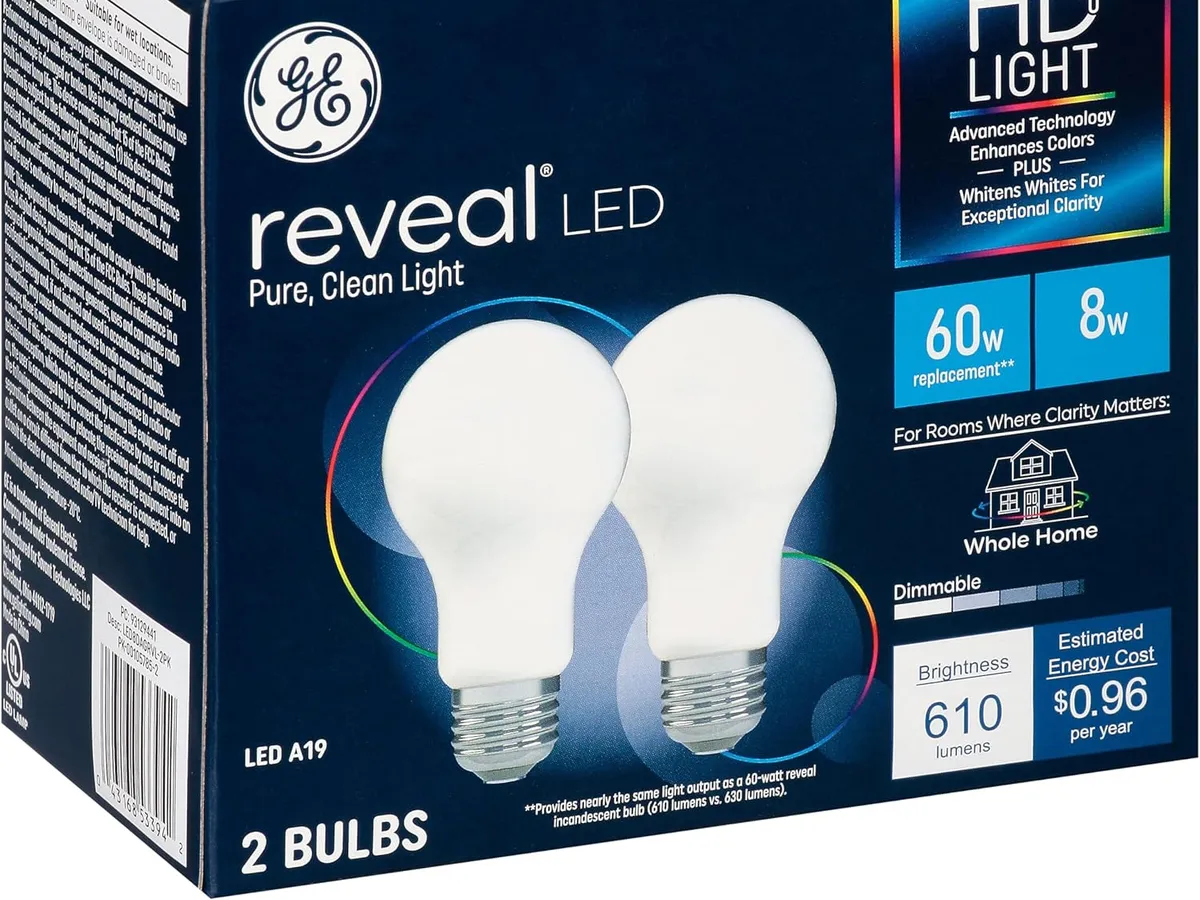
The GE Reveal HD+ is the secret weapon of interior designers, photographers, art collectors, and anyone who has ever looked at a room under cheap LED light and thought, "Why does everything look so flat?" While standard LED bulbs produce a generic white-ish output that flattens reds, oranges, and skin tones, the Reveal HD+ uses a proprietary neodymium-glass filter to strip out the dull yellow wavelengths that wash colors out - producing what GE calls "HD+ Light". The result is a cleaner, crisper output that makes reds look genuinely red, blues look genuinely blue, and whites look bright and clean instead of dingy cream.
Each bulb runs at 9 watts (replacing a 60-watt incandescent) and costs approximately $1.08 per year in electricity to operate at average household usage - one of the lowest annual operating costs in this entire lineup. The 2-pack sells for $19.98 (just $9.99 per bulb, marked down 5% from a typical price of $21.00), and the bulbs are fully dimmable with standard incandescent-style dimmer switches. The A19 shape with a medium (E26) base fits every standard American fixture - lamps, ceiling cans, pendants, sconces, vanity fixtures - so there's no compatibility puzzle to solve before you buy.
Why It's Famous: GE's HD+ Light Filters Dull Yellow for Whiter Whites and Bolder Colors
The Reveal HD+ is GE's flagship "designer light" product and is specifically engineered for spaces where color matters most - kitchens (where you want food to look appetizing), bathrooms (where you want makeup and skin tones to look accurate), and craft and hobby spaces where clarity matters. GE has been making consumer light bulbs since Edison founded the company in 1892, and the brand carries more name-recognition trust than virtually any other lighting label in the United States. The Reveal line specifically has been refined across multiple generations of LED technology to deliver the cleanest color rendering GE produces.
Where the Reveal really shines is in food photography, art lighting, and makeup mirrors. Skin tones look more natural, food photographs come out with truer reds and greens, and artwork hung in your living room actually looks like the colors the artist intended. The trade-off versus a standard daylight LED is that the Reveal output is slightly warmer in tone - so it's not the right pick for garages, basements, or workshops where you want maximum cold-white brightness. For living areas, dining rooms, kitchens, and bathrooms, this is the bulb that makes your house look like a magazine photo.
✓ Pros | ✗ Cons |
|---|---|
HD+ Light technology - dramatically better color rendering Dimmable with standard incandescent-style dimmers Just $1.08/year in energy costs at average use $9.99 per bulb - a fair premium for HD+ technology Backed by GE - lighting brand since 1892 Standard E26 base fits all common fixtures A19 shape looks right in exposed-bulb fixtures | Newer Amazon listing with only 38+ reviews so far Slightly warmer output than daylight LEDs 2-pack pricing only (no bulk multi-packs) Best suited for living spaces, not workshops |
Sunco A19 LED Bulb with GU24 Twist-Lock Base (10-Pack)
Pick #5 - Best for GU24 Fixtures and CFL Replacement
800 Lumens | 9W (60W Equivalent) | 2700K Soft White | CRI 91 | GU24 Twist-Lock Base | Dimmable (10%-100%) | Energy Star + UL + Title 20 Compliant | 5-Year Protection Warranty | 10-Pack at $2.60 Per Bulb | 1,182+ Reviews at 4.7 Stars | Amazon's Choice
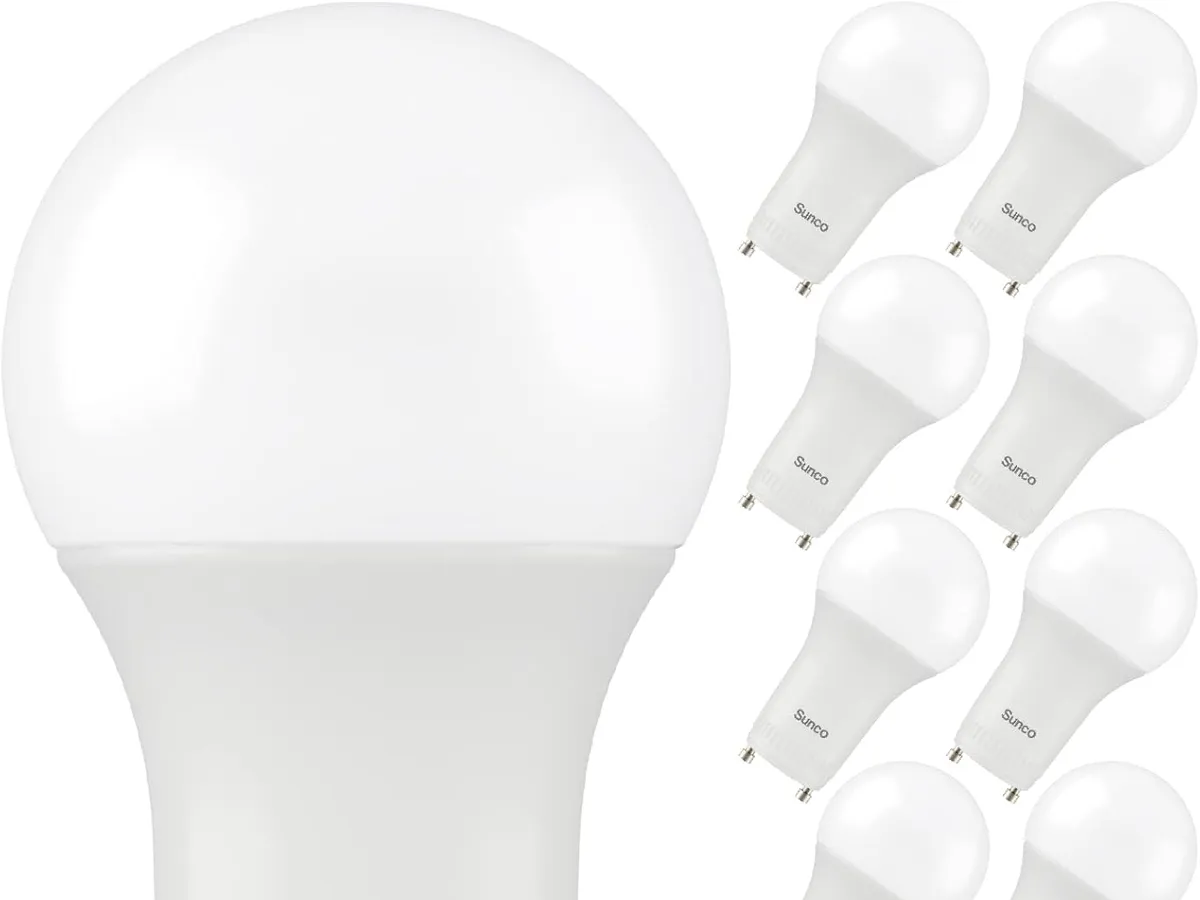
If you've ever walked into a home built after 2009 in California, Washington, Oregon, or any state with strict residential energy codes, you've probably noticed the strange two-prong "twist-and-lock" sockets in the ceiling fixtures. That's a GU24 base - a code-mandated socket designed to force homeowners away from energy-wasting incandescent bulbs and toward CFL or LED replacements. The problem is that most GU24 bulbs you can find at hardware stores are decade-old CFL models that take 30 seconds to warm up, render colors poorly, and contain mercury. The Sunco GU24 A19 LED solves all of that - and at $25.99 for the 10-pack (just $2.60 per bulb, marked down 16% from a list price of $30.99), it's also the most cost-effective way to retrofit an entire GU24-equipped home.
Each 9W Sunco LED produces a full 800 lumens of 2700K soft-white light (equivalent to a 60W incandescent), turns on instantly at full brightness, and is rated shatter resistant and shock and vibration resistant for use in ceiling fans, garages, and high-vibration fixtures. The headline feature for quality-conscious buyers is the CRI 91 color rendering index, which is well above the 80-82 CRI typical of budget LEDs and matches the rendering quality you'd expect from a premium specification-grade bulb. The bulb is also fully dimmable from 10% to 100% with compatible dimmer switches, which is rare in the GU24 LED category.
Why It's Famous: CRI 91, 5-Year Warranty, and Five Color Temperatures to Match Any Room
The Sunco GU24 A19 carries the full set of certifications that matter: Energy Star qualified, UL certified, FCC compliant, RoHS compliant, and California Title 20 certified. The Energy Star qualification means these bulbs may qualify for utility rebates in regions where local electric utilities offer residential lighting rebates - small per-bulb but meaningful across a 10-pack order. The bulb is available in 5 color temperatures: 2700K soft white (warm, the default for this listing), 3000K warm white, 4000K cool white, 5000K daylight, and 6000K daylight deluxe - so you can match the color temperature to each room of your house from one supplier.
Sunco is a US-based brand with responsive customer support, and they back every bulb with an industry-leading 5-Year Protection warranty - longer than any other manufacturer on this list. With over 1,182 verified reviews at a 4.7-star rating and the Amazon's Choice designation, the bulb has the social proof to match its spec sheet. The trade-off is that the bulb is specifically built for GU24 twist-and-lock sockets - if your fixtures use standard E26 medium base sockets, you'll want one of the other picks on this list. But for anyone living in a home with the code-mandated GU24 fixtures, this is by far the best LED upgrade available.
✓ Pros | ✗ Cons |
|---|---|
CRI 91 color rendering - far above typical LED bulbs 5-Year Protection warranty - longest on this list Energy Star, UL, Title 20 certified for rebate eligibility Dimmable from 10%-100% with compatible dimmers Available in 5 color temperatures (2700K-6000K) Shatter resistant and shock/vibration resistant Amazon's Choice with 4.7-star rating $2.60 per bulb in the 10-pack - excellent value | Only fits GU24 twist-and-lock sockets (not E26) Higher per-bulb cost than basic A19 LEDs No smart or color-changing capability Limited to homes with GU24-equipped fixtures |
LED Light Buying Guide: What to Look For
Lumens vs. Watts: How Bright Do You Need?
Lumens measure actual light output. Watts measure energy consumption. With LEDs, you want to compare lumens to lumens because the watt rating just tells you how much electricity the bulb consumes. As a baseline, a traditional 40W incandescent produces about 450 lumens, a 60W produces about 800 lumens, a 75W produces about 1,100 lumens, and a 100W produces about 1,600 lumens. For most home applications, 800 lumens per fixture is plenty for general room lighting. Use 1,000+ lumens for kitchens, bathrooms, and workshops where you want maximum brightness, and step down to 450-600 lumens for bedside lamps and accent lighting.
Color Temperature: Warm White, Soft White, or Daylight?
LED color temperature is measured in Kelvin (K). Lower numbers produce warmer, more orange-yellow light; higher numbers produce cooler, more blue-white light. 2700K soft white mimics traditional incandescent bulbs and works best in bedrooms, living rooms, and dining rooms. 3000K warm white is slightly less yellow, ideal for kitchens, bathrooms, and home offices that need a bit more energy. 4000K cool white is neutral and works well in garages, basements, and laundry rooms. 5000K daylight is crisp and energizing - perfect for workshops, retail spaces, and outdoor security lighting. Avoid 6500K+ for indoor residential use; the cold blue tone causes eye strain over time.
CRI (Color Rendering Index): Why It Matters
CRI measures how accurately a light source renders colors compared to natural sunlight on a scale of 0 to 100. Budget LED bulbs typically rate 80-82 CRI, which is acceptable for general lighting but flattens reds, oranges, and skin tones. Premium bulbs like the GE Reveal HD+ and Sunco GU24 deliver CRI 91+, producing noticeably truer color rendering. Photographers, artists, makeup users, and food enthusiasts should always choose 90+ CRI bulbs. For garages, closets, and utility spaces, standard 80+ CRI is fine.
Smart Bulb vs. Standard LED: Which Should You Choose?
Smart bulbs cost 3-10x more than standard LEDs and give you app control, voice control, color-changing capability, scheduling, and integration with home automation systems. They make sense if you have 3+ fixtures in a room you control as a group, want color-changing or tunable-white capability, or are building a smart home around Alexa, Google Home, or Apple HomeKit. Standard LEDs make sense everywhere else - garages, closets, hallways, basements, and any fixture controlled by a single wall switch you don't need to automate. A common mistake is putting smart bulbs in fixtures controlled by wall switches; if anyone flips the wall switch off, the smart bulb loses power and can't be controlled remotely.
Base Types: E26, E12, GU24, and More
The E26 medium base is the standard American screw-in socket and fits 95% of household lamps and ceiling fixtures - the Philips Hue, Kasa KL125, Amazon Basics, and GE Reveal HD+ on this list all use E26. The E12 candelabra base is the smaller version found in chandeliers, decorative wall sconces, and some pendant fixtures. The GU24 twist-and-lock base is mandated by energy codes in California, Washington, and Oregon for many fixture types - the Sunco GU24 pick on this list is built specifically for these sockets. Always check your existing fixture before ordering - swapping a wrong-base bulb is the most common LED purchase mistake.
Conclsuion:
Transitioning your home to LED lighting is one of the simplest ways to reduce energy consumption without sacrificing light quality. Whether you choose the high-end versatility of the Philips Hue ecosystem or the straightforward value of bulk packs from Amazon Basics, the immediate impact on your utility bill and the long-term reduction in maintenance are undeniable. Modern LEDs have finally reached a point where color accuracy and dimming capabilities rival traditional incandescent bulbs, making them a viable choice for every room in the house.
Before finalizing your purchase, always verify your fixture's socket type and check if your existing wall dimmers are LED-compatible. As smart home standards like Matter continue to evolve, investing in high-quality bulbs now ensures your lighting setup remains functional and integrated for years to come. Start with your most-used rooms to see the fastest return on investment, and gradually phase out older bulbs as they reach the end of their lifespan.
Frequently Asked Questions
Q1: How long do LED light bulbs really last?
A: Quality LED bulbs are typically rated for 10,000 to 25,000 hours of operation. The Amazon Basics A19 on this list carries an explicit 10,000-hour rating (about 9 years at 3 hours of daily use), and premium smart bulbs like Philips Hue are rated significantly longer. The catch is heat - LEDs installed in fully-enclosed fixtures, recessed cans without proper ventilation, or hot attic spaces will fail much faster than their rated lifespan. For enclosed fixtures, specifically buy bulbs marked "enclosed fixture rated" to avoid premature failure.
Q2: Are LED bulbs safe to use on dimmer switches?
A: Only if the bulb is specifically marked "dimmable". The Philips Hue, Kasa KL125, GE Reveal HD+, and Sunco GU24 picks on this list are all dimmable; the Amazon Basics 24-pack is non-dimmable and will buzz, flicker, or refuse to dim smoothly if installed on a dimmer circuit. Even dimmable LEDs sometimes have compatibility issues with older incandescent-style dimmers - if you have a TRIAC dimmer from before 2015, you may need to upgrade to a modern LED-compatible dimmer. Lutron Caseta, Leviton Decora, and similar modern dimmers work cleanly with virtually all dimmable LEDs.
Q3: Why do my LED bulbs flicker?
A: Flicker is usually caused by one of three issues: a non-dimmable bulb installed on a dimmer circuit (replace with dimmable LEDs), an incompatible dimmer switch (upgrade to LED-rated dimmer), or a loose connection in the fixture (turn off the breaker and tighten the socket contacts). If only one bulb in a multi-bulb fixture flickers, that bulb is failing and should be replaced. Some LED bulbs flicker at 120Hz in a way that's invisible to most people but causes headaches in sensitive individuals - if you experience this, look for bulbs marketed as "flicker-free" with high-quality drivers (Philips Hue, GE, Sunco, and Kasa all use better drivers than no-name brands).
Q4: Do LED bulbs save money compared to incandescent?
A: Yes, dramatically. The Amazon Basics A19 listing specifically estimates each 9W bulb saves $55.87 in lifetime energy costs versus a 60W incandescent (based on 3 hours of daily use). The GE Reveal HD+ runs at just $1.08 per year in electricity costs. Across a typical home with 30-40 light fixtures, switching to LEDs saves $2,000-$5,000 over a decade plus eliminates 20-30 bulb replacements during the same period.