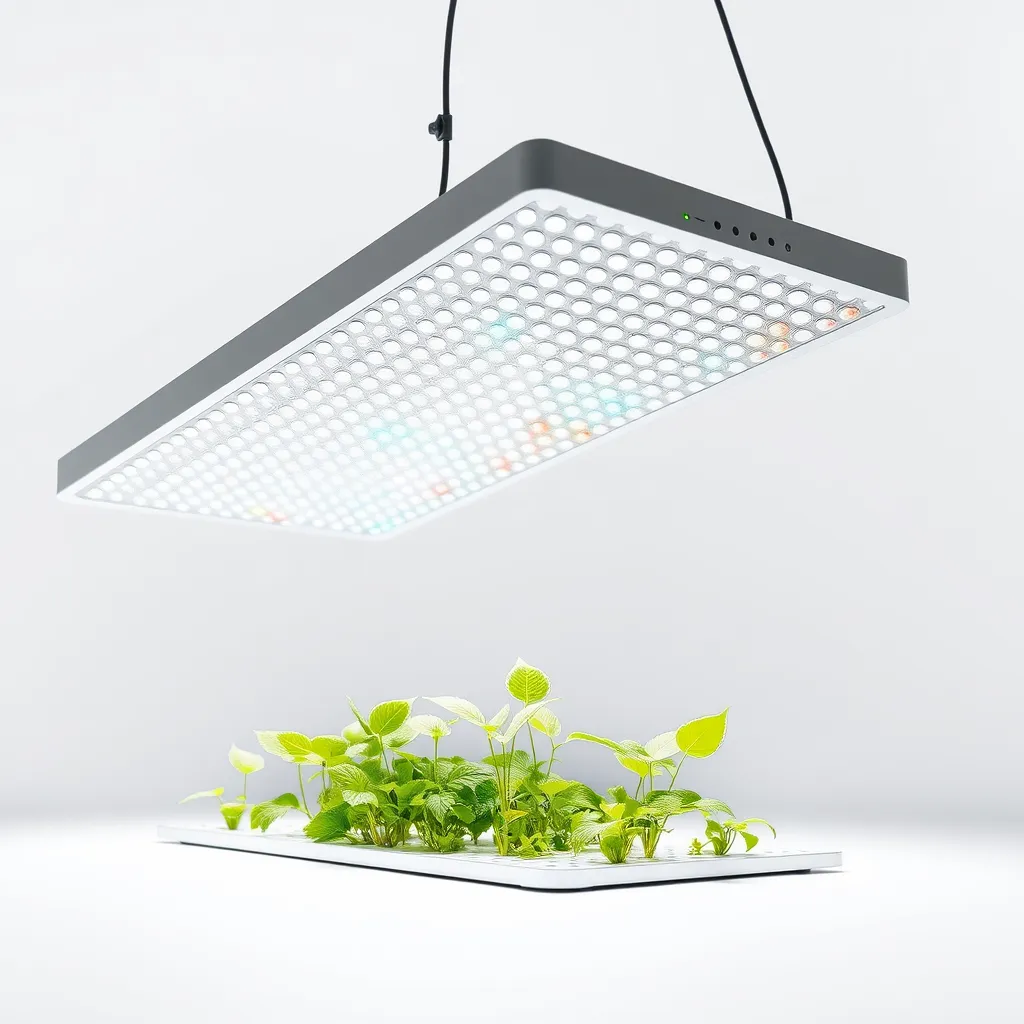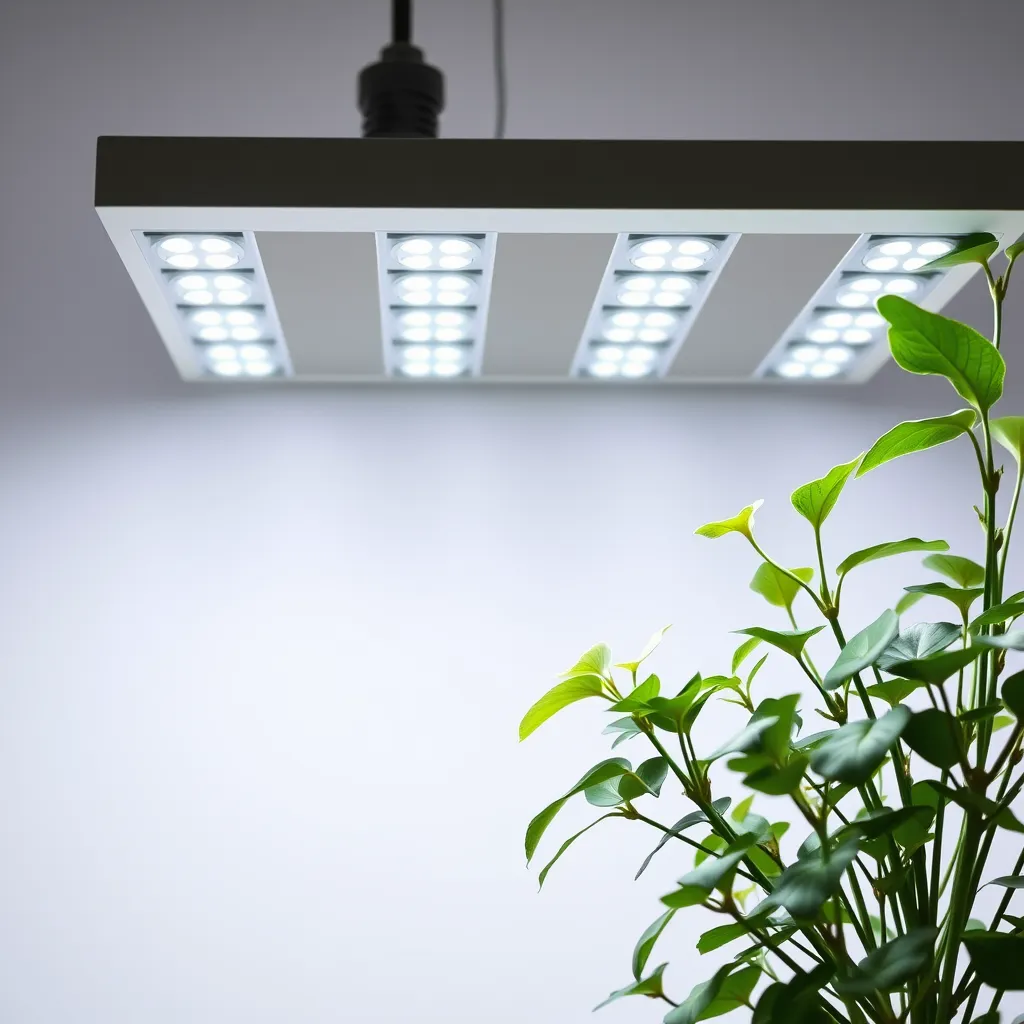
The right full spectrum LED grow light can replace an entire shelf of old HPS, MH, and "blurple" fixtures - giving you one light that takes plants from seedling to harvest, slashes your power bill, and runs cool enough to mount inches above the canopy. We spent weeks comparing the top-rated full spectrum LEDs on Amazon - evaluating PPE efficiency, coverage area, diode quality, build construction, and real-world value - so you can pick the one that fits your tent and your budget.
Light | Best For | Power | Coverage | Efficiency | Price | |
|---|---|---|---|---|---|---|
Spider Farmer G5000 | Best Overall (Smart App) | 480W | 4×4 ft | 2.8 µmol/J | ~$330 | |
VIVOSUN VS4000 / LumaLight | Best for Beginners | 400W | 4×4 ft | 2.9 µmol/J | ~$300 | |
Mars Hydro TSW2000 | Best Budget | 300W | 3×3 ft | 2.6 µmol/J | ~$180 | |
Barrina BU4800 | Brightest Output (with IR) | 480W | 4×4 ft | 3,000 µmol/m²/s PPFD | ~$270 | |
AC Infinity IONBOARD S44 | Best Premium Build | 400W | 4×4 ft | 2.75 µmol/J | ~$379 |
Spider Farmer G5000
Pick #1 - Best Overall Full Spectrum LED Grow Light
480W | 4×4 ft Coverage | 1,680 Diodes | 2.8 µmol/J | App Control | 5-Year Warranty
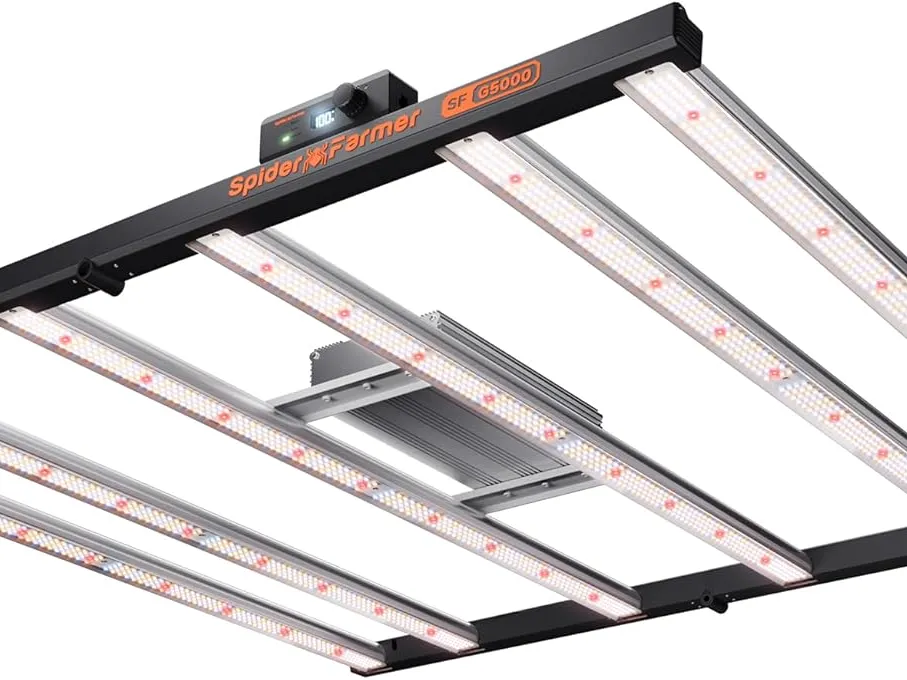
The Spider Farmer G5000 is the most well-rounded full spectrum LED on this list, combining a modern bar-style design, app-controlled dimming, and an aggressive price point that undercuts most premium 4×4 fixtures. It uses 1,680 high-efficiency Bridgelux diodes spread across an extended bar layout, draws a true 480 watts, and delivers 2.8 µmol/J PPE - enough output to run a 4×4 flower tent from seed all the way through harvest with a single fixture. The full spectrum (660-665nm red, 3200-4200K warm white, and 4800-5000K cool white) covers every wavelength plants actually use during photosynthesis.
The standout feature is the Spider Farmer app integration over Bluetooth and WiFi. You can program custom light schedules, simulate sunrise and sunset transitions, dim from 10-100% in fine increments, and adjust brightness remotely from your phone - even while you're traveling. Up to 60 G5000 fixtures can be daisy-chained on a single dimming control, making it equally appealing to home growers and small commercial operations scaling up.
Why It's Famous: Premium Performance at Mid-Tier Pricing
For around $330, the G5000 gives you specs that rivaled $500+ fixtures just a couple years ago: bar-style uniformity, app control, dimming, daisy chaining, and a 5-year US-based warranty. The extended bar layout puts more diodes near the edges of the canopy, which is exactly where most quantum-board lights fall off and create dim corners. Spider Farmer also runs a US service center, so warranty claims and replacement parts are handled domestically rather than shipped from overseas.
The trade-off is that the G5000 uses Bridgelux diodes rather than the more well-known Samsung LM301B/H. In testing, Bridgelux performance is essentially equivalent at this price tier, but if you're a spec-sheet purist who wants Samsung specifically, you'll pay more elsewhere. The fixture is also large (33.6" x 33.56") and is engineered for a 4×4 tent - it will not fit in a 3×3 space.
Pros | Cons |
|---|---|
1,680 diodes in bar-style layout for excellent canopy uniformity | Uses Bridgelux diodes rather than Samsung (performance is similar) |
WiFi + Bluetooth app control with custom schedules and sunrise/sunset | Sized for 4×4 only - will not fit in a 3×3 tent |
10-100% dimming with daisy chain support up to 60 fixtures | App setup has a small learning curve for first-time users |
5-year warranty with US-based service center | |
Strong value: 480W of true output for around $330 |
VIVOSUN VS4000 / LumaLight 400W
Pick #2 - Best for Beginners
400W | 4×4 ft Coverage (5×5 max) | 2.9 µmol/J | Dimming Knob | 5-Year Warranty
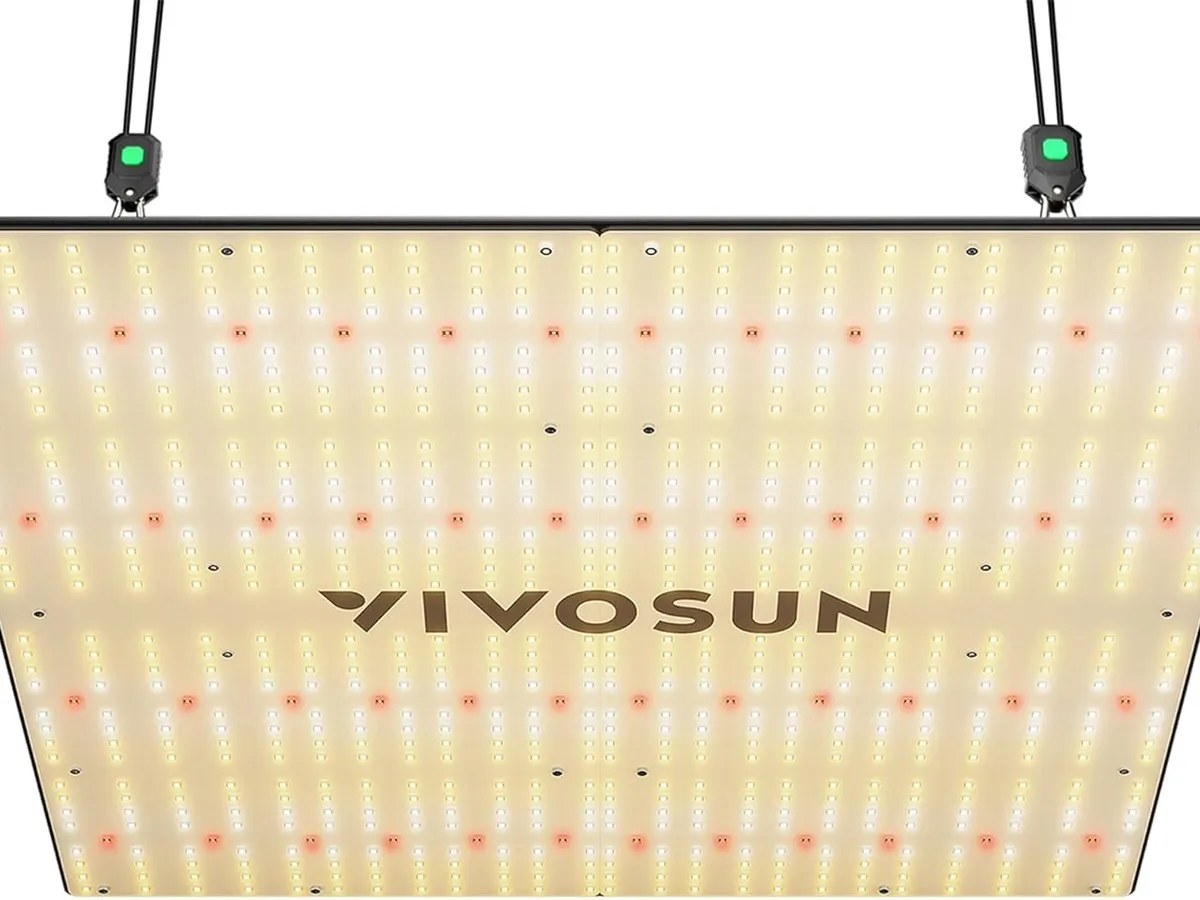
VIVOSUN has built a reputation for making indoor growing equipment that just works out of the box, and the VS4000 (sold as the LumaLight 400W in newer listings) is the cleanest, most beginner-friendly fixture in this lineup. It draws a true 400 watts, hits a class-leading 2.9 µmol/J efficiency, and covers a 4×4 ft canopy comfortably with up to 5×5 ft maximum coverage at lower intensities. There's no app, no controller pairing, and no setup beyond mounting it in your tent - just a physical dimming knob on the ballast that adjusts output from 25% to 100%.
The full-spectrum diode layout delivers a sun-like white light that makes plant inspection easy: you can spot nutrient deficiencies, pests, and pH issues in their actual colors instead of squinting through purple haze. The fanless design means zero noise (a real quality-of-life upgrade in a small grow room), and the ventilation-hole heat sink dissipates heat passively without ever overheating the diodes. VIVOSUN backs every fixture with a 5-year after-sales service from their US team.
Why It's Famous: Plug and Play Done Right
If you've never grown indoors before, the VS4000 is the fixture we'd hand you. It removes every potentially confusing variable - no apps to download, no daisy-chain wiring to figure out, no smart controller to integrate - and lets you focus on actually growing. The dimming knob is intuitive: turn it down to 50% for seedlings and early veg, crank it to 100% when flowering kicks in. That's it. The 2.9 µmol/J efficiency is also the highest on this list, meaning more usable light per watt of electricity than any other fixture in the comparison.
What you give up for that simplicity is advanced features. There's no scheduling, no remote control, no integration with VIVOSUN's GrowHub controllers (you'd need a different model for that). For most home growers running one or two tents, none of those things actually matter - the light goes on a basic outlet timer and you're done. But if you're scaling up or want automation, the Spider Farmer G5000 above is a better fit.
Pros | Cons |
|---|---|
Highest efficiency on this list at 2.9 µmol/J | No app, scheduling, or smart controller integration |
Dead-simple setup with physical dimming knob | Dimming starts at 25% (not 0-100% like some competitors) |
Silent fanless operation with passive cooling | Driver gets warm at full output |
Sun-like white spectrum makes plant inspection easy | |
5-year US-based warranty |
Mars Hydro TSW2000
Pick #3 - Best Budget Full Spectrum LED
300W | 3×3 ft Flower / 4×4 ft Veg | 704 LEDs | 2.6 µmol/J | Dimmable + Daisy Chain
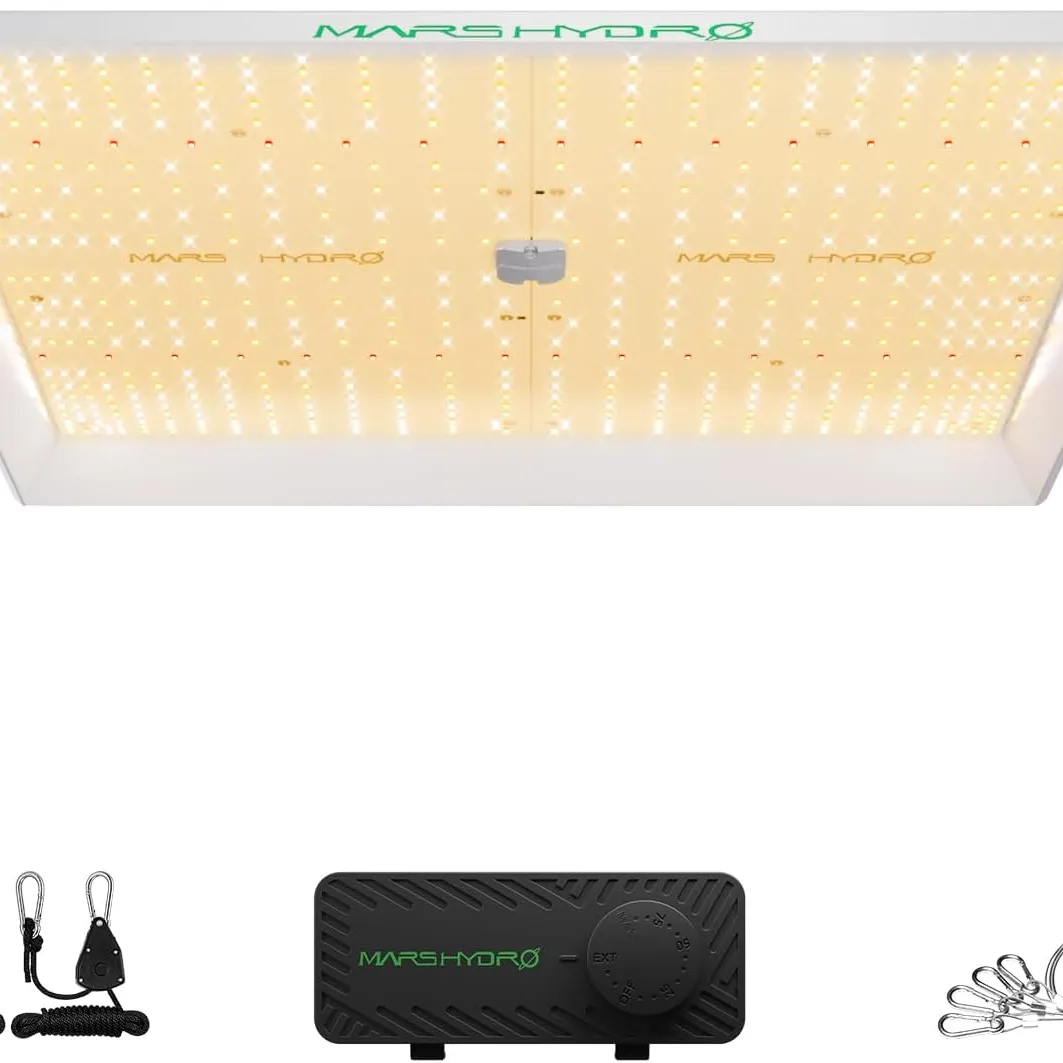
The Mars Hydro TSW2000 has been one of the most-recommended budget grow lights in the indoor growing community for years, and it earns its spot here by delivering legitimate full-spectrum performance at the lowest price in this comparison. It draws 300 watts, packs in 704 SMD diodes, and delivers 2.6 µmol/J efficiency - figures that beat most lights in the same price bracket. The TSW2000 is rated for 3×3 ft flowering and 4×4 ft vegetative coverage, making it the right size for a typical first or second tent.
Mars Hydro's patented 120° white reflector hood is the design choice that sets the TSW2000 apart from generic budget fixtures. It collects light dispersing in all directions and redirects it down toward the canopy, increasing usable light intensity by roughly 25% compared to a flat panel of the same wattage. The full spectrum includes 730-740nm IR alongside warm white (3200-4200K) and cool white (5200-6800K), supporting plants from seed to harvest. An external dimmer button on the driver runs from 0-100%, and you can daisy chain up to 50 TSW2000s on a single control if you ever scale up.
Why It's Famous: Real Specs at a Beginner Price
At around $180, the TSW2000 is the cheapest legitimate full-spectrum LED in this guide - and it's not a corner-cut budget compromise. You get a true 300 watts (not the misleading "1500W equivalent" marketing many cheap brands use), a real dimmer, daisy chain support, ETL/CE/RoHS safety certifications, and a 5-year warranty with a US service center. For first-time indoor growers who don't want to drop $300+ on their starter light, it's the obvious pick.
The trade-off is simply size: the TSW2000 is built for a 3×3 flower footprint, not a 4×4. If you have a 4×4 tent and want to fill it with a single light, you'll need to step up to the Mars Hydro TS3000 or one of the larger fixtures on this list. The reflector hood also means it has a slightly larger physical profile than a flat quantum board, which is worth checking against your tent dimensions before ordering.
Pros | Cons |
|---|---|
Lowest price on this list at around $180 | Sized for 3×3 flowering only (4×4 is veg-only coverage) |
Patented reflector hood boosts usable light intensity by ~25% | Lower efficiency than the Spider Farmer or VIVOSUN picks |
704 diodes with full spectrum including 730-740nm IR | Reflector hood adds physical bulk vs. flat quantum boards |
0-100% external dimmer with daisy chain (up to 50 lights) | |
5-year warranty with ETL/CE/RoHS certifications |
Barrina BU4800
Pick #4 - Brightest Output (with IR + Adjustable Panels)
480W | 4×4 ft Flower / 5×5 ft Veg | 1,376 LEDs | 3,000 µmol/m²/s PPFD | IP65 Waterproof
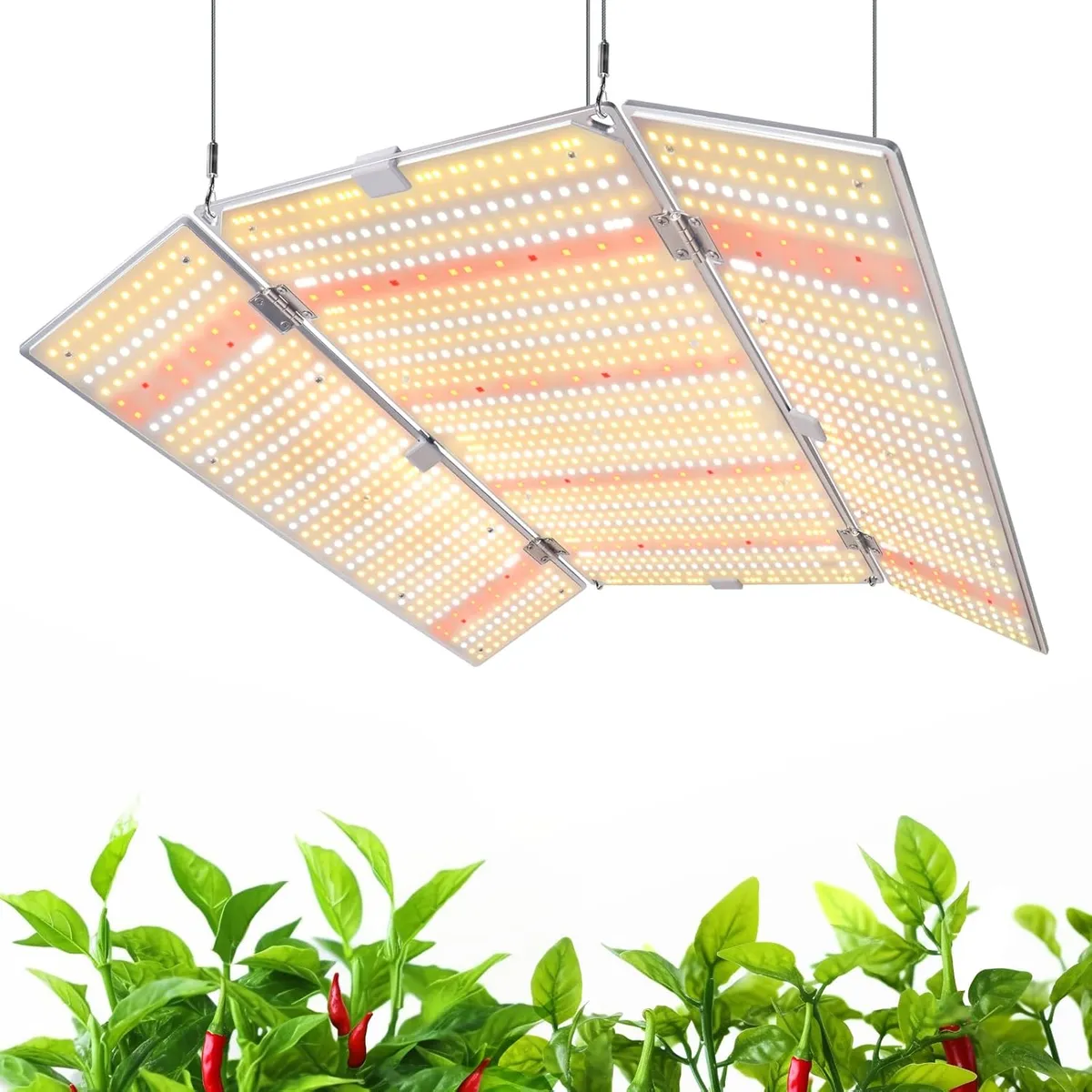
The Barrina BU4800 is the brightest fixture on this list, pumping out 63,000 lumens and a peak PPFD of 3,000 µmol/m²/s from 1,376 SMD diodes - enough raw light intensity to push CO2-supplemented grows or dense flowering canopies that demand maximum photons. It draws 480 watts and is rated for 4×4 ft flowering and 5×5 ft vegetative coverage. The full spectrum includes white (3000K + 5000K), red (660nm), and IR (730nm), so you get the bloom-boosting wavelengths along with the standard photosynthetic range.
The genuinely unique design feature is the dual angle-adjustable panel layout. Instead of a single flat board, the BU4800 splits its diodes across two panels that pivot relative to each other. When you angle them inward at 60°, central PPFD jumps by more than 25%, letting you concentrate light on a specific section of the canopy or spread it wide depending on the growth stage. The IP65 rating (rare in this category) means the diodes are sealed against splashing water and dust, giving the fixture a significantly longer expected lifespan in humid grow environments. A daisy chain dimming function supports up to 10 connected lights.
Why It's Famous: Maximum PPFD with a Flexible Form Factor
If you're chasing yields and want to push your plants with the highest PPFD you can practically deliver to a 4×4 canopy, the BU4800 is the most aggressive light in this guide. The 3,000 µmol/m²/s peak intensity is genuinely commercial-grade output, and the IR diodes contribute to the Emerson effect that pushes flowering plants harder during bloom. The angle-adjustable panels are also a real grower's feature - you can flatten them out for even veg coverage and tilt them inward when you want to concentrate light on a flowering centerpiece.
The trade-offs are familiar for high-output fixtures: 480W is meaningful electricity, and you'll want to make sure your tent ventilation can handle the heat load even with the passive aluminum cooling. The BU4800 also doesn't have app control or smart features - it's a workhorse fixture, not a smart device. For growers who just want maximum photons per dollar with IR included, that's exactly the right priority.
Pros | Cons |
|---|---|
Highest peak PPFD on this list at 3,000 µmol/m²/s | 480W requires adequate ventilation in smaller tents |
Angle-adjustable dual panels boost central intensity by 25%+ | No smart controller, app, or scheduling features |
IP65 waterproof rating - rare at this price point | Dual-panel design is bulkier than flat quantum boards |
Includes IR (730nm) diodes for flowering boost | |
Daisy chain dimming for up to 10 connected lights |
AC Infinity IONBOARD S44
Pick #5 - Best Premium Build & Smart Ecosystem
400W | 4×4 ft Coverage | Samsung LM301H | 2.75 µmol/J | IP65 | UIS Smart Controller Compatible
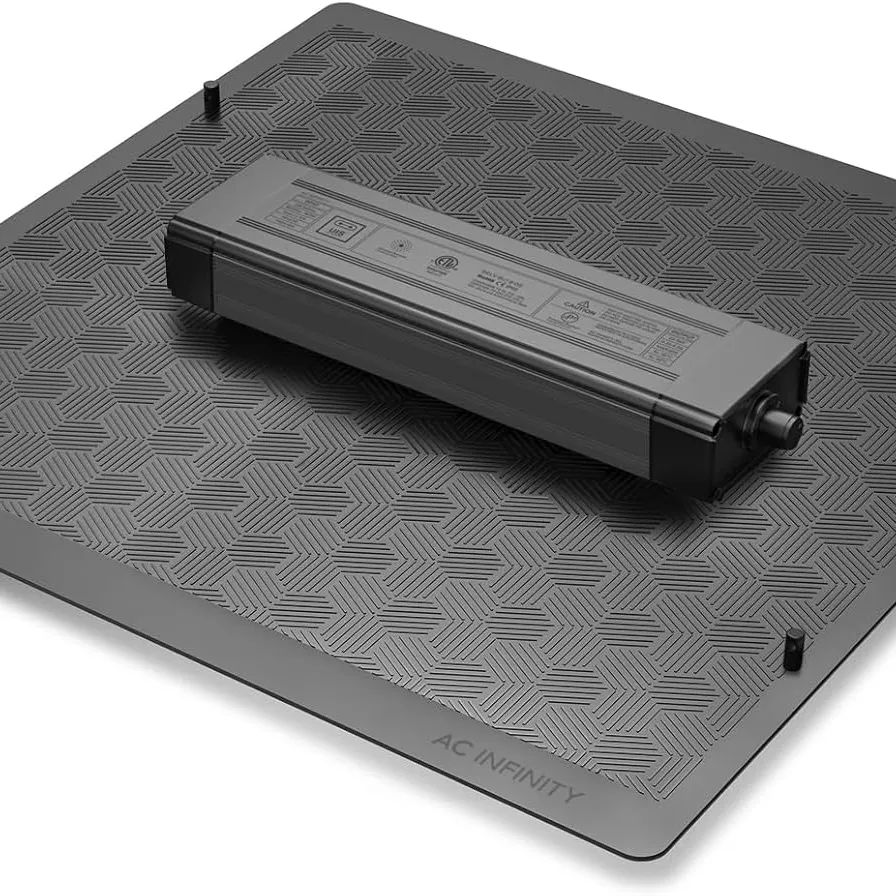
AC Infinity is the quality benchmark in indoor growing equipment, and the IONBOARD S44 is the fixture you buy when you want the best build quality, the best diodes, and the option to plug into a fully automated grow tent ecosystem. It uses genuine Samsung LM301H diodes - the gold standard for full-spectrum white horticulture LEDs - draws 400 watts, hits 2.75 µmol/J PPE, and covers a 4×4 ft canopy with the most uniform PAR map of any fixture in this comparison. The diodes are algorithmically positioned to eliminate hotspots and push light deeper into the canopy than a randomly arranged board can manage.
The fixture is built on a unibody aluminum chassis that doubles as a passive heatsink, sealed to IP65 standards against humidity and dust. There are no fans, so it runs silent. The onboard dimmer adjusts output in 20% increments, but the real magic happens when you connect the S44 to an AC Infinity UIS controller (sold separately): then you get full automation, custom schedules, sunrise/sunset cycles, and integration with their fans, humidifiers, and CO2 controllers - all from one app. Every component is built to commercial standards, and the build quality is immediately obvious the moment you unbox it.
Why It's Famous: Best-in-Class Build with Ecosystem Integration
The IONBOARD S44 is the fixture for growers who want to do this seriously and want every component working together. Plug it into a Controller 69 Pro (or newer), and the S44 becomes part of an automated tent that adjusts lighting, ventilation, humidity, and circulation in response to real-time conditions. That kind of integration is hard to replicate with mismatched gear from different brands. Samsung LM301H diodes also age more slowly than budget alternatives, so the S44 will likely still be running at near-original output years after cheaper fixtures have started to dim.
The catch is the price. At $379, the S44 is the most expensive light on this list, and the smart controller integration only matters if you're committing to AC Infinity's full ecosystem. If you just want a great standalone light and don't care about app control or fan automation, the Spider Farmer G5000 or VIVOSUN VS4000 deliver 90% of the performance at a meaningfully lower price. But for premium builds, the S44 is the one to beat.
Pros | Cons |
|---|---|
Genuine Samsung LM301H diodes - gold standard for horticulture LEDs | Most expensive option on this list at $379 |
Algorithmic diode placement for industry-best PAR uniformity | Smart features require a separately sold UIS controller |
IP65-rated unibody aluminum construction | Onboard dimmer only adjusts in 20% steps without a controller |
Integrates with AC Infinity UIS controllers for full tent automation | |
Silent fanless operation built to commercial standards |
Full Spectrum LED Grow Light Buying Guide: What to Look For
What "Full Spectrum" Actually Means
A true full spectrum LED produces light across the entire photosynthetically active range of 400-700nm, mimicking natural sunlight. It combines blue wavelengths (400-500nm) for compact vegetative growth, green wavelengths (500-600nm) for canopy penetration, and red wavelengths (600-700nm) for flowering. Modern fixtures achieve this by pairing blue LED chips with a phosphor conversion layer plus dedicated 660nm deep red diodes - producing a warm-white appearance with enhanced red. Older "blurple" lights using only blue and red diodes are inferior in nearly every measurable way and should be avoided.
PPE / Efficiency: The Spec That Actually Matters
PPE (Photosynthetic Photon Efficacy), measured in µmol/J, tells you how many usable photons the fixture produces per watt of electricity. Higher is better. Modern quality full spectrum LEDs run between 2.5 and 2.9 µmol/J. Anything below 2.0 is outdated technology. A higher PPE means lower power bills and less heat in your tent for the same light output - both real money savers over the life of the fixture.
Coverage Area: Veg vs. Flower
Manufacturers list two coverage figures: vegetative (lower intensity, larger area) and flowering (higher intensity, smaller area). A fixture rated "4×4 flower / 5×5 veg" means it can run a 4×4 ft canopy through bloom or a 5×5 ft canopy through veg. Always size your light to your flowering footprint - that's when plants demand the most photons. Undersizing for flower will tank your yields.
Diodes: Samsung vs. Bridgelux vs. Generic
Samsung LM301B and LM301H are the most-respected horticulture diodes on the market and command a price premium. Bridgelux is the well-regarded American alternative and performs nearly identically at this point. Generic "SMD" diodes from unbranded sources are a coin flip - some are fine, many are not. If a fixture in this price range names its diode brand, that's a good sign. If it just says, "high quality LEDs," be cautious.
Dimming, Daisy Chaining, and Smart Control
A dimmer is essential - you'll need to lower output during seedling and early veg to avoid stressing young plants. Daisy chaining lets you control multiple fixtures from a single dimmer, which matters once you scale beyond one tent. Smart features (app control, scheduling, sunrise/sunset simulation) are nice to have but not essential - a $15 outlet timer does most of what an app does for a single light.
Conclusion:
Transitioning to high-quality LED lighting is the most significant upgrade an indoor gardener can make. These fixtures provide a balanced light recipe that mimics natural sunlight, ensuring plants develop strong stems and dense yields without the excessive heat of older bulb technologies. As the industry moves toward bar-style designs and smart app integration, the ability to fine-tune your environment has never been more accessible or affordable.
When making your final selection, consider the physical dimensions of your space and your long-term goals. While a high-wattage bar light offers the best uniformity for a large tent, a compact panel might be the more efficient choice for specialized racks or small-scale hobby setups. By matching the right fixture to your specific canopy needs, you ensure a more sustainable and productive indoor garden for years to come.
Frequently Asked Questions
Q1: Can one full spectrum LED handle both veg and flower?
A: Yes - this is the main reason to buy a full spectrum LED. The broad white-plus-red spectrum supports plants through every growth stage. Run the light at 50-75% intensity (or raise the height) during veg, then crank it to 100% (or lower the height) for flowering. The spectrum itself doesn't need to change.
Q2: Do I need supplemental UV or far-red?
A: For most home growers, no. The base full spectrum is sufficient and does 90%+ of the work. Some advanced growers add UV-A (380nm) for terpene enhancement or far-red (730nm) for the Emerson effect - benefits are real but modest, in the 5-15% range. If you're optimizing for commercial yields, supplemental wavelengths matter. For a first or second tent, they don't.
Q3: How high should I hang my full spectrum LED?
A: Start at the manufacturer's recommended height - typically 18-24 inches above the canopy for seedlings, 14-18 inches for veg, and 10-14 inches for flower. Always check the PPFD chart for your specific fixture. Too close burns plants; too far wastes light to the tent walls.
Q4: Are LED grow lights better than HPS?
A: Yes, in nearly every way. LEDs use 40-50% less electricity for the same usable light, run dramatically cooler (often eliminating the need for AC in summer), last 50,000+ hours vs. ~10,000 for HPS, and provide a full spectrum that supports both veg and flower with one fixture. HPS still has slightly higher raw output per fixture in commercial settings, but for home growers the LED advantage is overwhelming.