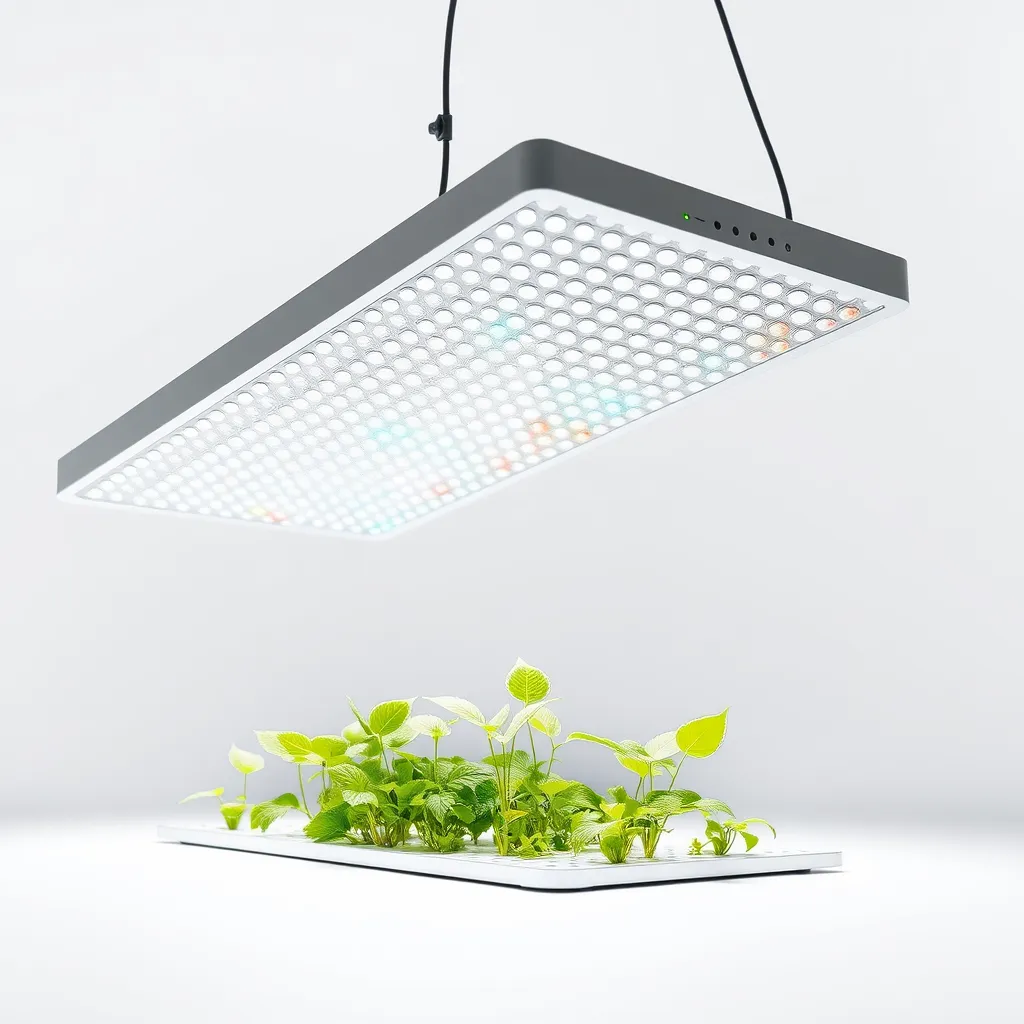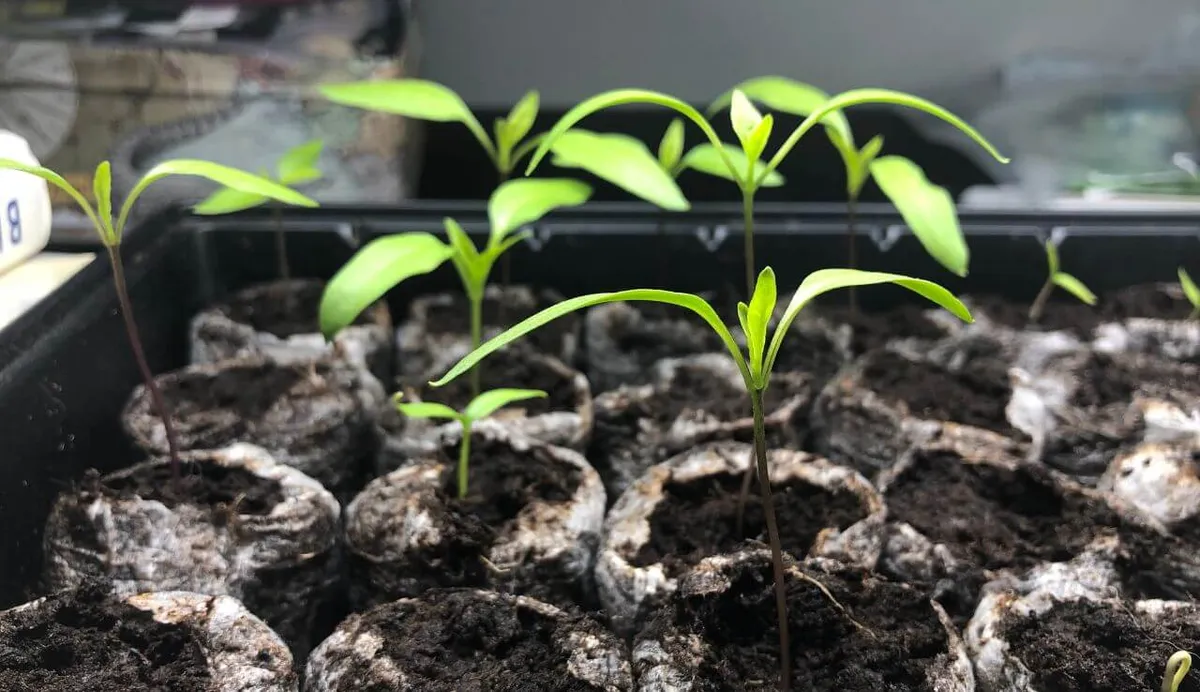
Whether you need to keep a single pothos alive in a windowless office, build a multi-tier seed starting rack in your basement, or turn an IKEA bookshelf into a thriving indoor garden, the right LED grow light makes all the difference. We spent weeks researching and comparing the top-rated grow lights on the market - evaluating light spectrum, energy efficiency, ease of installation, and real-world value - so you can pick the one that fits your plants and budget.
Grow Light | Best For | Watts | Spectrum | Coverage | Price | |
|---|---|---|---|---|---|---|
Briignite A19 LED Bulb | Simple Bulb Solution | 11W | Full Spectrum 4000K | 1-3 plants | $13.99 (2-Pack) | |
Soltech Aspect Gen 2 | Best Design & Decor | 36W | Full Spectrum 3000K | 4-8 sq ft | $199.99 | |
VIVOSUN T5 2FT (4-Pack) | Best for Shelves & Racks | 60W (4x15W) | Full Spectrum 5000K | Shelf or rack system | $44.99 | |
SANSI 36W BR30 Bulb | High-Power Bulb | 36W | Full Spectrum 4000K | 6-10 sq ft | $31.41 | |
Mosthink LED Strip (2-Pack) | Cabinet & Shelf Strips | 15W (2x7.5W) | Full Spectrum | 1-2 shelf levels | $15.99 |
Briignite A19 LED Grow Light Bulb (2-Pack)
Pick #1 - Best Simple Screw-In Solution
11W | E26 Base | Full Spectrum 4000K | 1,000 Lumens | PPF 25 μmol/s | 25,000-Hour Lifespan
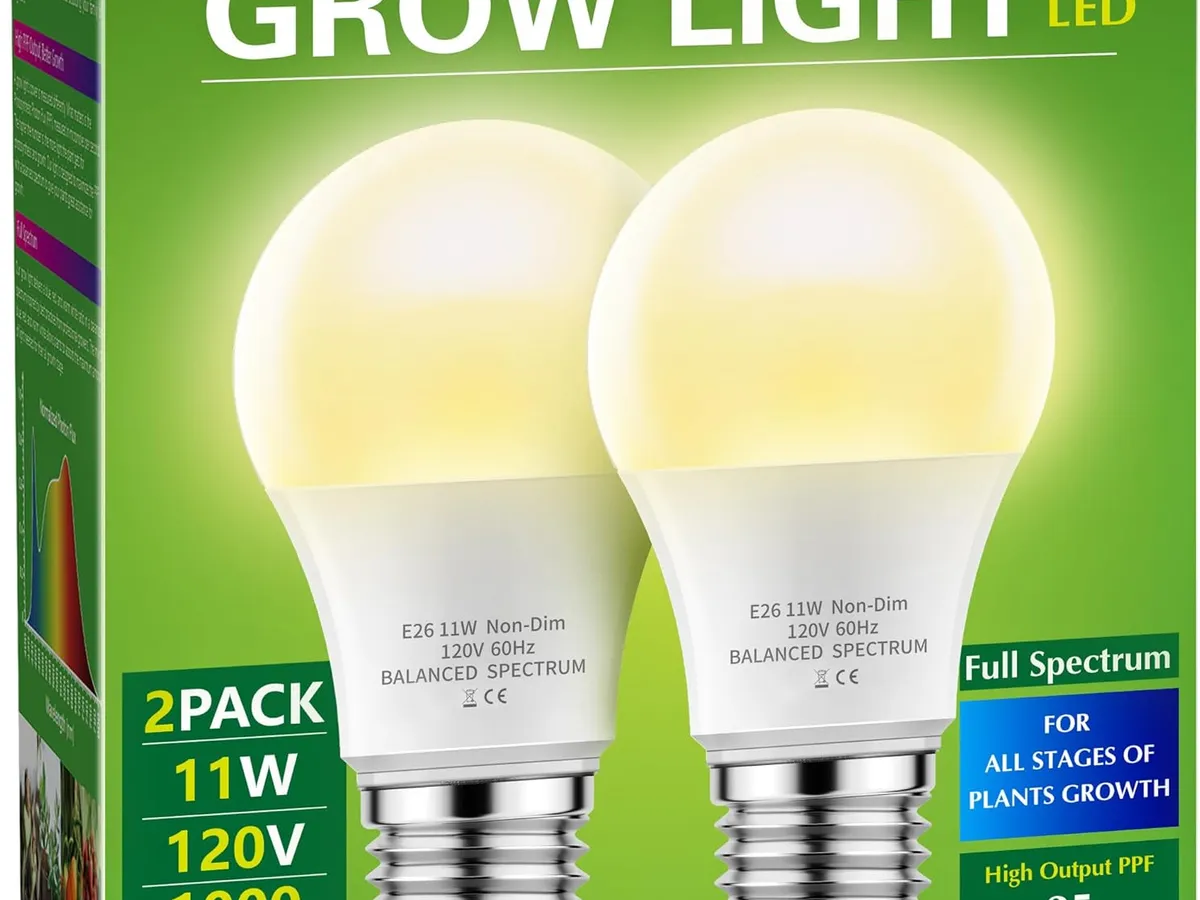
The Briignite A19 is the easiest, cheapest way to give your houseplants supplemental light without buying any special fixtures. It screws into any standard E26 lamp socket - desk lamp, clip lamp, floor lamp, or track light - and produces a balanced full-spectrum output at 4000K warm white. At 11 watts, it delivers approximately 1,000 lumens with a PPF of 25 micromoles per second, which is sufficient for low-to-medium light houseplants like pothos, philodendron, snake plants, peace lilies, and most tropical foliage positioned 6-12 inches below the bulb.
Unlike older-generation grow bulbs that emit a harsh purple or magenta glow, the Briignite appears as a natural warm white to the human eye. That makes it suitable for living rooms, bedrooms, offices, and any visible space where a purple light would look out of place. The A19 form factor is identical to a standard household bulb, so no one would know it is a grow light unless you told them. With over 15,000 reviews and an Amazon “Best Seller” ranking in Plant Growing Light Bulbs, the Briignite is one of the most purchased grow bulbs on the market.
Why It’s Our Top Simple Solution: Zero Effort, Zero Fixtures
No special fixtures, no wiring, no installation - just screw it into a lamp you already own and position it near your plants. The Briignite is the lowest-cost, lowest-effort way to supplement natural light for indoor plants. It is ideal for apartment dwellers with north-facing windows, offices without natural light, or any space where one to three plants need supplemental light during darker months. At $13.99 for a two-pack ($7.00 per bulb), you can equip two separate lamps for the price of a single meal out.
The plastic and aluminum heat dissipation system keeps the bulb running cool to the touch, so you can position it close to leaves without burning foliage. The 25,000-hour lifespan translates to over 5.7 years of daily 12-hour use, meaning you will likely repot your plant several times before you need to replace the bulb. The 180-degree beam angle spreads light across a small group of plants rather than concentrating it in a narrow spotlight.
The main limitation is coverage. A single bulb works well for one to three plants in a close arrangement, but it will not cover a full seed-starting flat or a wide shelf. If you need broader coverage, buy additional bulbs in separate fixtures or consider the VIVOSUN T5 strips further down this list. Some users report that the 4000K color temperature leans slightly warm compared to the 5000K-6500K spectrum preferred for seedlings and high-light plants, so if you are starting seeds or growing herbs that demand intense blue-spectrum light, a cooler-temperature option may perform marginally better.
Pros | Cons |
|---|---|
Screws into any standard E26 lamp - no fixtures needed | Limited coverage - best for 1-3 plants only |
Natural 4000K warm white appearance - no purple glow | 4000K may be too warm for optimal seed starting |
$7.00 per bulb - cheapest option on this list | No timer or dimmer built in - needs external timer |
25,000-hour lifespan with cool-running design | PPF of 25 μmol/s is low for high-light plants |
15,000+ reviews with 4.6-star rating on Amazon | Not powerful enough for fruiting or flowering crops |
Soltech Solutions Aspect Gen 2 Pendant Grow Light
Pick #2 - Best Design & Home Decor Integration
36W | Full Spectrum 3000K | CRI 98 | Dimmable | 50,000-Hour Lifespan | 5-Year Warranty
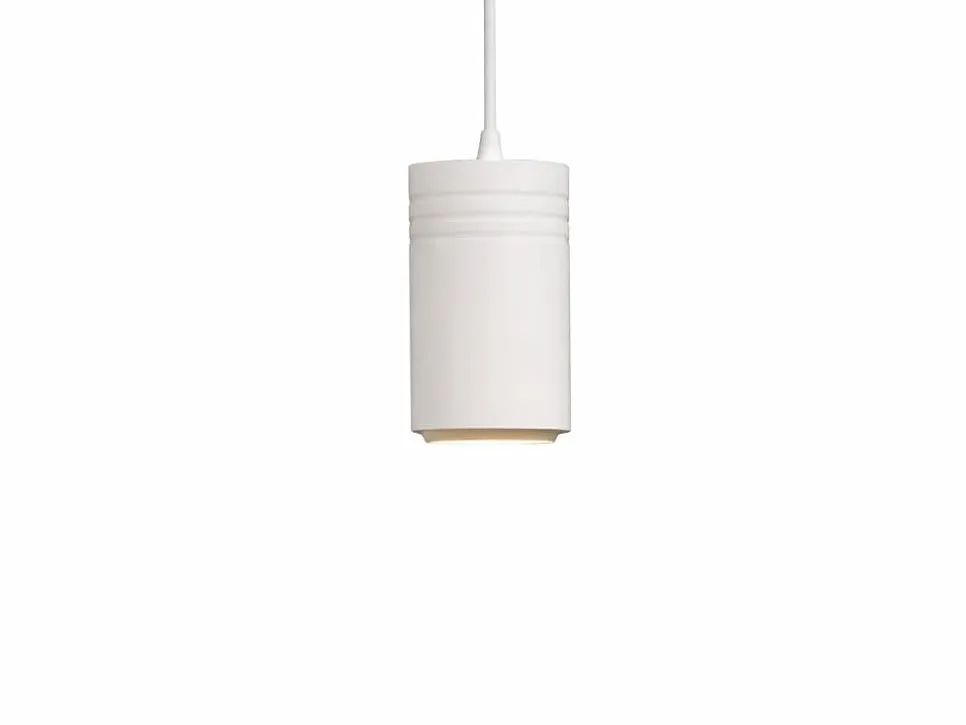
The Soltech Aspect Gen 2 is the only grow light on this list - or arguably on the entire market - that was designed from the ground up to function as a premium pendant light fixture first and a plant light second. The sleek, hand-crafted aluminum housing is available in white and black finishes and hangs from an 18-foot fabric cord that blends into any interior. With a CRI of 98 (out of 100), the warm 3000K light renders colors with near-perfect accuracy, creating a museum-quality visual experience that makes your plants and room look beautiful.
Under the hood, the Gen 2 is a serious grow light. It delivers 110 percent more plant-usable light than the original Small Aspect model, using precision-molded plastic optics that focus the beam downward at a 60-degree angle where plants need it - without blinding you with harsh glare. The built-in inline dimmer lets you fine-tune brightness for different plant types: turn it up for high-light tropicals and succulents, or dial it down for ferns and low-light foliage. At 36 watts, the Aspect Gen 2 covers roughly 4 to 8 square feet depending on hanging height, which is enough for a plant shelf, a cluster of floor plants, or a reading nook with a large monstera.
Why It’s Famous: A Grow Light Interior Designers Actually Recommend
Professional interior designers and plant influencers worldwide recommend the Aspect because it solves a problem no other grow light does: it looks genuinely good in your home. Every other light on this list - no matter how effective - looks like what it is: a grow light. The Aspect looks like something you would find in a high-end furniture showroom. It serves double duty as both a decorative pendant fixture and a full-spectrum grow light, which means you are not just buying a plant tool - you are buying room lighting that happens to also grow plants.
The Gen 2 runs at only 36 watts while producing more usable plant light than the 40-watt original Large Aspect, thanks to improved LED chip efficiency. It is rated for 50,000 hours - over 11 years at 12 hours per day - and backed by Soltech’s 5-year manufacturer warranty with a 100-day money-back guarantee. The far-red wavelengths (680nm+) enhance photosynthetic efficiency through the Emerson Effect, a process that amplifies the impact of the red and blue wavelengths already present in the spectrum.
At $199.99, the Aspect Gen 2 is by far the most expensive option on this list. But it is worth reframing that price: if you were shopping for a premium pendant light at West Elm or CB2, you would spend $150-$300 on a fixture that does nothing for your plants. The Aspect costs the same and grows your plants. For homeowners who refuse to hang industrial-looking strip lights or clip ugly bulbs onto their furniture, the Aspect is the only real option.
Pros | Cons |
|---|---|
Stunning pendant design that blends into any room | Most expensive grow light on this list at $199.99 |
CRI 98 - near-perfect color rendering | Limited to 4-8 sq ft coverage per unit |
Built-in dimmer for adjustable brightness | No built-in timer - requires external timer or smart plug |
110% more plant-usable light than original Small Aspect | Requires ceiling mounting or the separate Stello stand ($99+) |
50,000-hour lifespan with 5-year warranty | 3000K warm spectrum may not be ideal for seed starting |
VIVOSUN T5 Grow Lights 2FT (4-Pack)
Pick #3 - Best for Shelves, Racks & Seed Starting
60W Total (4 x 15W) | 5000K Full Spectrum | Timer (8/12/18H) | 4-Level Dimming | Linkable | IP-Rated Aluminum
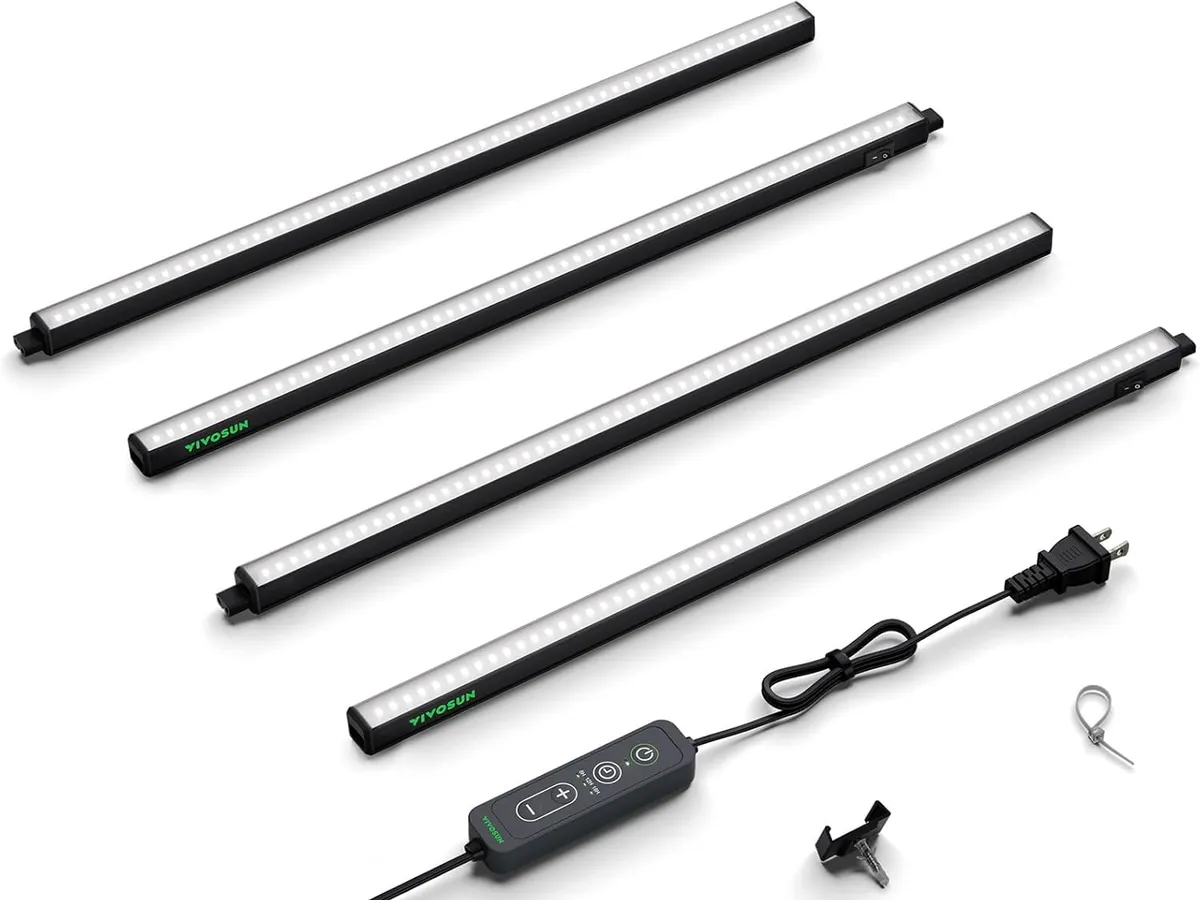
The VIVOSUN T5 pack includes four 2-foot LED light strips that link together and mount under shelves, on racks, or inside grow tents. At 60 watts total and 5000K daylight-white spectrum, the four strips provide broad, even coverage across an entire shelf system - ideal for seed starting, herb gardens, microgreens, and multi-tier plant displays. Each strip contains 60 high-efficiency LEDs with an optical lens that spreads light evenly with high transmittance, ensuring consistent coverage across all plants without hot spots or dim edges.
What sets the VIVOSUN apart from basic strip lights is the built-in timer and dimming controller. You can set automatic schedules of 8, 12, or 18 hours and adjust brightness across four levels - eliminating the need for a separate smart plug or outlet timer. After a power outage, the lights restore the previous brightness automatically while the timer resets for a fresh schedule. The durable aluminum shade on each strip redirects light downward onto your plants, reducing wasted light that would otherwise scatter sideways.
Why It’s Famous: Professional-Grade Features for Home Growers
VIVOSUN is one of the most recognized brands in the indoor growing community, and the T5 strips inherit that reputation for quality. The daisy-chain design offers two connection methods - extension cables or direct connectors - so you can configure the strips to fit any shelf setup. Three installation options (cable ties, screws, or double-sided tape) mean you can mount them without tools in under 10 minutes. Every accessory you need is included in the box.
At $44.99 for four strips ($11.25 per strip), the VIVOSUN is pricier per unit than some generic alternatives, but the integrated timer, dimmer, and VIVOSUN’s SGS-compatible smart growing ecosystem justify the premium. If you already own or plan to buy a VIVOSUN GrowHub controller, these strips integrate seamlessly for app-based control from anywhere. For serious seed starters and indoor herb growers who want reliable, even coverage with automated scheduling, the VIVOSUN T5 is the best strip-light system you can buy without going commercial.
The trade-off is that this is a 4-pack, not a 6 or 8-pack, so covering a full four-tier shelf may require purchasing two sets. The 5000K color temperature is optimized for vegetative growth and seed starting rather than flowering, though it performs well across all growth stages for houseplants and herbs. The physical profile is larger than the ultra-slim Mosthink strips, so headroom between shelves matters - check that you have at least 12-14 inches of clearance.
Pros | Cons |
|---|---|
Built-in timer (8/12/18H) and 4-level dimmer - no extra accessories | $44.99 is pricier than basic strip alternatives |
5000K daylight spectrum ideal for seed starting and vegetative growth | 4-pack may not cover a full 4-tier shelf system |
Aluminum shade directs light downward for efficient use | Larger profile than ultra-slim strip lights |
Three installation methods included (ties, screws, tape) | Timer resets after power outage (brightness is retained) |
Compatible with VIVOSUN SGS smart growing ecosystem | No smart home integration without separate GrowHub |
SANSI 36W Full Spectrum LED Grow Light Bulb
Pick #4 - Best High-Power Screw-In Bulb
36W | E26 BR30 | Full Spectrum 4000K | PPF 65.6 μmol/s | PPFD 265.58 μmol/s/m² @ 1ft | 25,000-Hour Lifespan | 5-Year Warranty
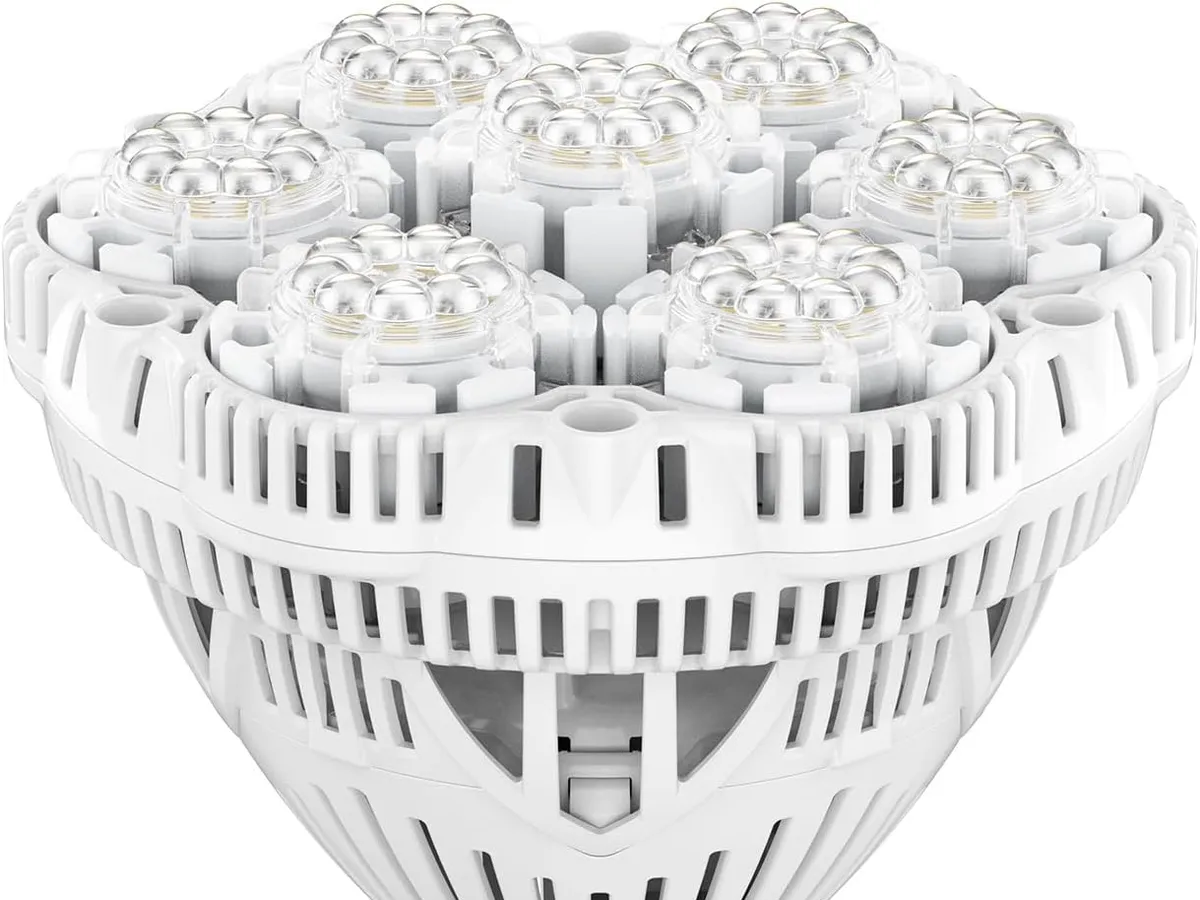
If you want a screw-in grow light bulb that delivers genuinely professional-level light intensity, the SANSI 36W is in a completely different league from standard 9-11W grow bulbs. With a PPF of 65.6 micromoles per second and a PPFD reading of 265.58 μmol/s/m² at one foot, the SANSI pushes out roughly three times the photosynthetically useful light of the Briignite A19. That is real, measurable intensity that supports not just foliage maintenance but active growth, flowering, and even fruiting in indoor plants like tomatoes, peppers, herbs, and citrus.
SANSI’s patented Chip on Ceramic (COC) technology is the engineering story behind this bulb’s performance. Traditional LED bulbs mount their chips on aluminum circuit boards, but SANSI solders the LED chips directly onto a non-conductive ceramic heat sink. This design reduces the thermal resistance between the LED junction and the heat sink surface, resulting in faster heat conduction, lower operating temperatures, and higher long-term reliability. The ceramic body also achieves a V0 flame retardant grade and WF2 anti-corrosion rating - specifications you typically only see in commercial lighting.
Why It’s Famous: Maximum Light Output in a Bulb Format
The SANSI 36W occupies a unique position: it is the most powerful grow light you can buy that still screws into a standard E26 lamp socket. That means you get near-panel-level light intensity without needing to mount fixtures, run cables, or drill into your ceiling. Screw it into a clamp lamp, a floor lamp with an adjustable head, or a dedicated shop light fixture, position it 12-24 inches above your plants, and you have a high-performance growing station.
The secondary optical lens design is worth highlighting. Unlike standard bulbs that scatter light broadly, the SANSI uses individual lenses over each LED chip to focus and direct the light more efficiently toward the plant canopy. This scientific light distribution improves light utilization and reduces wasted photons bouncing off walls. The result is a PPFD map that is significantly more concentrated and useful than what a standard reflector bulb would produce at the same wattage.
At $31.41 (down from $39.95), the SANSI costs more than the Briignite but delivers over 2.5 times the photosynthetic output. It is ETL listed for safety with a 5-year protection plan from SANSI - one of the longest warranties in the grow light bulb category. The BR30 form factor is wider than a standard A19 bulb, so confirm your lamp fixture can accommodate the larger diameter before purchasing.
Pros | Cons |
|---|---|
PPF 65.6 μmol/s - highest output screw-in bulb on this list | BR30 form factor is wider than standard A19 bulbs |
Patented ceramic heat sink runs cooler than aluminum competitors | $31.41 is 2-3x the cost of basic grow bulbs |
ETL listed with 5-year protection plan | No built-in timer or dimmer |
Secondary optical lens for focused, efficient light distribution | 36W generates noticeable heat - needs airflow |
Supports full growth cycle including flowering and fruiting | Heavy ceramic body - confirm fixture can support weight |
Mosthink LED Plant Grow Light Strips (2-Pack)
Pick #5 - Best Budget Strip Light for Cabinets & Small Shelves
15W Total (2 x 7.5W) | Full Spectrum 380-800nm | Auto Timer (2/4/8H) | 4 Dimmable Levels | USB Powered | 50,000-Hour Lifespan
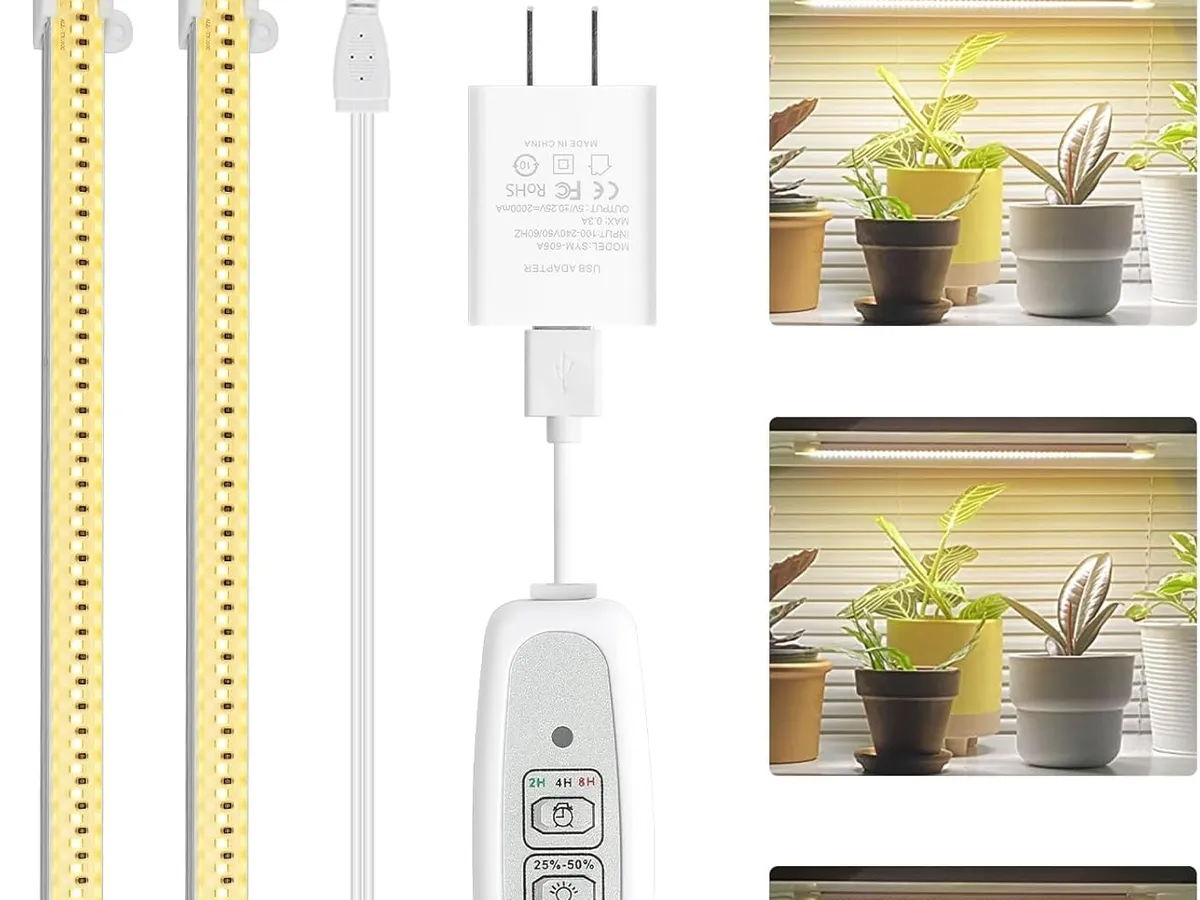
The Mosthink LED strip is the go-to choice for small-scale indoor gardening setups - IKEA cabinet gardens, narrow plant shelves, office desks, and compact spaces where a full T5 fixture would be overkill. Each pack includes two 13.2-inch light bars with 48 LEDs each, producing a full spectrum output from 380nm to 800nm that mimics natural sunlight. The strips mount with included screws or double-sided adhesive tape and draw power through a USB cord with an AC adapter, making them one of the most flexible grow lights available in terms of placement.
The built-in auto timer is a genuine set-and-forget feature. Set it to 2, 4, or 8 hours, and the strips will automatically turn on and off at the same time every day without any manual intervention - as long as you do not unplug them or flip the power off. Four dimmable brightness levels (25%, 50%, 75%, 100%) let you tailor intensity to different plants and growth stages. The 78-inch USB power cord is long enough to reach from a shelf to a nearby outlet without needing an extension cord, and the maximum distance of 33 inches between the two bars provides wide enough spacing for most shelf setups.
Why It’s Famous: The IKEA Cabinet Garden Favorite
The Mosthink strips became popular because they solve a very specific problem: how do you light plants inside a glass-door cabinet, a narrow bookshelf, or a tiny apartment corner without a bulky fixture? The ultra-slim 13.2-inch bars tuck neatly under a shelf, inside a Detolf display case, or behind a desk monitor. The adhesive backing sticks to glass, wood, metal, and plastic surfaces, and the USB power means you can run them from a power bank, laptop, or wall adapter.
With over 12,500 reviews and a 4.3-star rating, the Mosthink is one of the best-selling LED grow strip lights on Amazon. Users consistently praise how easy they are to install, how unobtrusive they look, and how well they keep succulents, herbs, and small houseplants healthy in low-light conditions. The ROHS and PSE safety certifications provide peace of mind for a product that often runs unattended for hours each day.
At $15.99 for the two-pack ($8.00 per strip), the Mosthink is the most affordable strip light on this list. The trade-off is that 7.5 watts per bar is modest - these are supplemental lights, not primary grow lights. They will keep low-to-medium light plants healthy and growing, but they do not produce enough intensity for high-light plants, fruiting crops, or serious seed starting. For those applications, step up to the VIVOSUN T5 system or the SANSI 36W bulb.
Pros | Cons |
|---|---|
Auto timer with daily repeat - true set-and-forget | 7.5W per bar is supplemental only - not enough for high-light plants |
Ultra-slim 13.2-inch bars fit inside cabinets and narrow shelves | Timer resets if power is interrupted |
USB powered - works with wall adapters, power banks, or laptops | Adhesive tape may lose grip on some surfaces over time |
$8.00 per strip - most affordable strip light on this list | Only 2 strips per pack - larger setups need multiple packs |
12,500+ reviews with 4.3-star rating | No waterproofing - indoor use only |
Indoor Grow Light Buying Guide: What to Look For
How Much Light Do Indoor Plants Need?
Light requirements vary dramatically by species. Low-light plants like pothos, snake plants, ZZ plants, and cast iron plants need just 500-2,000 lux for 8-12 hours daily. They tolerate dim corners but grow noticeably faster with even modest supplemental lighting - a single Briignite bulb in a desk lamp is usually sufficient. Medium-light plants including philodendron, monstera, calathea, ferns, and peace lilies need 2,000-5,000 lux for 10-14 hours daily. Most popular houseplants fall in this category, and a dedicated grow light positioned 12-24 inches above the plant is recommended for rooms with limited natural light. High-light plants like succulents, cacti, herbs, citrus, and fiddle leaf figs demand 5,000-10,000+ lux for 12-16 hours daily. These plants require direct sunlight or strong grow light output like the SANSI 36W, positioned 6-12 inches above the canopy.
PPF and PPFD: The Numbers That Actually Matter
Lumens measure brightness as perceived by the human eye, but plants do not see light the way we do. The two metrics that matter for plant growth are PPF (Photosynthetic Photon Flux), measured in micromoles per second (μmol/s), which tells you how much total photosynthetically active light a fixture produces, and PPFD (Photosynthetic Photon Flux Density), measured in μmol/s/m², which tells you how much of that light reaches a specific area at a specific distance. When comparing grow lights, PPFD at your intended mounting height is the most useful number. The SANSI 36W’s PPFD of 265.58 μmol/s/m² at one foot, for example, means seedlings and herbs directly beneath it receive enough light for active photosynthesis and growth.
Full Spectrum vs. Purple Grow Lights
Older LED grow lights used a combination of red and blue LEDs that produced a purple or magenta appearance. While those wavelengths are the most critical for photosynthesis, the purple glow is aesthetically unpleasant in living spaces and makes it difficult to visually assess plant health. Modern full-spectrum grow lights use white LEDs enhanced with targeted red wavelengths, producing a natural-looking warm or neutral white light that is both effective for plant growth and pleasant for human environments. There is no performance advantage to purple grow lights for typical houseplant care. Every light on this list uses full-spectrum white technology.
Color Temperature: What the Kelvin Number Means
Color temperature is measured in Kelvin (K) and describes the visual warmth or coolness of the light. The lights on this list range from 3000K (Soltech Aspect) to 5000K (VIVOSUN T5). Lower Kelvin numbers produce a warmer, more amber glow that is pleasant for living spaces and supports flowering. Higher Kelvin numbers produce a cooler, more blue-white light that mimics midday sunlight and supports vegetative growth and seed starting. For general houseplant maintenance, anything from 3000K to 5000K works well. For dedicated seed starting or vegetable growing, lean toward 5000K-6500K.
Timer and Automation: Why It Matters
Consistency is more important than total hours when it comes to grow light schedules. Plants need a regular day-night cycle to complete metabolic processes, and running lights on an erratic schedule can stress certain species. A built-in timer (like on the VIVOSUN and Mosthink) eliminates the need for a separate outlet timer. If your chosen light does not include a timer (like the Briignite, Soltech, or SANSI), a simple $8-$12 mechanical or smart plug timer from Amazon will do the job. Most indoor plants benefit from 10-14 hours of grow light exposure per day, with at least 8-10 hours of darkness.
Conclusion:
Choosing the right LED grow light is only the first step toward a successful indoor garden. To get the most out of your investment, consistency is key. Using a simple mechanical or smart timer to ensure your plants receive 12 to 16 hours of light daily will mimic their natural environment and prevent the growth stunting that occurs with irregular light cycles.
As LED technology evolves, we are seeing a shift toward more aesthetic and integrated designs that fit seamlessly into home decor. Whether you choose a high-end pendant or a budget-friendly bulb, remember to monitor your plants for signs of light stress, such as leaf bleaching or stretching. Adjusting the height of your fixture by just a few inches can significantly impact your plant's health and vibrancy over time.
Frequently Asked Questions
Q1: Can I use regular LED bulbs instead of grow lights?
A: Standard warm white LED bulbs provide some benefit to plants - they emit light across the visible spectrum including wavelengths plants can use. However, they are not optimized for photosynthesis and produce less usable light per watt than dedicated grow lights. A standard 10W LED bulb might provide 20-30 percent of the photosynthetically useful light that a 10W grow light produces. For low-light plants that only need modest supplementation, a regular LED bulb may be sufficient. For medium and high-light plants, a dedicated grow light is significantly more effective.
Q2: How many hours per day should I run grow lights?
A: Most indoor plants benefit from 10-14 hours of grow light exposure per day. Use a timer to automate the schedule - consistency is more important than total hours. The grow light should provide a dark period of at least 8-10 hours to allow plants to complete dark-phase metabolic processes. Running grow lights 24/7 does not benefit most plants and can stress some species. Start with 12 hours on and 12 hours off, then adjust based on how your plants respond.
Q3: Do grow lights increase electricity costs significantly?
A: A typical LED grow bulb (11-36W) running 12 hours per day costs approximately $0.50-$1.60 per month at average U.S. electricity rates ($0.12/kWh). Even a shelf system with four VIVOSUN T5 strips (60W total) costs approximately $2.60 per month. LED grow lights are extremely energy-efficient - the electricity cost is negligible for home plant lighting applications.