Best LED Grow Lights: Top 7 for Every Grow Size and Budget

Best LED Grow Lights: Top 7 for Every Grow Size and Budget

LED Grow LightsPRODUCT REVIEW5 min readMarch 21, 2026A.Wahab

Best LED grow lights for 2026: Spider Farmer SF-1000, Mars Hydro TS1000, and HLG 600 compared by coverage, efficiency, spectrum, and value.

Whether you are starting your first indoor herb garden, scaling up a dedicated grow tent for cannabis or tomatoes, or running a commercial multi-light operation, the right LED grow light determines everything from plant health to final yield. We spent weeks researching and comparing the top-rated LED grow lights on the market - evaluating photon efficacy, spectrum quality, build materials, thermal management, real-world grower feedback, and price-to-performance ratio - so you can pick the one that fits your grow space, your plants, and your budget.

The LED grow light market has matured dramatically over the past five years. The old blurple (blue-purple) panels that once dominated Amazon are largely obsolete, replaced by modern full-spectrum white LEDs with supplemental red diodes that deliver better yields, more natural plant growth, and improved color rendering for visual plant inspection. Prices have dropped to the point where a genuinely high-quality 100-watt quantum board costs less than a cheap blurple panel did in 2018. The technology has caught up to the hype, and today's best LED grow lights are not just competitive with traditional HPS and MH setups - they are categorically better in efficiency, spectrum control, lifespan, and heat output.

Light

Best For

Coverage

Wattage

Efficacy

Price

Spider Farmer SF-1000

Best for Beginners

3x3 ft (veg) / 2x2 ft (flower)

100W

2.5 µmol/J

$79 - $120

Check Price

Mars Hydro TS-1000

Best Budget Grow Light

3x3 ft (veg) / 2.5x2.5 ft (flower)

150W

2.3 µmol/J

$89 - $110

Check Price

Spider Farmer SF-2000

Best Mid-Level for 2x4 Tents

4x2 ft (veg) / 3x4 ft (flower)

200W

2.7 µmol/J

$191 - $220

Check Price

VIPARSPECTRA P1000

Best Ultra-Budget Pick

2.5x2.5 ft (veg) / 2x2 ft (flower)

100W

~2.0 µmol/J

$55 - $90

Check Price

AC Infinity IONBOARD S33

Best Smart Controller Integration

3x3 ft (flower)

260W

2.7 µmol/J

$259

Check Price

HLG 350 Diablo

Best for Serious Hobbyists

5x5 ft (veg) / 3x5 ft (flower)

330W

2.75 µmol/J

$549

Check Price

Spider Farmer SF7000

Best Commercial / Max Yield

5x5 ft (veg) / 5x5 ft (flower)

650W

2.8 µmol/J

$499+

Check Price

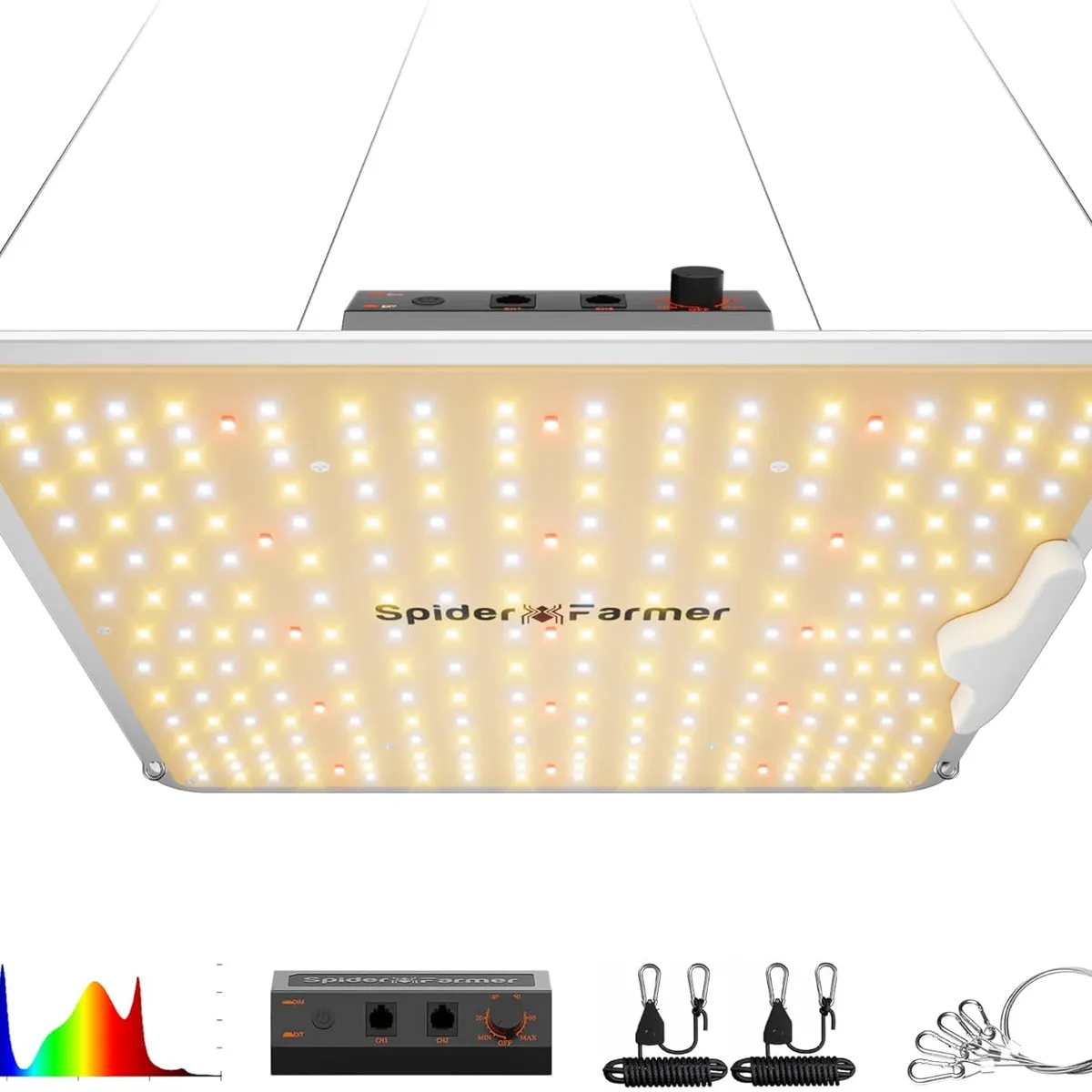
Spider Farmer SF-1000: Best LED Grow Light for Beginners

Pick #1 - Best for Beginners and Small Tents

100W | 2.5 µmol/J System PPE | Full Spectrum (3000K + 5000K + 660nm Red + 760nm IR) | Dimmable | Fanless Silent Design | 5-Year Warranty

Spider Farmer SF-1000
Check on Amazon

The Spider Farmer SF-1000 is the grow light that shows up in nearly every beginner's tent build, every Reddit "first grow" post, and every YouTube channel dedicated to small-scale indoor gardening - and there is a clear reason. At 100 watts of actual wall draw, the SF-1000 produces a genuine full-spectrum output tuned for every growth stage from seedling through harvest, costs under $80 on sale, and comes from a brand that has been manufacturing LED grow lights since 2015. It is the entry point where quality actually starts in this market.

The 2026 version of the SF-1000 features upgraded high-efficiency LED diodes with a system PPE of 2.5 µmol/J and an increased diode count compared to previous generations. Spider Farmer's diode layout positions chips more densely around the edges of the board, which produces a more uniform PPFD map across the canopy - meaning less light concentrated in the center hot spot and more usable intensity reaching the corners of your tent. The full-spectrum output combines 3000K warm white diodes (providing reddish light ideal for flowering), 5000K cool white diodes (providing blueish light that drives vegetative growth), 660nm deep red diodes (which speed up flowering time and boost yields), and 760nm infrared diodes (which promote cell elongation and help with phytochrome conversion). This is the same spectrum architecture used in grow lights costing two and three times the price.

The dimmable driver allows you to dial the intensity from zero to 100 percent using a simple knob on the driver box. This is not just a convenience feature - it is a critical tool for managing light stress. Seedlings and fresh clones need significantly less light intensity than plants in full flower, and being able to start at 40 to 50 percent and ramp up gradually prevents bleaching, nutrient lockout from light stress, and stunted early growth. The SF-1000 is also compatible with Spider Farmer's GGS smart controller system, which adds scheduled dimming, sunrise and sunset simulation, and overheat protection through an app. For growers who eventually want to scale up to multiple lights running on automated schedules, this controller compatibility means the SF-1000 grows with you.

The fixture itself is built on an aluminum heat sink with no fan - meaning zero noise and no moving parts that can fail. The Spider Farmer branded driver is detachable and sits outside the grow tent, reducing heat inside the canopy zone. At just 100 watts, the SF-1000 generates minimal heat compared to the 200-watt HPS it replaces, which significantly reduces the need for supplemental cooling and ventilation in a small 2x2 or 2.5x2.5 foot tent. With 12,330 ratings and a 4.6-star average on Amazon, marked as Amazon's Choice, and over 600 units purchased in the past month, the SF-1000 is the most popular and most-purchased grow light on this list by a wide margin.

Why It's Famous: The Perfect First Grow Light

The SF-1000 dominates the beginner market because it eliminates the typical mistakes new growers make when buying their first light. It is not too powerful for a small tent (100 watts is ideal for a 2x2 canopy), not too complicated (one dimmer knob, plug it in, done), and not too expensive to absorb the learning curve cost of a first grow that might not go perfectly. The five-year warranty backed by local service centers in the US, Canada, UK, EU, and Australia is a genuine differentiator - most budget lights offer one to two years at best, and many Chinese brands offer no meaningful warranty support at all.

The honest limitation of the SF-1000 is coverage. The 2x2-foot flowering footprint means this light is not going to fill a 3x3 tent with enough intensity for dense flower production - you will get good vegetative growth across 3x3, but flowering plants need the fixture concentrated over a smaller area. If your tent is 3x3 or larger, you should be looking at the SF-2000 or the AC Infinity IONBOARD S33. For single-plant growers, herb gardens, seedling stations, or anyone running a 2x2 or 2.5x2.5 tent, the SF-1000 hits the exact sweet spot of performance, price, and reliability.

Pros

Cons

2.5 µmol/J system PPE - genuine efficiency for the price

2x2 ft flowering footprint limits it to small tents

Full spectrum with IR for all growth stages seed to harvest

Upgraded LEDs are not Samsung LM301H EVO in this version

Dimmable with GGS smart controller compatibility

Will not produce dense flowers across a full 3x3

5-year warranty with local service centers globally

No built-in WiFi/app - requires separate GGS controller

Fanless silent design, detachable driver, aluminum heat sink

Single-light purchase - no multi-pack discount

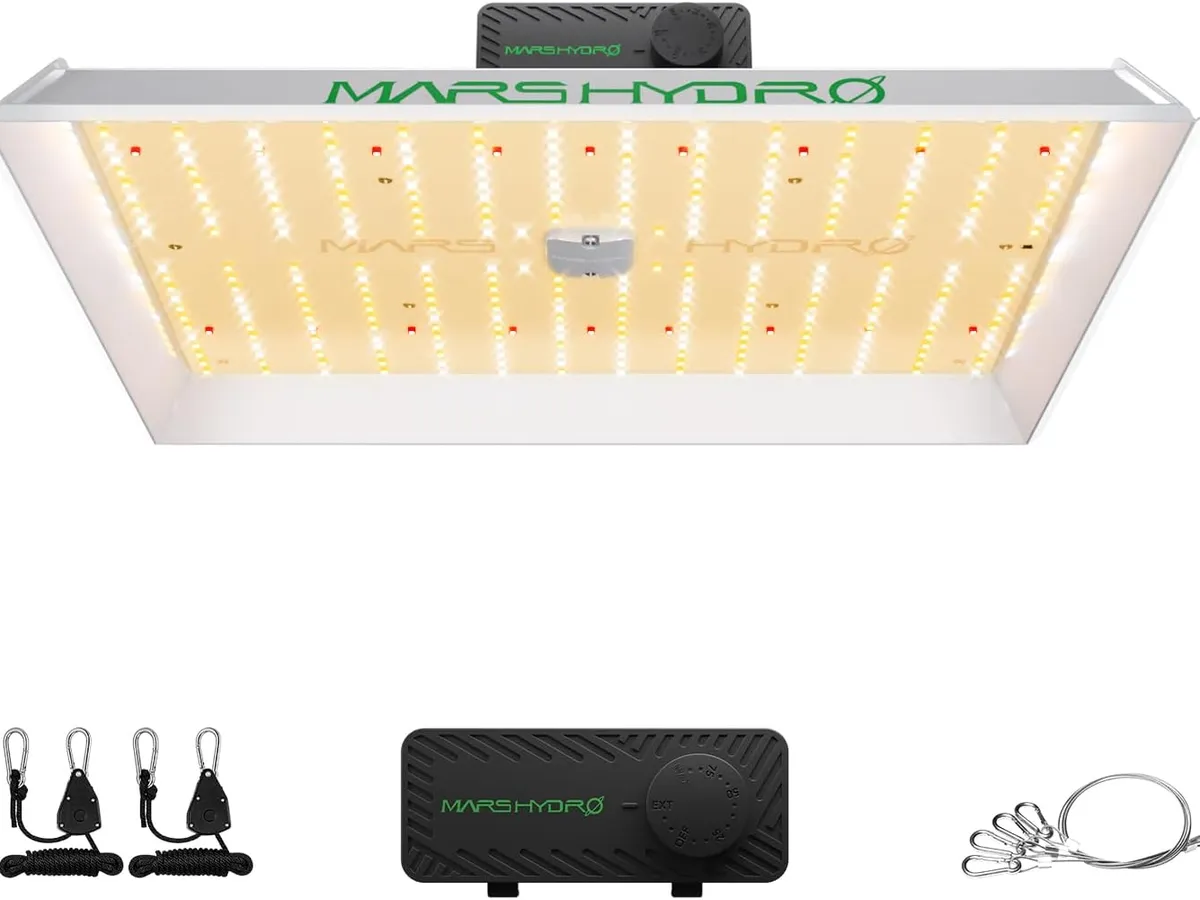
Mars Hydro TS-1000: Best Budget LED Grow Light

Pick #2 - Best Budget Grow Light

150W | 2.3 µmol/J PPE | Full Spectrum (IR + 3200-4200K + 5200-6800K) | 5-Level Dimming | Daisy Chain Up to 50 Units | Patented Reflector Hood | 5-Year Warranty

Mars Hydro TS-1000
Check on Amazon

The Mars Hydro TS-1000 is the grow light that gives you more actual watts per dollar than anything else in the entry-level market. At 150 watts of true power draw with 354 individual LEDs, the TS-1000 delivers roughly 50 percent more photon output than typical 100-watt competitors while pricing itself directly alongside them. Mars Hydro has been manufacturing grow lights since 2009 - making them one of the longest-running brands in the LED horticulture space - and the TS-1000 represents their most-sold product across their entire lineup. With over 4,170 ratings and a 4.6-star average on Amazon, and over 400 units purchased in the past month, this is a proven workhorse.

The standout engineering feature is Mars Hydro's patented white reflector hood design. Unlike flat-board quantum lights that rely entirely on the angle of the diodes themselves for light distribution, the TS-1000's reflector hood uses a 120-degree refraction angle to redirect photons that would otherwise be lost to the sides and above the fixture. Mars Hydro claims this increases usable light intensity by up to 25 percent compared to a reflectorless board of the same wattage. The practical result is a broader, more intense light footprint than the raw PPE number might suggest - the TS-1000 punches above its 2.3 µmol/J spec sheet rating in actual tent conditions because more of its photons end up hitting plants instead of tent walls.

The diode layout follows a dense-center, sparse-edge arrangement that creates a more uniform PPFD distribution between the middle and edges of the coverage area. The full-spectrum output spans 730-740nm far red IR, 3200-4200K warm white, and 5200-6800K cool white, which covers every wavelength band that drives photosynthesis across all growth stages. The TS-1000 features a 5-level dimming system via an independent button on the external driver, with adjustable 0 to 100 percent brightness settings. It supports daisy-chaining up to 50 LED lights in a single group, making it genuinely scalable for commercial operations. The power supply is multi-voltage (120VAC, 240VAC, and 277VAC), so it works in residential and commercial electrical systems worldwide without adapters.

The fanless aluminum housing provides passive heat dissipation with zero operating noise. Mars Hydro backs the TS-1000 with a 5-year warranty and maintains local after-sales repair centers. The build quality has improved significantly over earlier Mars Hydro generations - the driver reliability issues that plagued early TS-series models have been addressed in the current production run, and the solder points on the diode board are now coated for moisture protection.

Why It's Famous: 150 Watts at a 100-Watt Price

The TS-1000's value proposition is simple math. At $89.99, you are paying roughly $0.60 per watt - the same price point as most 100-watt lights, but with 50 percent more output. This extra headroom matters more than beginners realize. A 100-watt light at full blast in a 2x2 tent produces adequate PPFD for flowering, but there is no room to compensate if your tent is slightly larger, if your plants stretch taller than expected, or if you want to push for maximum density. The TS-1000's 150 watts give you that margin: you can run it at 75 percent in a 2x2 for comfortable flowering, or crank it to 100 percent and credibly flower a 2.5x2.5-foot canopy that a 100-watt light would struggle with.

The trade-off is efficiency. At 2.3 µmol/J, the TS-1000 converts electricity into usable plant light less efficiently than the Spider Farmer SF-1000's 2.5 µmol/J. Over a full grow cycle, that difference translates to slightly higher electricity costs for the same amount of usable photons. The driver block also sits externally with a barrel power connector that is not the most secure mounting solution - it works fine in a stationary tent setup, but it is not waterproof and can disconnect if the cable is tugged. For growers who want the absolute most light per dollar and do not mind slightly lower efficiency, the Mars Hydro TS-1000 is the budget king. For growers who prioritize diode quality and long-term efficiency, the Spider Farmer SF-1000 edges it out.

Pros

Cons

150W actual draw - 50% more output than 100W competitors

2.3 µmol/J efficiency is lower than SF-1000's 2.5

Patented reflector hood increases usable intensity by up to 25%

Barrel power connector is not waterproof or fully secure

Daisy chain up to 50 lights for massive scalability

No smart controller integration - dimming only via driver knob

Multi-voltage 120/240/277VAC works globally

Mars Hydro's historical marketing claims have been inflated

5-year warranty, 354 LEDs, full spectrum with far red IR

Heavier and warmer than 100W alternatives at full power

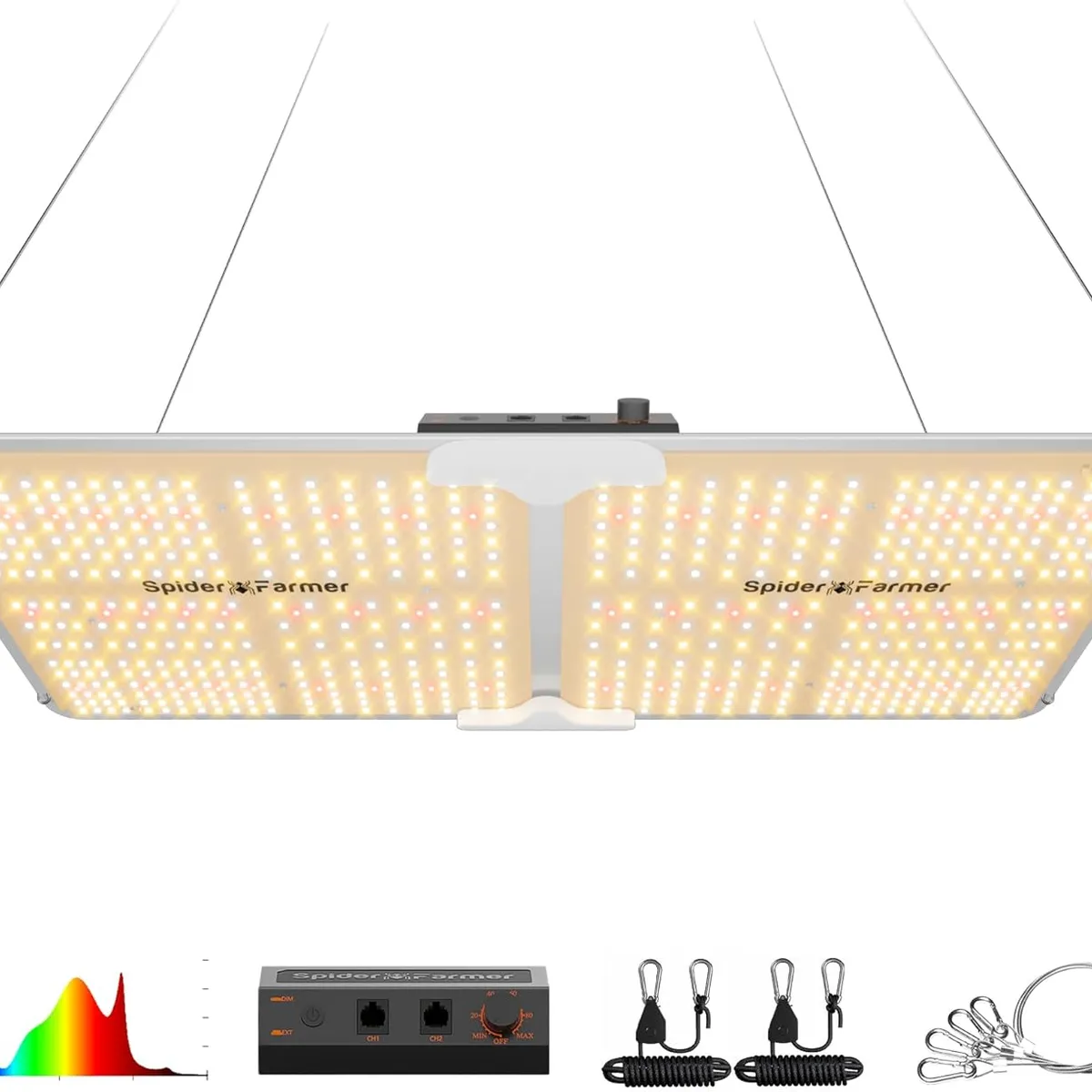
Spider Farmer SF-2000: Best Mid-Level LED Grow Light for 2x4 Tents

Pick #3 - Best Mid-Level for 2x4 and 3x3 Tents

200W | 2.7 µmol/J System PPE | Full Spectrum (3000K + 5000K + 660nm Red + 760nm IR) | Dimmable | Detachable Driver | Compatible with GGS Controllers | 5-Year Warranty

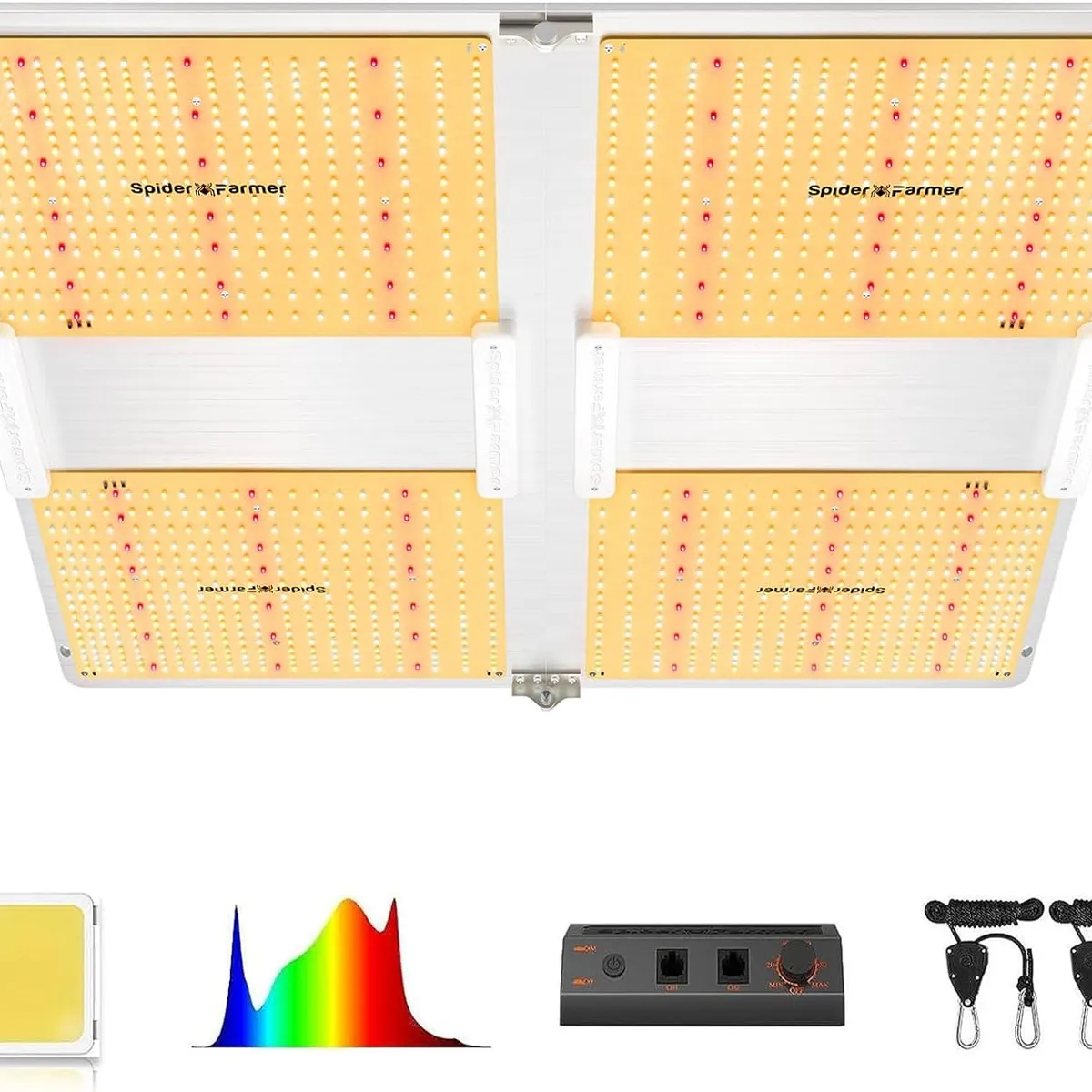
Spider Farmer SF-2000
Check on Amazon

The Spider Farmer SF-2000 is where the brand's engineering hits its stride. At 200 watts with a system PPE of 2.7 µmol/J, this is one of the most efficient quantum board grow lights available under $200 - matching or beating fixtures that cost significantly more. The SF-2000 takes everything that makes the SF-1000 the beginner favorite and scales it to the most popular grow tent size in the hobby: the 2x4-foot tent. If you are graduating from a 2x2 to a larger space, or starting fresh with a tent that can hold two to four full-sized plants, the SF-2000 is the fixture that serious growers overwhelmingly recommend.

The 2026 version of the SF-2000 runs upgraded high-efficiency LEDs with an increased diode count, delivering the same optimized edge-density diode layout as the SF-1000 but across a larger 25.5 by 10.5-inch board. The spectrum is identical to the SF-1000 - 3000K warm white, 5000K cool white, 660nm deep red, and 760nm IR - which means the same proven full-cycle coverage from seedling through harvest. The key difference is raw output: at 200 watts, the SF-2000 produces enough photosynthetically active radiation to drive dense flower production across a 2x4-foot canopy at 12 to 16 inches from the tops, or comfortable vegetative growth across a 3x4 to 4x4 footprint at 24 inches.

The detachable Spider Farmer branded driver is a genuine quality-of-life upgrade over integrated-driver designs. By mounting the driver outside your grow tent using the included extension cable, you remove the single largest heat source from the canopy environment. In a 2x4 tent where airflow and temperature management are already tight, this can mean the difference between a tent running at 78°F and one running at 84°F - a gap that significantly affects plant transpiration, nutrient uptake, and terpene development. The dimming knob on the driver provides smooth 0 to 100 percent adjustment, and the GGS controller compatibility opens up app-based scheduling, sunrise and sunset simulation, and multi-light unified dimming for growers who want automation.

The aluminum heat sink is thick and sturdy with no fan required, keeping the operating environment completely silent. The fixture plugs into a standard outlet and can be hung using the included adjustable rope hangers. Spider Farmer's five-year warranty applies, and the same global network of local service centers supports the SF-2000. With 12,330 combined ratings across the SF series and a 4.6-star average, plus over 100 units purchased in the past month for this specific model, the SF-2000 has earned its position as the default recommendation for mid-sized grows.

Why It's Famous: The 2x4 Tent Standard

The 2x4-foot grow tent is the most popular tent size among home growers, and the SF-2000 was dimensionally engineered to fill it perfectly. The rectangular 25.5 by 10.5-inch board mirrors the tent's proportions, meaning the light pattern aligns with the growing area without wasting photons on the tent walls. This is a meaningful advantage over square-format lights that leave the narrow ends of a 2x4 tent underlit, and over bar-style lights that require more precise hanging height to achieve even coverage. You hang the SF-2000 in a 2x4 tent, adjust the height, and the coverage just works.

At 2.7 µmol/J, the SF-2000 is also the most efficient light on this list under $250. That efficiency translates directly to lower electricity costs over time and less waste heat to manage. A full grow cycle running 18 hours of veg light followed by 12 hours of flower light across roughly four months will cost approximately $15 to $25 in electricity at average US rates - about half what a 400-watt HPS setup would cost for comparable output. Multiple cannabis growers report yields of 1.5 to 2.5 grams per watt with the SF-2000 in optimized conditions, which puts the total harvest value of this light's output well above its purchase price within a single cycle.

The limitation is the same as any single-board quantum light: coverage drops off meaningfully at the edges. If you are running a 3x3 tent rather than a 2x4, you will notice the corners receiving less intensity. For a true 3x3 flowering canopy, the AC Infinity IONBOARD S33 at 260 watts is the better match. But for the 2x4 tent that most hobbyists actually use, the SF-2000 is the gold standard.

Pros

Cons

2.7 µmol/J system PPE - most efficient under $200

Not ideal for square 3x3 tents - rectangular footprint

Detachable driver reduces heat inside the tent

At $192, it is a step up in investment from entry-level

Perfect dimensional match for 2x4 grow tents

Edge PPFD drops off in tents wider than 2 feet

GGS controller compatible for automated scheduling

No built-in WiFi - controller sold separately

5-year warranty, full spectrum with IR, silent fanless design

Upgraded LEDs are branded Spider Farmer, not Samsung EVO

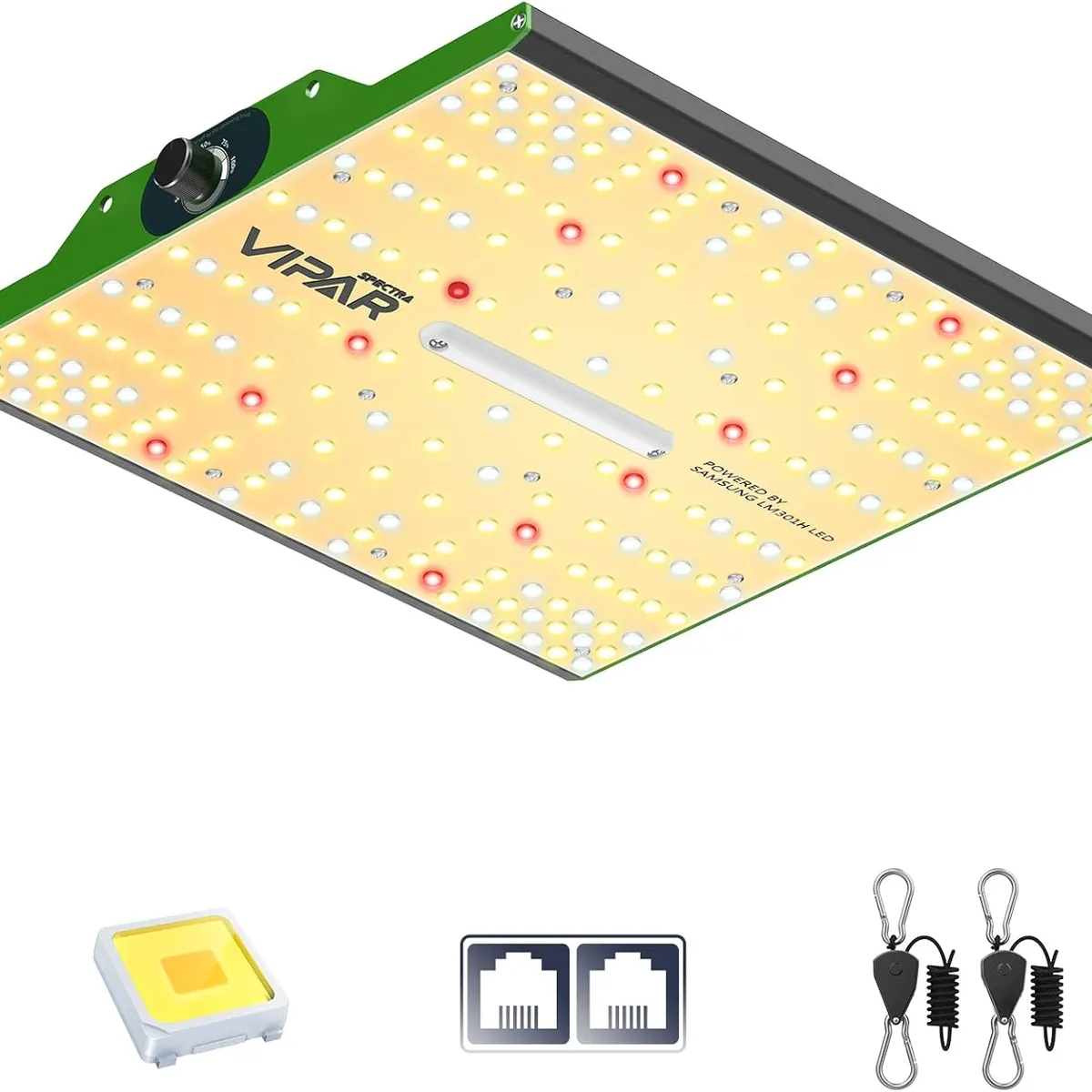
VIPARSPECTRA P1000: Best Ultra-Budget LED Grow Light

Pick #4 - Best Ultra-Budget Pick

100W | Full Spectrum (3000K + 5000K + 660nm Red + 730nm Far Red IR) | Dimmable | Daisy Chain Up to 20 Units | Fanless | ETL Listed

AC Infinity IONBOARD S33
Check on Amazon

The VIPARSPECTRA P1000 is the grow light you buy when you want to spend as little as possible without buying something that will disappoint you. At $55.23 on the current limited-time deal - regularly $89.99 - this 100-watt fixture undercuts every other light on this list while still delivering a genuine full-spectrum output with dimmable control and daisy chain capability. VIPARSPECTRA has been manufacturing LED grow lights for over 12 years, and the P1000 is their flagship entry-level product. With 5,108 ratings, a 4.7-star average (the highest rating of any light on this list), and over 700 units purchased in the past month, this is the volume leader in the budget grow light category.

The P1000's upgraded diode layout uses a scientifically optimized distribution pattern paired with a high-safety-performance LED driver. The full spectrum includes 660nm red, 3000K warm white, 5000K cool white, and 730nm far red IR - the same wavelength bands as lights costing two to three times the price. The coverage area is rated at 2.5x2.5 feet for vegetative growth at 16 inches and 2x2 feet for flowering at 10 inches. That 10-inch flowering distance is worth noting: it means the P1000 needs to hang closer to the canopy than competitors like the SF-1000, which requires more careful height management to avoid light burn on the tallest colas.

The dimmer knob provides continuous adjustment for matching light intensity to each growth stage, and the daisy chain feature supports connecting up to 20 P1000 units in a group - a feature that makes this fixture viable for small commercial operations, vertical farms, and multi-tent setups where keeping costs per light as low as possible is the primary consideration. The build follows the same approach as the rest of the market: aluminum heat sink body, fanless passive cooling, no ballast, plug-and-play installation. VIPARSPECTRA is ETL listed and offers US-based local after-sales service.

Why It's Famous: The Sub-$60 Gateway to Indoor Growing

The P1000's greatest achievement is making the barrier to entry for indoor growing nearly nonexistent. At $55 on sale, the cost of the grow light is no longer the expensive part of an indoor setup - the tent, the soil, the nutrients, and the seeds all cost more. This has made the P1000 the default recommendation in online growing communities for anyone asking "what is the cheapest light that actually works?" The 4.7-star average across over 5,000 reviews is not an accident; it reflects a product that consistently meets expectations at a price point where expectations are typically not met.

The honest trade-off is component quality. The P1000 does not use Samsung or Osram diodes - it uses generic SMD LEDs that produce a similar spectrum but at lower efficiency and with less consistent binning. You will not match the yields-per-watt of a Spider Farmer or HLG fixture, and the light's long-term lumen maintenance (how well it holds its brightness over years of use) is likely shorter. The driver is also unbranded, which historically has been the most common failure point in budget grow lights. But for the grower who wants to run two or three cycles to learn the basics before investing in premium equipment, or for the herb and lettuce grower who does not need to push maximum PPFD, the VIPARSPECTRA P1000 delivers more than enough to justify its price.

Pros

Cons

Under $56 on sale - lowest price on this list

Generic SMD LEDs, not Samsung or Osram branded diodes

4.7 stars across 5,108 reviews - highest rated on this list

Lower efficiency than Samsung-diode competitors

Daisy chain up to 20 units for commercial scalability

10-inch flowering height requires careful canopy management

Full spectrum with far red IR, dimmable, ETL listed

Unbranded driver may have shorter lifespan

700+ bought in past month - proven mass-market reliability

2x2 ft flowering footprint is small for the price-conscious

AC Infinity IONBOARD S33: Best LED Grow Light with Smart Controller Integration

Pick #5 - Best Smart Controller Integration

260W | Samsung LM301H Diodes | Full Spectrum (660nm + 730nm + 3000K + 5000K) | 0-100% Dimmable | IP-65 Rated | UIS™ Smart Ecosystem Compatible | 3x3 Coverage

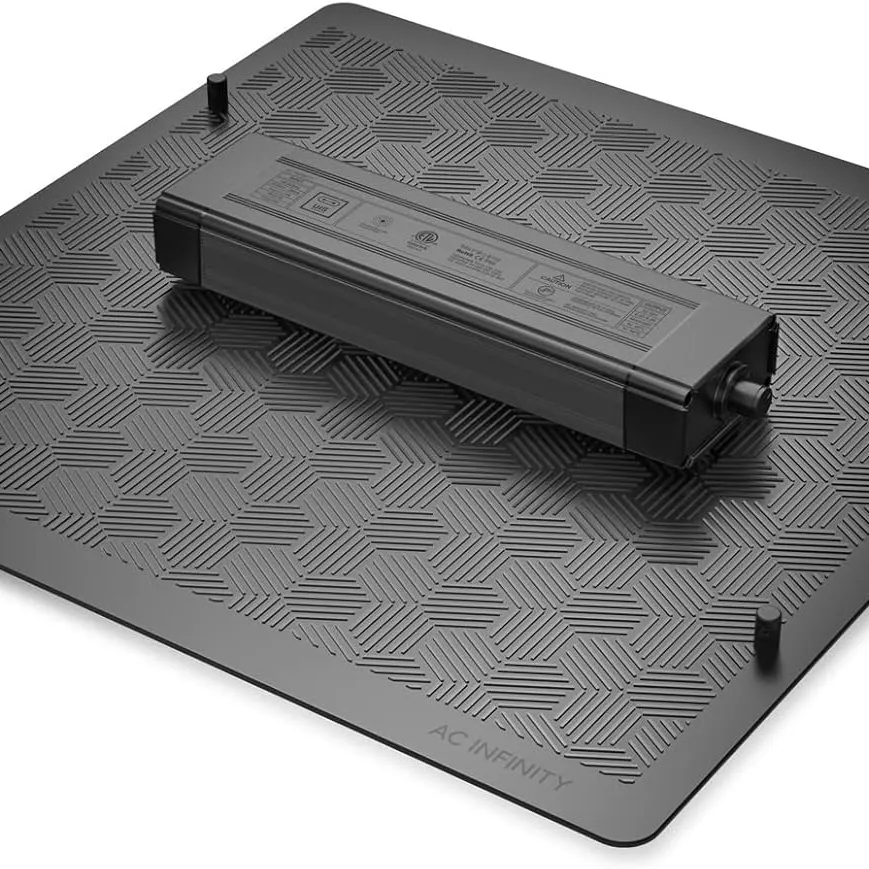
AC Infinity IONBOARD S33
Check on Amazon

The AC Infinity IONBOARD S33 is the grow light for the grower who wants their entire tent environment managed from a single app on their phone. AC Infinity is a Los Angeles-based technology company that started in HVAC and ventilation before expanding into the horticulture space, and their approach reflects that engineering DNA: everything they build is designed to connect, communicate, and automate. The IONBOARD S33 is not just a grow light - it is one node in AC Infinity's UIS™ (Universal Infinity System) platform, which links lights, inline fans, clip fans, controllers, and environmental sensors into a unified smart ecosystem where each device can respond to the others automatically.

On pure light performance, the IONBOARD S33 holds its own against any competitor at this price point. It runs 640 Samsung LM301H diodes - the same diode family used in professional commercial fixtures - positioned using an algorithmic layout that AC Infinity claims produces the most uniform PAR map and deepest canopy penetration of any board in its class. At 260 watts, it delivers enough output to drive dense flowering across a full 3x3-foot canopy. The full spectrum covers 660nm deep red, 730nm far red, 3000K warm white, and 5000K cool white - providing the same wavelength bands needed for complete seed-to-harvest growing.

The dimmer operates in 20 percent increments from 0 to 100 percent using a control knob on the proprietary driver. But the real magic happens when you connect the IONBOARD to AC Infinity's Controller 69 or later (sold separately). Through the AC Infinity app, you gain access to WiFi-based remote control, custom grow cycle scheduling, automated lighting recipes, sunrise and sunset simulation, and integration with AC Infinity's environmental sensors for temperature, humidity, and VPD-responsive automation. Imagine your light automatically dimming to 80 percent when the tent temperature exceeds 85°F, or your inline fan ramping up when VPD falls outside the optimal range, while your light maintains its scheduled intensity - all without you touching anything. That is what the UIS ecosystem delivers.

The build quality reflects the premium positioning. The entire fixture is constructed on a fanless unibody aluminum board and sealed to IP-65 standards, meaning it is fully protected against dust ingress and low-pressure water jets. This is the only light on this list rated for high-humidity grow environments without concern for moisture damage to the electronics. With 1,033 ratings and a 4.5-star average on Amazon, the IONBOARD S33 has a smaller review base than the mass-market competitors but a fiercely loyal user community that values the ecosystem integration.

Why It's Famous: The Grow Light That Talks to Your Tent

No other grow light brand offers the depth of smart integration that AC Infinity does. Spider Farmer's GGS system is a step in this direction, and Mars Hydro has introduced Bluetooth control on newer models, but neither matches the breadth of AC Infinity's UIS platform. When you buy an IONBOARD S33, you are buying into an ecosystem that includes CLOUDLINE inline fans, CLOUDRAY clip fans, environmental controllers, and a unified app that ties them all together. For growers who travel, work long hours, or simply want the peace of mind that their tent is maintaining optimal conditions around the clock, this integration is not a luxury - it is a genuine functional advantage that directly impacts yields and plant health.

The trade-off is cost - both direct and ecosystem. The IONBOARD S33 at $259 is the second most expensive light on this list, and unlocking its full potential requires the Controller 69 ($79+) on top of that. If you are not going to use the smart features, you are paying a premium for an IP-65-rated board with Samsung LM301H diodes that performs comparably to the Spider Farmer SF-2000 at a higher price. The 260-watt output is also tuned specifically for a 3x3 tent - it will not adequately flower a 4x4 canopy the way the HLG fixtures will. But for the 3x3 grower who wants the most technologically advanced, fully automated growing experience available under $350, the IONBOARD S33 is the clear choice.

Pros

Cons

Samsung LM301H diodes - professional-grade components

$259 is premium pricing for a 260W board light

UIS™ ecosystem for full tent automation via app

Smart features require Controller 69 ($79+) sold separately

IP-65 rated - sealed against dust and moisture

Dimming in 20% increments, not continuous like Spider Farmer

Algorithmically positioned diodes for uniform PAR

260W not enough for 4x4 flowering coverage

Fanless unibody aluminum, daisy chain capable

2-year warranty is shorter than Spider Farmer's 5-year

HLG 350 Diablo: Best LED Grow Light for Serious Hobbyists

Pick #6 - Best for Serious Hobbyists

330W | 2.75 µmol/J PPE (3.11 PPF/W) | 911 PPF Output | Samsung LM301H + LM351H Deep Red 660nm | Quantum Board QB 648 | Dimmable 60-330W | Integrated Reflectors | ETL/UL Certified | Designed & Assembled in USA | 5-Year Warranty

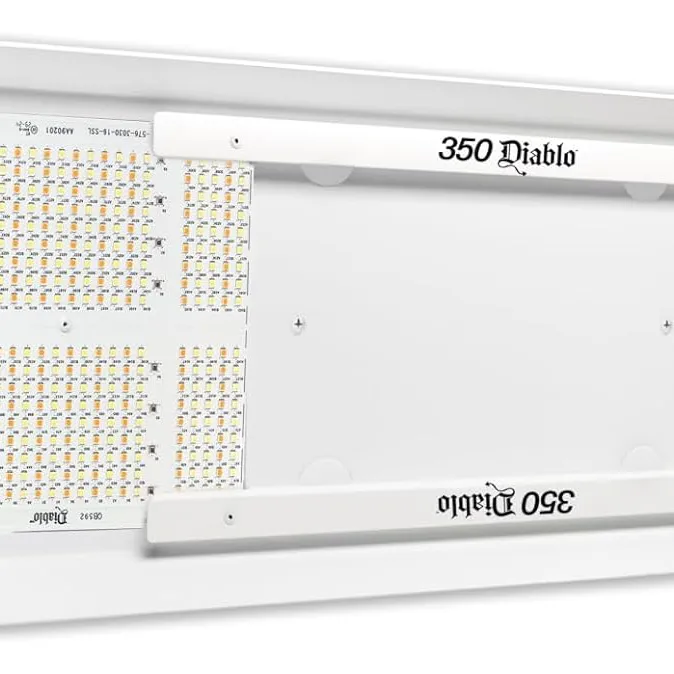
HLG 350 Diablo
Check on Amazon

The HLG 350 Diablo is the point on this list where you cross from consumer-grade grow lights into professional horticulture engineering. Horticulture Lighting Group was formed in 2016 from the merger of Johnson Grow Lights and Northern Grow Lights, and they are the company that invented the quantum board - the flat, high-density LED panel format that every other brand on this list has since adopted. When Spider Farmer, Mars Hydro, and VIPARSPECTRA build quantum-board-style fixtures, they are following a design language that HLG created. Buying the HLG 350 Diablo is buying from the originator.

Each HLG 350 Diablo uses two custom-designed Advanced Diablo Quantum Boards populated with Samsung LM301H full-spectrum white diodes and Samsung LM351H 660nm deep red diodes. These are top-bin Samsung diodes - the highest performance grade available - not the lower-bin seconds that Chinese manufacturers purchase at discount and market under the same Samsung name. The difference shows up in real-world performance: the 350 Diablo produces 911 PPF (photosynthetic photon flux) at just 330 watts, achieving an extraordinary 3.11 PPF per watt in independent lab testing. That PPF-per-watt number is one of the highest in the industry for a fixture in this price range, and it means more of every dollar you spend on electricity gets converted into photons that your plants can actually use.

The 35-inch wide rectangular design with integrated reflectors is specifically engineered for 3x5-foot flowering coverage at 15 inches above the canopy, or 5x5-foot vegetative coverage at 24 inches. The integrated reflectors are a key design element that distinguishes the Diablo series from standard flat quantum boards: they redirect photons that would normally escape sideways back down into the canopy, improving photon delivery to lower plant sites and reducing hotspot intensity directly beneath the fixture. The practical result is more even bud development from top to bottom of the plant, with less popcorn (small, underdeveloped buds) on the lower branches.

The Inventronics driver is dimmable from 60 to 330 watts, auto-senses input voltage (120/240/277VAC), and features passive cooling that keeps the entire system fanless and silent. The fixture is ETL and UL certified to US safety standards - a certification that requires independent third-party testing, not just self-declaration. HLG backs the 350 Diablo with a 5-year warranty, and the fixture is designed and assembled in Tennessee, USA. With 59 ratings and a 4.4-star average on Amazon, the review base is smaller than the mass-market brands, which reflects HLG's distribution through specialty hydroponic retailers rather than Amazon as a primary channel.

Why It's Famous: The Quantum Board That Started It All

When experienced growers talk about "just buying the HLG," they are talking about this tier of fixture. The HLG 350 Diablo represents the point where component quality, engineering precision, and real-world yield results converge to create a light that pays for itself. Multiple growers running the 350 Diablo in 3x5 tents report yields above 2 grams per watt in optimized conditions - meaning a single harvest can produce well over a pound of dried flower from a fixture that draws less electricity than a desktop computer. The top-bin Samsung diodes maintain their output intensity longer than lower-grade alternatives, meaning the 350 Diablo will still be performing at 90+ percent of its original output after 50,000 hours when cheaper lights have degraded to 70 or 80 percent.

The trade-off is price. At $549, the HLG 350 Diablo costs more than the Spider Farmer SF-2000 and AC Infinity IONBOARD S33 combined. It has no smart controller integration, no app, no WiFi - just a dimmer knob, premium components, and American assembly. If you want automation, you will need to add a third-party timer and environmental controller separately. The 59-review count on Amazon also means less crowd-sourced quality validation than the mass-market brands, though HLG's reputation in the hydroponic retail community is rock-solid. For the hobbyist who is done experimenting with budget gear and wants to invest once in a fixture that will last a decade, the HLG 350 Diablo is the enthusiast's choice.

Pros

Cons

Top-bin Samsung LM301H + LM351H diodes - best component quality

$549 - most expensive mid-wattage light on this list

3.11 PPF/W - among the highest efficiency in the industry

No smart controller integration, no app, no WiFi

Integrated reflectors improve lower-canopy bud development

Only 59 Amazon reviews - smaller crowd validation

Designed and assembled in USA, ETL/UL certified

3x5 flowering footprint is specific - not ideal for square tents

5-year warranty, auto-sensing 120/240/277V, passive cooling

Inventronics driver runs warmer than MeanWell alternatives

Spider Farmer SF7000: Best Commercial LED Grow Light for Maximum Yield

Pick #7 - Best for Commercial Operations and Maximum Yield

650W | 2.8 µmol/J PPE | 1786 PPF Output | Samsung LM301B Diodes | Full Spectrum (2800-3000K + 4800-5000K + 650-665nm Red) | Dimmable | Daisy Chain Up to 60 Units | Foldable Design | Detachable Driver | 5-Year Warranty

Best for Commercial Operations and Maximum Yield
Check on Amazon

want true commercial-level output without paying premium-brand prices. Running at 650 watts, it delivers 1786 µmol/s with an efficiency of 2.8 µmol/J-enough to replace a 1000W HPS while significantly reducing energy consumption and heat output. For cost-per-watt and cost-per-yield, it stands out as one of the strongest value options in the high-wattage LED market.

The fixture uses Samsung LM301B diodes arranged across a large, foldable board, combining 3000K warm white, 5000K cool white, and 660nm deep red for a balanced full-spectrum output. This spectrum supports complete seed-to-harvest growth without needing to swap lights between stages. The upgraded diode layout improves PPFD uniformity across a 5x5-foot canopy, helping eliminate weak edge growth and producing more consistent results from center to corner.

A dimmable driver allows precise control from low-output seedling settings to full-power flowering. The SF7000 also supports daisy chaining, enabling multiple fixtures to be controlled from a single dimmer-ideal for scaling into larger grow operations. The detachable driver can be mounted outside the grow space to reduce heat buildup, improving environmental control at higher wattages.

Spider Farmer backs the SF7000 with a 5-year warranty and a large global support network. Combined with its foldable design, strong efficiency, and competitive pricing, the SF7000 delivers a rare mix of performance, scalability, and practicality-making it a top choice for serious growers looking to maximize yields without overspending

Why It's Famous: The Commercial Grower's Benchmark

The SF7000 stands out by delivering 650W of commercial-level output for around $499.99-roughly half the price of comparable fixtures like HLG’s 600 Rspec FR. With 1786 µmol/s and strong real-world performance, it offers one of the best price-to-performance ratios in high-wattage grow lights. Growers consistently report dense, high-quality results in 5x5 setups, making it a top choice for upgrading from smaller tents or scaling into multi-light rooms using daisy chaining.

Its 5x5 flowering coverage and scalability make it viable even for small commercial grows, where multiple units can be controlled from a single dimmer at a much lower total cost than premium brands.

The trade-offs are minor but worth noting. It uses Samsung LM301B diodes instead of newer LM301H variants, and its advertised 2.8 µmol/J is likely closer to ~2.5-2.6 in real conditions. It also lacks the same level of third-party testing transparency as higher-end brands, and heat management is important at full power.

Pros

Cons

1786 PPF at 2.8 µmol/J - highest raw output on this list

Samsung LM301B diodes, not the newer LM301H or EVO

$499.99 - nearly half the price of competing 650W fixtures

Stated 2.8 µmol/J is likely diode-level, not system-level

Daisy chain up to 60 units for full commercial room control

650W generates significant heat - needs strong ventilation

Foldable design for easy transport and storage

No independent lab-verified efficacy report published

5-year warranty, GGS controller compatible, detachable driver

Large 29x22" footprint doesn't fit tents smaller than 4x4

LED Grow Light Buying Guide: What to Look For

Efficacy (µmol/J): The Single Most Important Specification

Efficacy measures how efficiently a grow light converts electricity into photosynthetically active radiation (PAR) - the wavelengths of light that plants actually use for photosynthesis. It is expressed in micromoles per joule (µmol/J), and a higher number means more usable light per watt of electricity consumed. For context: a cheap blurple panel from 2017 might achieve 1.0 to 1.5 µmol/J. A good modern full-spectrum LED achieves 2.0 to 2.5 µmol/J. A premium fixture with top-bin Samsung diodes achieves 2.5 to 3.0+ µmol/J. When comparing grow lights, always compare efficacy first. A 200-watt light at 2.7 µmol/J produces more usable plant light than a 300-watt light at 1.5 µmol/J while consuming a third less electricity.

Coverage Area: Veg Footprint vs. Flower Footprint

Every grow light manufacturer lists two coverage areas: vegetative and flowering. The vegetative footprint is always larger because plants in the vegetative stage need less light intensity (roughly 200-400 µmol/m²/s PPFD) than plants in the flowering stage (600-1000+ µmol/m²/s PPFD). Always buy your light based on the flowering footprint, not the veg footprint. A light rated for "3x3 veg / 2x2 flower" is genuinely a 2x2 light for the purposes of growing flowering or fruiting plants to maturity. If you buy based on the veg footprint, you will end up with insufficient intensity for flowering and loose, airy buds or undersized fruit.

Spectrum: Why Full-Spectrum White Beats Blurple

Modern full-spectrum white LEDs (typically a mix of 3000K and 5000K diodes) with supplemental 660nm deep red and 730nm far red diodes represent the current best practice in LED grow light design. This approach produces a broad, sunlight-like spectrum that covers every wavelength band involved in photosynthesis, photomorphogenesis, and the phytochrome signaling system. The old blurple (blue-purple) panels that used only blue and red diodes were based on an oversimplified understanding of plant light requirements. While plants do absorb most strongly in the blue and red wavelengths, they also use green, yellow, and far red light in ways that affect growth patterns, yield, chemical production, and overall health. Full-spectrum white light also allows you to visually inspect your plants with accurate color rendering - something that is impossible under purple light.

Diode Quality: Samsung, Osram, and Bridgelux

The diodes (individual LED chips) on a grow light are the components that actually produce the photons your plants use. Samsung LM301B, LM301H, and the newest LM301H EVO are the industry standards for high-efficiency horticulture LEDs. Osram deep red 660nm diodes are considered the best supplemental red LEDs available. Bridgelux is a US-based manufacturer that produces good-quality diodes at a lower price point than Samsung - several brands including Spider Farmer have begun transitioning to Bridgelux in their 2026 models while maintaining similar performance. When a manufacturer does not name their diode supplier, the diodes are almost certainly generic Chinese LEDs that may produce a similar spectrum but at lower efficiency, lower consistency, and shorter lifespan.

Driver Quality: MeanWell vs. Inventronics vs. Generic

The driver is the power supply that converts your wall outlet's AC electricity into the DC current that powers the LED diodes. It is the most common failure point in any LED grow light. MeanWell is the gold standard for reliability in LED drivers and is used in many Spider Farmer models. Inventronics is the driver brand used by HLG and is similarly respected in the commercial lighting industry. Spider Farmer has also introduced their own branded drivers. Generic, unbranded drivers - common in budget lights from VIPARSPECTRA and similar brands - are functional but statistically more likely to fail within the first two to three years. A dead driver means a dead light, so this component matters more than most buyers realize.

Dimmability: Why It Matters More Than You Think

A dimmable driver is not a luxury feature - it is a practical necessity for growing plants from seedling to harvest under a single fixture. Seedlings and fresh clones need roughly 200 to 300 µmol/m²/s PPFD. Vegetative plants thrive at 400 to 600. Flowering plants want 600 to 1000+. Without a dimmer, you are managing light intensity entirely by raising and lowering the fixture height, which is less precise and can create uneven coverage as the light-to-canopy distance increases. Every light on this list is dimmable, which reflects how standard this feature has become in the modern market.

How to Calculate Your Grow Light Needs

The simplest rule of thumb is 30 to 50 watts of actual wall draw per square foot of flowering canopy for LED grow lights. A 2x2 tent (4 sq ft) needs 120 to 200 watts. A 2x4 tent (8 sq ft) needs 240 to 400 watts. A 3x3 tent (9 sq ft) needs 270 to 450 watts. A 4x4 tent (16 sq ft) needs 480 to 800 watts. This is a rough guide - actual requirements vary based on efficacy, light height, tent reflectivity, plant species, and growing goals. Higher-efficacy lights (2.5+ µmol/J) can operate at the lower end of these wattage ranges and still achieve excellent results, while lower-efficacy lights need more watts to deliver the same PPFD.

Conclusion:

Choosing the right LED grow light is no longer about finding the highest wattage, but about matching the photon output and spectrum to your specific canopy size. Modern quantum boards and bar-style fixtures provide a level of efficiency that makes indoor gardening more accessible and affordable than ever. By focusing on builds that offer high-quality diodes and reliable thermal management, you ensure your investment lasts for years of successful harvests.

As you set up your grow space, remember that light is only one part of the equation. Pair your new LED fixture with proper ventilation and a consistent nutrient schedule to fully realize the potential of these high-efficiency systems. Whether you are a hobbyist with a single tent or a commercial grower, the current generation of LED technology offers the precision needed to push your plants to their absolute limit.

Frequently Asked Questions About LED Grow Lights

Q1: How far should LED grow lights be from plants?

A: Most LED grow lights should be hung 18 to 24 inches above the plant canopy during vegetative growth and 12 to 18 inches during flowering. Seedlings and fresh clones need the light further away - 24 to 30 inches - or dimmed to 40 to 50 percent to prevent light stress. The correct distance varies significantly between models depending on wattage and beam concentration. Always check the manufacturer's specific recommendations: the HLG 350 Diablo, for example, recommends 15 to 24 inches above the canopy, while the VIPARSPECTRA P1000 recommends just 10 inches for flowering. Using a PAR meter or a smartphone PPFD app to measure actual light intensity at canopy level is the most reliable way to dial in your hanging height.

Q2: How long do LED grow lights last?

A: Quality LED grow lights last 50,000 to 100,000 hours, which translates to 8 to 15 years at 18 hours of daily use. The LEDs do not burn out suddenly like incandescent bulbs - they gradually dim over time. Most manufacturers define the lifespan as the point at which output drops to 70 percent of the original (called L70). In practice, most growers replace their lights after five to seven years as newer, more efficient models become available, rather than because the old ones have stopped working. The driver is more likely to fail before the diodes do, which is why driver quality matters so much in the buying decision.

Q3: Can I use a regular LED bulb as a grow light?

A: Standard household LED bulbs can sustain low-light plants like herbs, lettuce, and pothos, but they lack the intensity and spectrum optimization needed for flowering or fruiting plants. A typical 10-watt household LED produces roughly 800 lumens spread across a wide angle with no supplemental red wavelengths - delivering maybe 20 to 40 µmol/m²/s PPFD at 12 inches, which is a fraction of what flowering plants require. Dedicated grow lights concentrate more energy in the red and blue wavelengths that drive photosynthesis, produce far higher PPFD per watt, and distribute that light in a focused pattern designed for a canopy. For serious growing of any kind, use a purpose-built LED grow light.

Affiliate Disclosure: This article contains affiliate links. If you purchase through these links, we may earn a small commission at no extra cost to you.