Lighting is the single biggest reason planted tanks succeed or fail. Get it right and your Anubias unfurls deep green leaves, your Rotala blushes red, and your carpet plants creep across the substrate like they were designed to. Get it wrong and you spend weekends scraping algae off glass while your plants melt. The good news is that modern LED fixtures have made high-quality planted tank lighting more affordable and easier to control than ever - you just need to match the light to your tank size, plant selection, and CO2 setup. We tested and researched the top-rated planted aquarium LEDs on the market - comparing PAR output, spectrum, programmability, and real-world value - so you can pick the one that actually grows the plants you want.
Light | Best For | PAR (12") | Watts | Spectrum | Price | |
|---|---|---|---|---|---|---|
Fluval Plant 3.0 | Best Overall | 90-130 µmol | 22W | 6-band Full Spectrum | $149.99 | |
hygger 55W High PAR COB | Best High-Light | 214 µmol | 55W | Full Spectrum 400-700nm | $105.99 | |
NICREW ClassicLED Plus | Best Budget | 40-60 µmol | 15W | Full Spectrum WRGB | $31.99 | |
ONF Flat Nano+ | Best for Nano Tanks | 80-120 µmol | 15W | ColorFull Full Spectrum | $174.99 | |
Finnex Planted+ 24/7 HLC | Best Automated Cycle | 70-120 µmol | 20W | 4-Bulb (D/R/G/B) | $84.99 |
Fluval Plant 3.0 LED
Pick #1 - Best Overall Planted Tank Light
22W | 15-24" Coverage | 6 Independent Color Channels | Bluetooth App Control | 3-Year Warranty
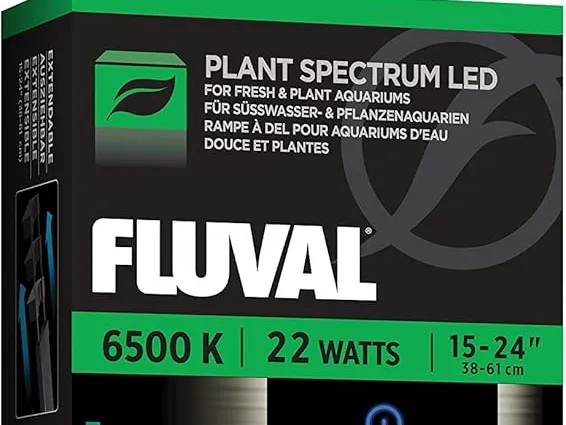
The Fluval Plant 3.0 is the light most experienced aquascapers recommend when a beginner asks "what should I buy?" - and for good reason. It pairs six independently controlled LED color channels with the free FluvalSmart Bluetooth app, giving you complete control over the spectrum, intensity, and daily cycle from your phone. You can program a gradual sunrise that ramps up over 30 minutes, hit peak intensity at midday, fade through dusk, and finish with a soft moonlight setting overnight - all without touching the fixture. Three preset configurations (Lake Malawi, Tropical, and Planted) get you growing immediately if you don't want to dial things in manually.
The 22W model covers 15 to 24 inch tanks and produces enough output to comfortably grow medium-light plants like Amazon Sword, Hygrophila, and most stem plants without CO2, while still having enough headroom (around 90-130 µmol PAR at 12 inches) to push into high-light territory if you add CO2 injection later. The 120-degree light dispersion from each diode eliminates dead spots, and the extendable mounting brackets fit a wide range of tank widths. Fluval backs it with a 3-year warranty - one of the longest in the category.
Why It's Famous: The "Set It and Forget It" Spectrum Control
What separates the Plant 3.0 from cheaper full-spectrum LEDs is that you're not stuck with whatever the manufacturer decided "full spectrum" means. Want more red to make your Ludwigia pop? Slide the red channel up. Fighting algae and need to dial back the blue? Drop it 20 percent. This level of control normally requires expensive standalone controllers - Fluval bakes it into a free app. The Plant 3.0 is also one of the few mid-range lights with an IP67 waterproof rating, so it can be mounted directly above the water surface without a glass top, giving you significantly better light penetration to substrate level.
The trade-off is price: at $149.99 for the 22W model, it's roughly 5x the cost of budget LEDs like the NICREW. If you're growing low-light plants and don't care about app control, that premium is hard to justify. But if you're serious about a planted tank and want one fixture that will scale with you from beginner to advanced setups, the Plant 3.0 pays for itself by not needing to be upgraded.
Pros | Cons |
|---|---|
|
|
hygger 55W High PAR COB LED
Pick #2 - Best High-Light for Demanding Plants
55W | 17,500 Lumens | PAR 530 µmol at 7" / 214 µmol at 12" | 5-Level Dimming | Pendant + Clip Stand
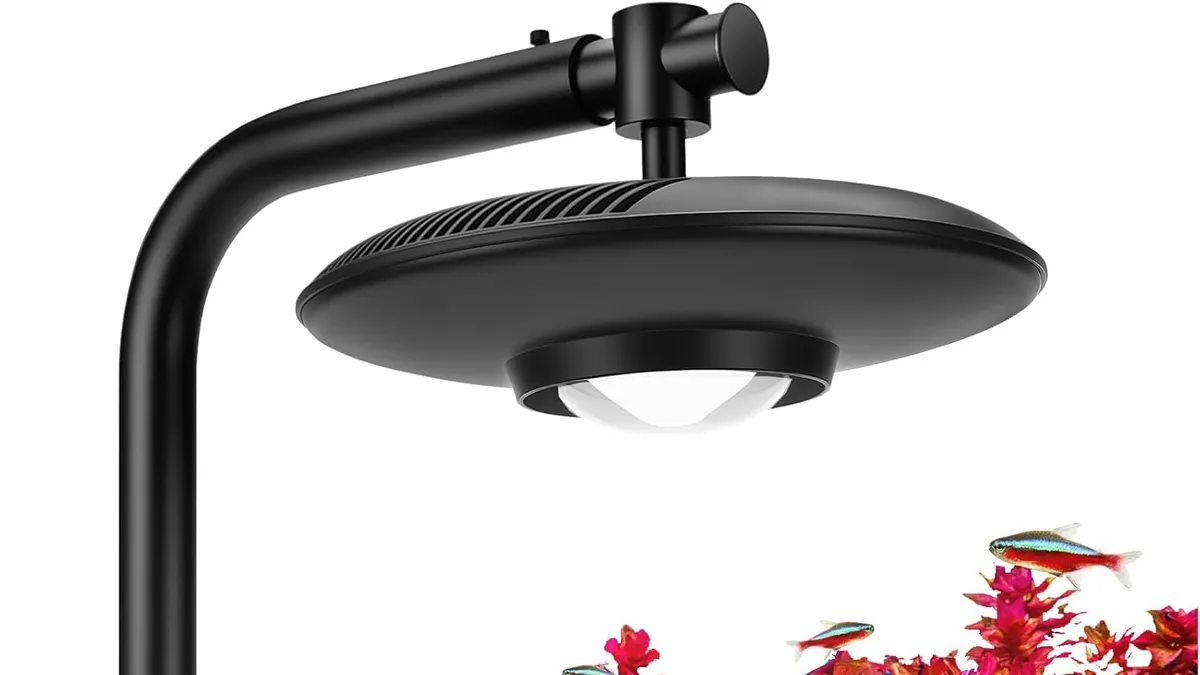
If you're growing demanding red plants, dense carpets like Monte Carlo or HC Cuba, or running a high-tech CO2-injected setup, you need real PAR - not just a bright-looking LED bar. The hygger 55W High PAR is a pendant-style COB (Chips on Board) light that delivers 530 µmol PAR at 7 inches and 214 µmol PAR at 12 inches, putting it firmly in the high-light category that supports the most demanding aquascaping plants. The COB design packs significantly more LED density into a single emitter than traditional strip LEDs, producing intense, focused light with a distinctive shimmer effect on the water surface that mimics natural sunlight reflecting off a lake floor.
The fixture comes with a premium aluminum alloy stand that adjusts from 0.5" to 16.5" above the tank and slides front-to-back from 10.4" to 13.6" for precise positioning - essential for nano and rimless tanks where placement matters as much as output. The wide clip base fits tanks with rims up to 1.8 inches thick. Five dimming levels (20% / 40% / 60% / 80% / 100%) let you ramp up gradually as your plant mass develops, and the fixture is fully compatible with any external smart plug or timer for automated scheduling. A built-in cooling fan handles the heat load from 17,500 lumens of output, keeping the fixture cool enough for long-term reliability.
Why It's Famous: True High-Light PAR at a Mid-Range Price
Most lights claiming "high light" peak at around 100-150 µmol PAR - barely enough to support demanding plants and certainly not enough to push pearling and red coloration. The hygger 55W blows past that threshold, delivering the kind of PAR you'd normally need a Chihiros WRGB II PRO or Twinstar S-series to match - at roughly half the price. The pendant style is also a major aesthetic upgrade over standard bar lights for show tanks, aquascaping competitions, and rimless display setups.
The trade-offs are real: at this PAR level, CO2 injection is mandatory. Run this light at full power without CO2 and you will get an algae explosion within two weeks. The pendant form factor also means it doesn't suit every setup - if your tank sits under a shelf or low ceiling, the stand height may not work. And with only 30 reviews on Amazon at 4.0 stars, the social proof is thinner than the more established options on this list. But if you're serious about high-light aquascaping, this is the most light-per-dollar you can buy.
Pros | Cons |
|---|---|
|
|
NICREW ClassicLED Plus
Pick #3 - Best Budget Planted Tank Light
15W | 18-24" Coverage | CRI 91 | Sunrise/Sunset Ramp | 6500K + Deep Red 660nm
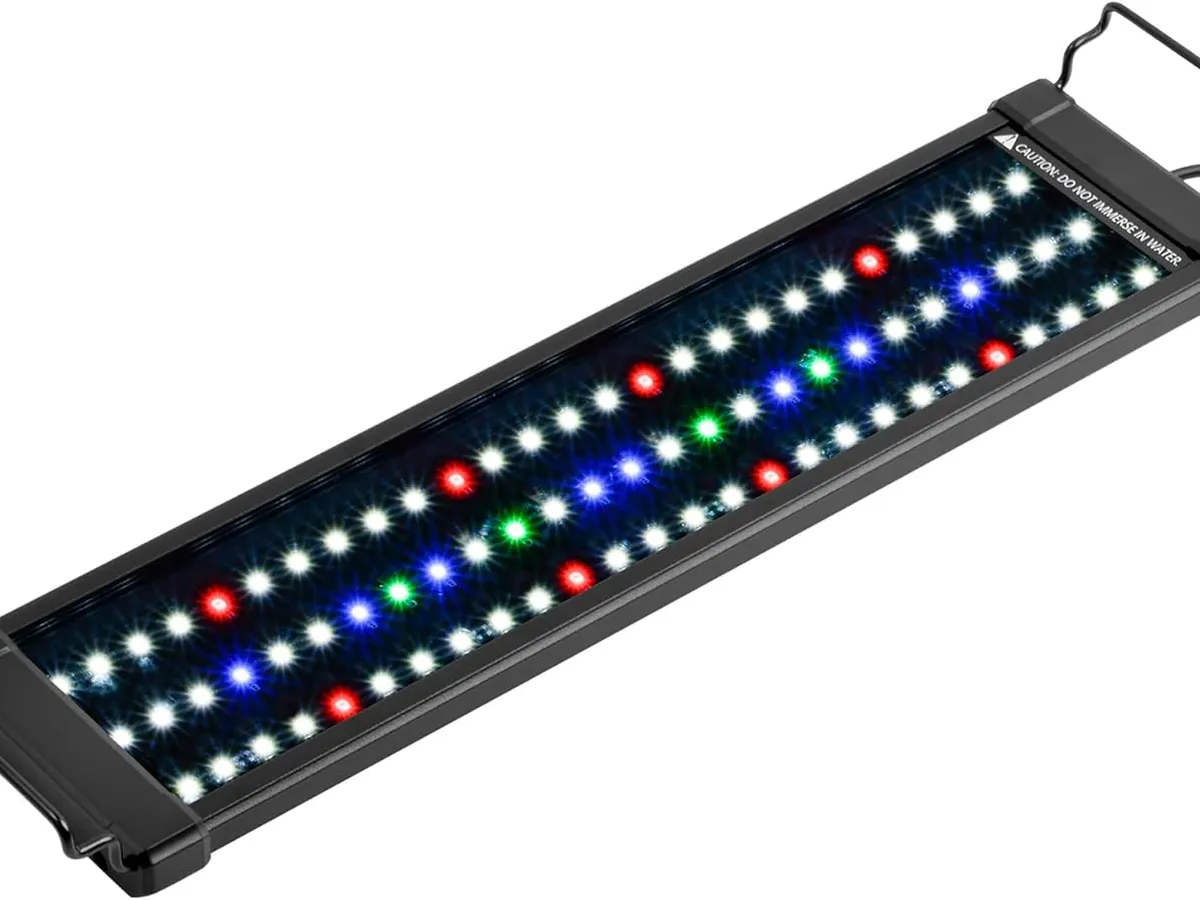
The NICREW ClassicLED Plus is the most popular budget LED in the planted tank hobby for one reason: it actually grows plants reliably at a price most beginners can stomach. At $31.99 for the 18-24" version (with larger sizes available up to 48-54" for $67.99), it costs a fraction of the premium options on this list while delivering a fine-tuned full-spectrum WRGB array that combines 6500K white, 450nm blue, true 660nm deep red, and green LEDs. The CRI of 91 is genuinely excellent - higher than many lights costing 3x more - and it produces accurate, natural color rendition that makes both fish and plants look like themselves rather than washed out or oversaturated.
This is the upgraded version of the original ClassicLED, with 25% more brightness and a built-in 15- or 30-minute sunrise and sunset ramp when paired with a NICREW timer (sold separately). Adjustable docking mounts on both sides fit most rimless and framed aquariums in seconds, and the aluminum alloy shell handles heat dissipation well enough for daily use over a glass canopy. With over 9,000 reviews averaging 4.6 stars on Amazon, it has the longest social-proof track record of any light on this list.
Why It's Famous: Real Plant Growth on a Beginner Budget
For low to medium-light plants - Anubias, Java Fern, Cryptocoryne, Amazon Sword, Hygrophila, Vallisneria, most stem plants - the NICREW ClassicLED Plus produces around 40-60 µmol PAR, which is plenty. You don't need CO2, you don't need fancy fertilizers, and you don't need to dial in spectrum settings on an app. You plug it in, set a timer for 6-8 hours, and your plants grow. For first-time planted tank keepers, that simplicity is exactly the right starting point.
The limitations are honest: this isn't a high-light fixture, and it won't grow demanding red plants, dense carpets, or anything requiring 100+ µmol PAR. If you have ambitions to grow Hemianthus callitrichoides or red Rotala, you'll outgrow this light. The spectrum-adjustable feature also only works when paired with the NICREW timer accessory - if you're using a wall switch, you only get the default white/blue mode. None of that matters for a beginner's tank with Anubias and Java Fern, which is exactly who this light is for.
Pros | Cons |
|---|---|
|
|
ONF Flat Nano+ LED
Pick #4 - Best for Nano Tanks Under 10 Gallons
15W | 1,300 Lumens | 7000K | App Controlled | IP54 Waterproof | 2-9 Gallon Rimless
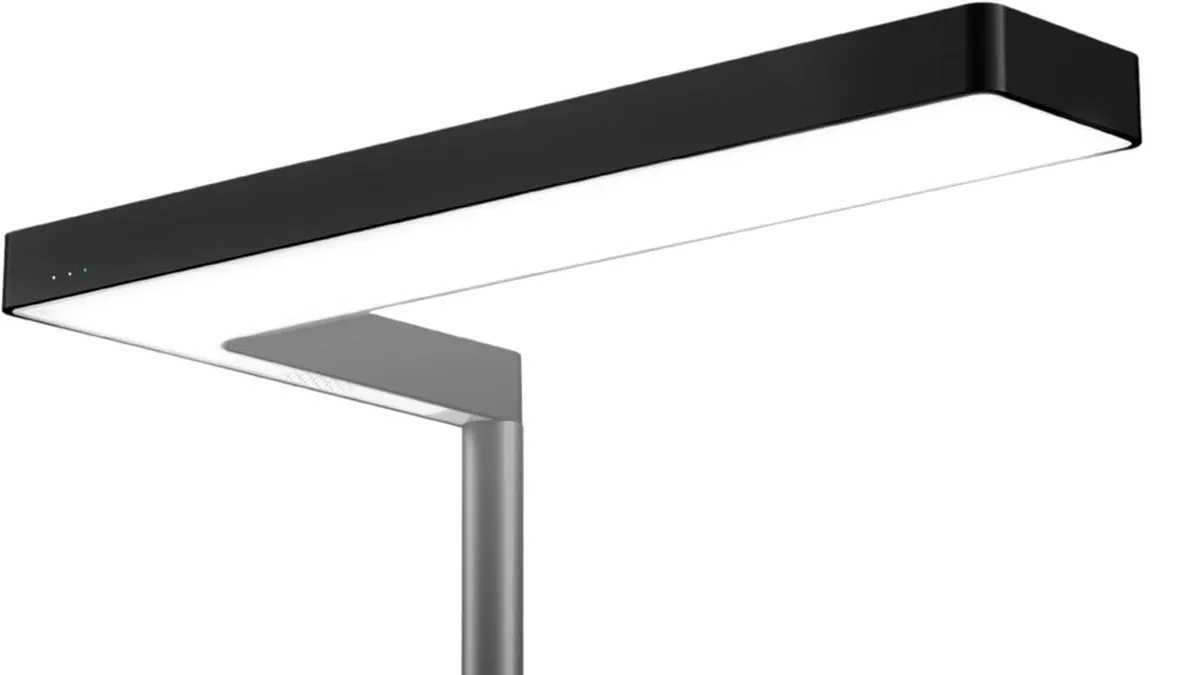
Nano tanks (anything under 10 gallons) have specific lighting needs that full-size fixtures handle poorly - they're either too long to fit, too bright for a small water volume, or built without the precise positioning a small rimless tank demands. The ONF Flat Nano+ is purpose-built for this use case. It's a 15W fixture producing 1,300 lumens of 7000K white light from a patented ColorFull LED that delivers a precisely tuned full-spectrum output - designed specifically for reviving heavily planted nano tanks where every wavelength matters.
The Flat Nano+ uses a side-clamp mount that gives you full height and angle adjustment for clean, rimless tank setups - slide the clamp to your desired height, lock it in, and you're done. The ONF Link app (iOS and Android) gives you up to 20 dimming levels, customizable daylight cycles, and up to 5 saved presets. Built-in memory means your settings persist even after the light is turned off. The IP54 waterproof rating handles splashes from water changes without issue, and the gradual ramp-up dimming feature prevents sudden light shocks to fish, shrimp, and your eyes alike.
Why It's Famous: Premium Nano Aesthetics + Real Plant Growth
Most nano tank LEDs look cheap, ship with bad spectrums, or simply don't produce enough PAR to grow anything beyond moss and Anubias. The Flat Nano+ delivers around 80-120 µmol PAR in a 5-gallon tank - enough to grow demanding nano-friendly plants like Bucephalandra, Monte Carlo, and small carpet plants. The minimalist black aluminum housing also looks the part for any high-end aquascape - Iwagumi setups, shrimp tanks, betta jars, and contest-worthy nano displays all benefit from the clean, premium aesthetic.
The price stings: at $174.99, the Flat Nano+ costs more than nearly every other light on this list while only covering tanks of 2-9 gallons. That's a serious premium for a small light. But for aquascapers who care about aesthetics as much as function - and who recognize that a nano tank lives or dies on its lighting - there's nothing else in this category that hits the same combination of build quality, app control, and plant-growing PAR.
Pros | Cons |
|---|---|
|
|
Finnex Planted+ 24/7 HLC
Pick #5 - Best Automated Day/Night Cycle
20W | 4-Bulb Cluster (Daylight/Red/Green/Blue) | True 660nm Red | Remote + IR Sensor | Weather Modes
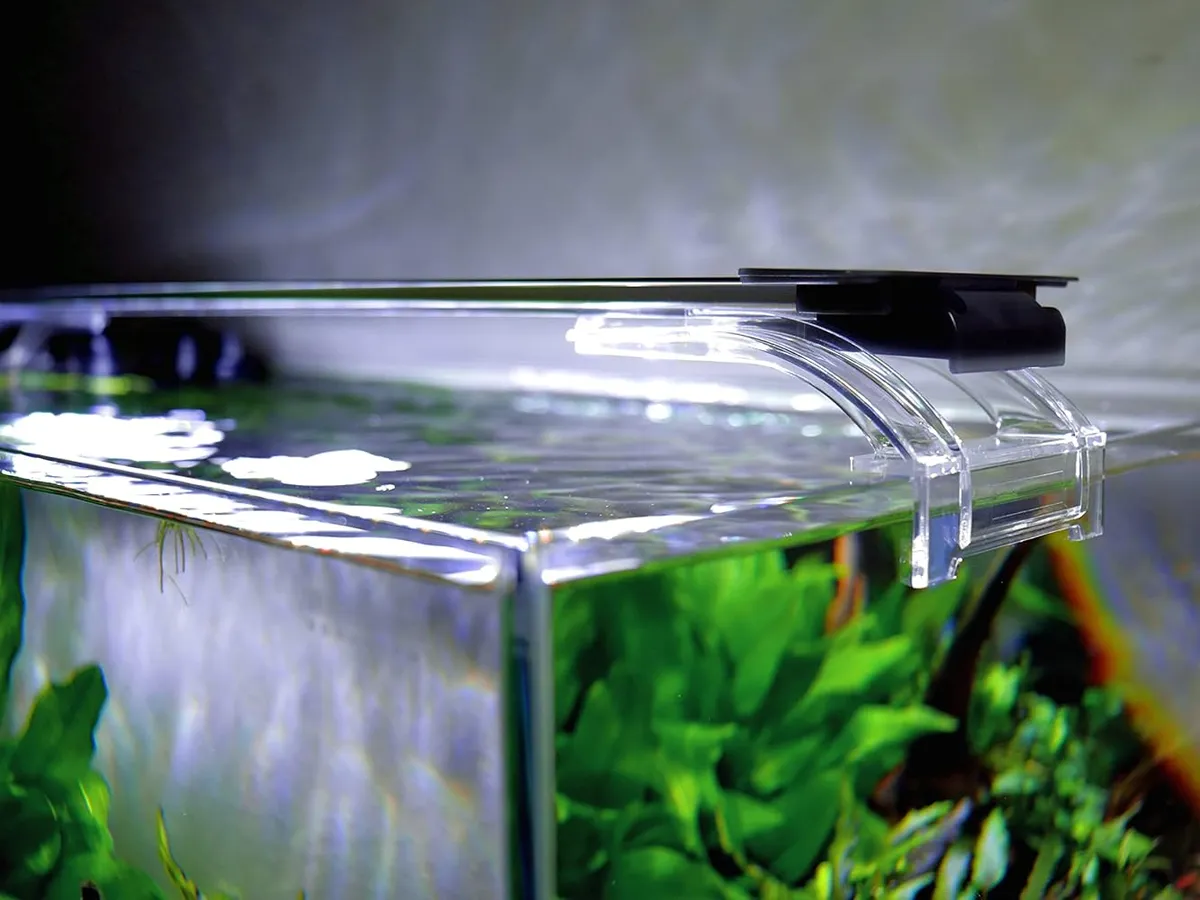
The Finnex Planted+ 24/7 HLC is the most "set it and forget it" planted tank light on this list. Its signature 24/7 mode runs a fully customizable sunrise-to-sunset program automatically every day - soft warm light at dawn, full daylight intensity at midday, gradual dimming through dusk, and a starry blue moonlight overnight. You set the program once via the included IR remote, and the light cycles through it on its own with no app, no phone, no smart plug required. For aquarists who want a hands-off planted tank, this is the most elegant control system in the category.
The HLC features a 4-bulb cluster of 8000K daylight, true 660nm deep red (the most efficient wavelength for plant photosynthesis), green, and blue LEDs. That 660nm red is the same wavelength used in horticultural grow lights and is a meaningful upgrade over the generic "warm white" found on cheaper fixtures. Four memory slots let you save your own custom color and intensity combinations, and four weather modes (Cloudy, Thunderstorm, Sunset, Starry Moon Night) add atmospheric variety for show tanks. The slim aluminum hood looks clean, and a built-in indicator sensor makes dialing in custom settings straightforward.
Why It's Famous: Truly Automated 24/7 Programming
App-controlled lights like the Fluval 3.0 are great if you actually open the app - but most people set their lights once and never touch the controls again. The Finnex 24/7 HLC is built around that reality. The 24/7 mode delivers a more natural day-night cycle than any timer-driven competitor without requiring you to think about it. The included remote is also genuinely useful - flicking between weather modes for a thunderstorm effect or a starry moonlight night creates a level of ambiance no app interface really matches.
The trade-offs are mostly about the remote-based interface. Programming custom colors via the IR remote is more fiddly than swiping through an app, and the remote can be lost over time. The PAR output (around 70-120 µmol at 12 inches) is solid for medium to medium-high light setups but won't push high-tech CO2 carpet plants the way the hygger 55W will. At $84.99 for the 20" version (24" at $94.99 and 36" at $129.99), pricing sits right in the middle of this list - and the 24/7 automation is genuinely worth it for the right user.
Pros | Cons |
|---|---|
|
|
Planted Tank LED Buying Guide: What Actually Matters
PAR vs. Lumens: The Real Brightness Metric
Lumens measure how bright a light looks to your eyes. PAR (Photosynthetically Active Radiation) measures how much usable light reaches your plants for photosynthesis - and PAR is what matters for a planted tank. A light can have impressive lumens but mediocre PAR if its spectrum is wrong. When comparing planted tank lights, always look for PAR data measured at the depth of your tank (typically 12-18 inches). For low-light plants, you need 20-50 µmol PAR. For medium-light, aim for 50-100 µmol. For high-light demanding plants like red carpets and stem plants, you need 100-200+ µmol at substrate level.
Matching Light to Your Plant Selection
Low light (20-50 µmol PAR): Anubias, Java Fern, Java Moss, Cryptocoryne, Vallisneria, Bucephalandra. These plants tolerate and thrive under modest lighting. CO2 injection is optional. Budget lights like the NICREW ClassicLED Plus are sufficient. This is the easiest level for beginners.
Medium light (50-100 µmol PAR): Amazon Sword, Hygrophila, Ludwigia, Pogostemon, Staurogyne, most stem plants. These plants grow noticeably faster with more light and benefit from CO2 supplementation. The Fluval Plant 3.0 and Finnex Planted+ 24/7 HLC are ideal for this range.
High light (100-200+ µmol PAR): Carpet plants (HC, Monte Carlo, DHG), red plants (Rotala, Alternanthera), demanding stem plants. CO2 injection is mandatory at this level, along with comprehensive macro and micro fertilization. The hygger 55W High PAR is built for this category.
Spectrum: Why Full Spectrum + Red Matters
Plants primarily use red (around 660nm) and blue (around 450nm) wavelengths for photosynthesis, with some additional use of green for deeper leaf penetration. A genuine "full spectrum" light covers all of these. Cheap LEDs that lean heavily on white and blue look bright but lack the red wavelengths plants need to thrive - and excess blue actually promotes algae growth. Look for fixtures that explicitly include 660nm deep red LEDs (like the Finnex HLC and NICREW ClassicLED Plus) or that let you adjust the red channel manually (Fluval Plant 3.0).
Photoperiod: How Long Should the Light Be On?
Most planted tanks thrive on 6-8 hours of light per day. Running lights longer than 10 hours doesn't grow plants faster - it just gives algae more time to bloom. If you want to view your tank in both morning and evening, use a split photoperiod: 4 hours in the morning, a 4-hour dark break midday, and 4 hours in the evening. This reduces algae pressure while maximizing your viewing time. Lights with built-in 24/7 cycles (Finnex HLC) and app-controlled programmable timers (Fluval Plant 3.0, ONF Flat Nano+) make this easy to set up.
CO2: When You Need It and When You Don't
The biggest mistake new planted tank keepers make is buying a powerful light without CO2 injection. High light + no CO2 = algae explosion, every time. If you don't plan to inject CO2, stick to low- or medium-light plants and lights producing under 100 µmol PAR. If you're running a high-PAR fixture like the hygger 55W, CO2 is non-negotiable. A liquid carbon supplement (like Seachem Excel) is a lower-effort middle-ground option for medium-light setups.
Conclusion:
The right choice depends on your tank size, plant selection, and how hands-on you want to be. The Fluval Plant 3.0 is the best overall light for hobbyists who want app-controlled spectrum and a fixture that scales from beginner to advanced. The hygger 55W High PAR is the most light-per-dollar for high-tech CO2 setups growing demanding plants. The NICREW ClassicLED Plus is the unbeatable budget pick for low to medium-light beginner tanks. The ONF Flat Nano+ is the premium choice for nano aquascaping where build quality and aesthetics matter as much as function. And the Finnex Planted+ 24/7 HLC is the most elegant set-it-and-forget-it option with its automated day-night cycle.
The right light transforms a planted tank from struggling to thriving - pick the one that matches your plants, your budget, and your patience for tinkering, and your aquarium will reward you for years.
Frequently Asked Questions
Q1: How many watts do I need for a planted aquarium?
A: Watts measure energy consumption, not light output, so they're not a great metric on their own. As a rough guideline for full-spectrum LEDs, aim for 0.5-1 watt per gallon for low-light plants, 1-2 watts per gallon for medium-light, and 2+ watts per gallon for high-light setups with CO2. PAR readings at your tank's depth are a far more accurate metric than wattage alone.
Q2: Can I grow plants with a standard aquarium kit LED?
A: The basic LED strip that comes with most aquarium starter kits typically produces 15-30 µmol PAR - enough for very low-light plants like Anubias, Java Fern, and Java Moss, but insufficient for most other species. Upgrading to a dedicated planted tank light is essential if you want to grow a variety of plants. The NICREW ClassicLED Plus at $31.99 is the most affordable upgrade that makes a noticeable difference.
Q3: Do I need CO2 for a planted tank?
Not necessarily - but it depends on your plant selection and light intensity. Low-light plants like Anubias, Java Fern, and Cryptocoryne grow fine without CO2 under low to medium-light fixtures. If you're running a high-PAR light or growing demanding species like carpet plants and red stem plants, CO2 injection is essentially required to prevent algae from outcompeting your plants.
Q4: How long should I run my planted tank light each day?
A: Most planted tanks do best with 6-8 hours of light per day. Beginners often run lights for 12+ hours thinking more is better - it isn't. Excessive light hours fuel algae growth without proportionally benefiting plants. If you want longer viewing time, use a split photoperiod with a 4-hour dark break in the middle of the day.
Affiliate Disclosure: This post contains affiliate links. If you purchase a product through one of these links, we may earn a small commission at no additional cost to you. All opinions expressed are our own.