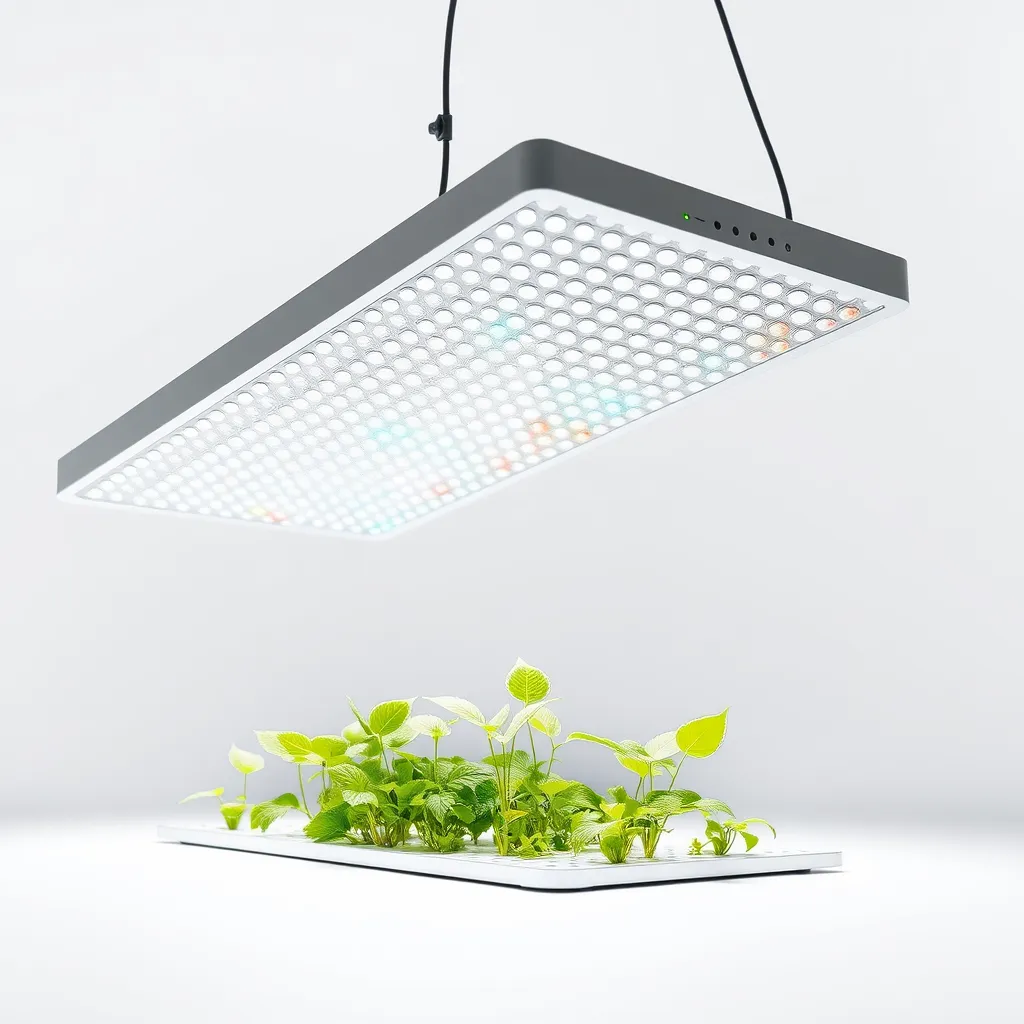
The single most important decision for a 4×4 grow tent isn't the soil, the nutrients, or the fans - it's the light hanging over the canopy. A 4×4 gives you 16 square feet of growing area, and the right LED determines whether all of it produces dense, even growth or whether your plants thrive under a bright center while the corners starve. The fix isn't simply buying the highest-wattage panel you can find - it's matching efficient, full-spectrum light with even coverage to the space: enough PPFD to drive flowering without scorching the tops, spread uniformly from wall to wall. We picked the best LED grow lights for a 4×4 tent across every budget and grow style - from value all-rounders to premium bar lights - judging each on actual wattage, efficiency (µmol/J), PPFD and coverage uniformity, dimming and control, build quality, and real-world value, so you can light all 16 square feet evenly and get the most out of every cycle.
Product | Best For | Type | Key Feature | Price | |
|---|---|---|---|---|---|
Spider Farmer SF-4000 | Best Overall / Value | Quantum-board LED | 450W, 2.7 µmol/J, dimmable | ~$340 | |
AC Infinity IONFRAME EVO6 | Best Premium / Efficiency | Bar-style LED + controller | Samsung LM301H EVO, 1991 PPFD | $579 | |
Mars Hydro TS3000 | Best Budget | Quantum-board LED | 420W, 1210 µmol/s, daisy chain | ~$250 | |
VIVOSUN VS4000 | Best for Beginners | Quantum-board LED | 400W, 2.9 µmol/J, dimmable | ~$256 | |
VIVOSUN VSFL6450 | Best High-Output / Max Yield | 6-bar foldable LED | 645W, full spectrum + UV/FR | ~$300 |
Spider Farmer SF-4000 LED Grow Light
Pick #1 - Best Overall for a 4×4 Tent
450W | 2.7 µmol/J | Full Spectrum (3000K / 5000K / 660nm / IR 760nm) | Dimmable + GGS-Compatible | Fanless | 5-Year Warranty
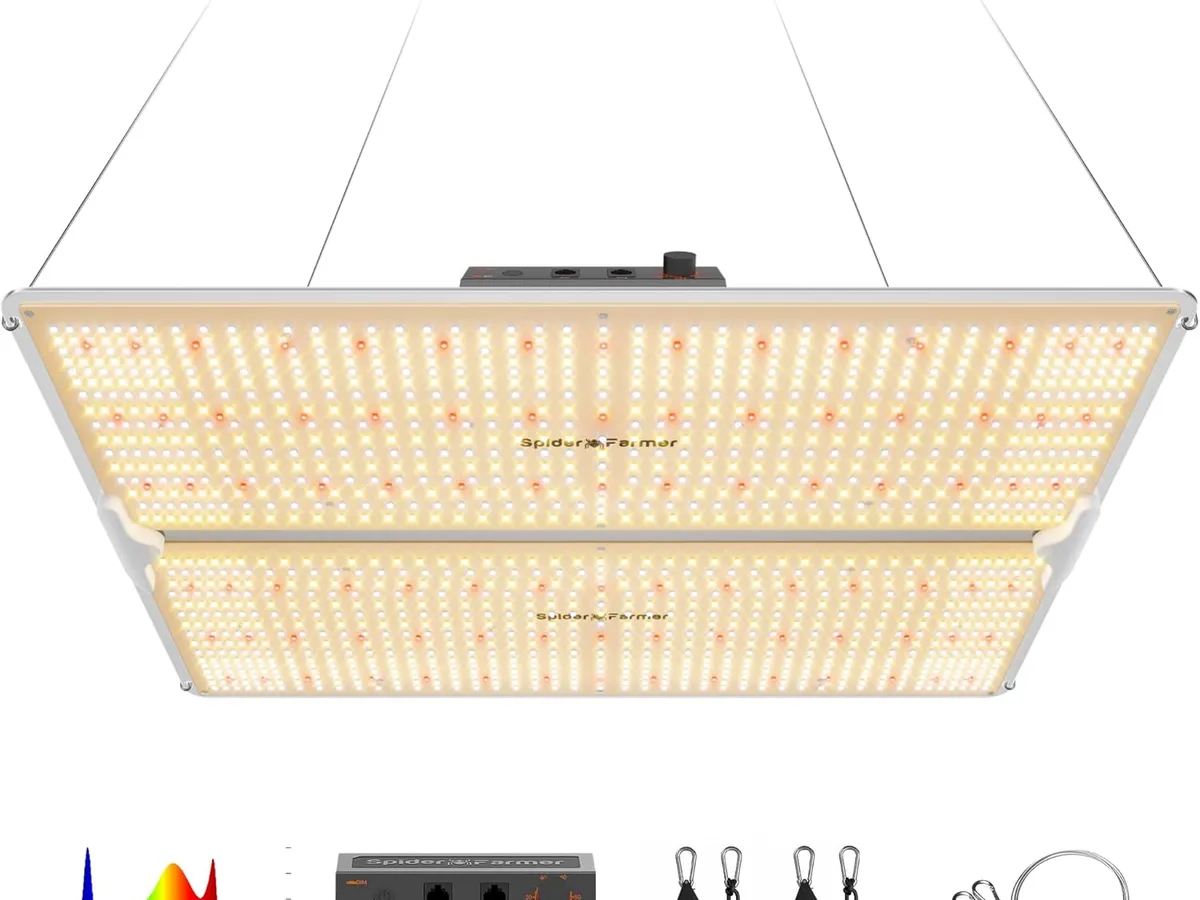
The Spider Farmer SF-4000 is the light most growers should buy for a 4×4, and the reason is balance: it puts genuine quantum-board performance over a full 4×4 flowering footprint without the premium price of a commercial bar fixture. At roughly $340 for the 4×4 model, it draws 450W actual power at 2.7 µmol/J efficiency, and its wide, flat board spreads diodes edge-to-edge so PPFD stays even across the canopy instead of spiking in the center. The 2026 version weights its diodes toward the edges specifically to flatten that PPFD curve, which is exactly what you want when you're trying to fill all 16 square feet evenly. With a 4.6-star average across more than 12,000 reviews, it's also one of the most proven lights on the market.
Day to day, it's easy to live with. A single dimming knob takes intensity from 10% to 100%, and the light is compatible with Spider Farmer's GGS controller for scheduled on/off cycling, sunrise/sunset dimming, and unified multi-light control if you expand later. The fanless design means it runs silent with nothing to fail mechanically, the thick aluminum heatsink keeps temperatures in check, and Spider Farmer backs it with a 5-year warranty serviced through regional centers. The full spectrum - white plus 660nm deep red and IR - covers seedlings through flower, with the red and IR pushing bloom.
Why It's Our Top Pick: The Best Performance-Per-Dollar for 4×4
Plenty of lights are cheaper and a few are more efficient, but the SF-4000 sits at the intersection of price, coverage, and reliability that suits the most growers. It delivers premium-tier diode performance and a flat, edge-weighted PPFD map sized precisely for a 4×4 flower canopy, at a price well below commercial bar lights. The fanless build removes the most common failure point, the dimmer plus optional controller covers everyone from hobbyists to multi-light setups, and the long warranty plus enormous review base make it a low-risk buy. For a first serious 4×4 light, this is the default recommendation.
Pros | Cons |
|---|---|
Edge-weighted diode layout for uniform 4×4 PPFD | 4×4 model costs more than budget boards (~$340) |
Fanless, silent design with a thick aluminum heatsink | App/smart control needs the separately sold GGS controller |
Dimmable knob plus controller support and multi-light daisy chaining | Best flowering coverage is 4×4; veg footprint runs larger |
Full spectrum (white + 660nm + IR) for veg through bloom | |
4.6-star average across 12,000+ reviews and a 5-year warranty |
AC Infinity IONFRAME EVO6 LED Grow Light
Pick #2 - Best Premium / Best Efficiency
500W | Samsung LM301H EVO (3.14 µmol/J per diode) | 1680 Diodes | 1991 PPFD | 4×4 Flower / 5×5 Veg | Schedule Controller Included
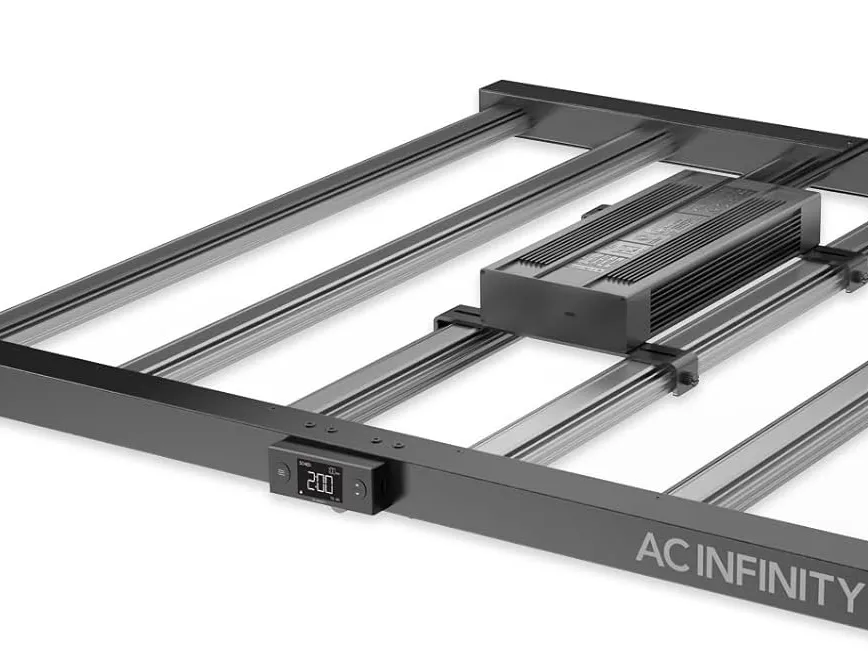
If you want the best light a 4×4 can take and don't mind paying for it, the AC Infinity IONFRAME EVO6 is the pick. It uses top-bin Samsung LM301H EVO diodes rated at 3.14 µmol/J per diode - the most efficient chips in this roundup - across a bar-style fixture with 1680 diodes that hits up to 1991 PPFD over a 4×4 flowering footprint (5×5 for veg). The bar layout, with algorithmically spaced diodes, is what separates it from board-style panels: light arrives more evenly across the canopy with deeper penetration and fewer hot spots. It's an Amazon's Choice pick at a 4.7-star average and is ETL certified.
It's also the most capable on control, and the schedule controller is included rather than an add-on. You get sunrise/sunset dimming, 10 brightness levels, and WiFi app control through AC Infinity's UIS platform, plus daisy-chaining for up to 80 fixtures if you scale into multiple tents. The LED driver is removable so you can mount it outside the tent to balance heat, and the steel-and-aluminum build feels a tier above typical consumer panels. At $579 it's the priciest light here, but it's also the one that earns its keep through efficiency and automation.
Why It's Worth the Premium: The Efficiency and Control Leader
The EVO6's case is simple: the most efficient diodes, the most even bar-style coverage, and the only fixture here that ships with a full smart controller in the box. Over many cycles, higher efficiency means more usable photons per watt and lower running costs, while the included scheduling, sunrise/sunset ramps, and app control turn it into a near-automated system. It's overkill for a casual single-plant grow, but for a serious grower who wants maximum, even output across a 4×4 with set-and-forget control, nothing else here matches it.
Pros | Cons |
|---|---|
Top-bin Samsung LM301H EVO diodes - the efficiency leader here | Most expensive pick at $579 |
Schedule controller included: sunrise/sunset, 10 levels, WiFi app | Rated 4×4 flower / 5×5 veg - don't over-drive a small tent |
Bar layout gives very even coverage and deep penetration (1991 PPFD) | Premium price is overkill for casual single-plant grows |
Removable driver for heat management; daisy-chain up to 80 lights | |
ETL certified, Amazon's Choice, 4.7-star average |
Mars Hydro TS3000 LED Grow Light
Pick #3 - Best Budget
420W | 1210 µmol/s PPF | 2.7 µmol/J | 1016 Diodes | 4×4 Bloom / 5×5 Veg | Dimmable 0-100% + Daisy Chain
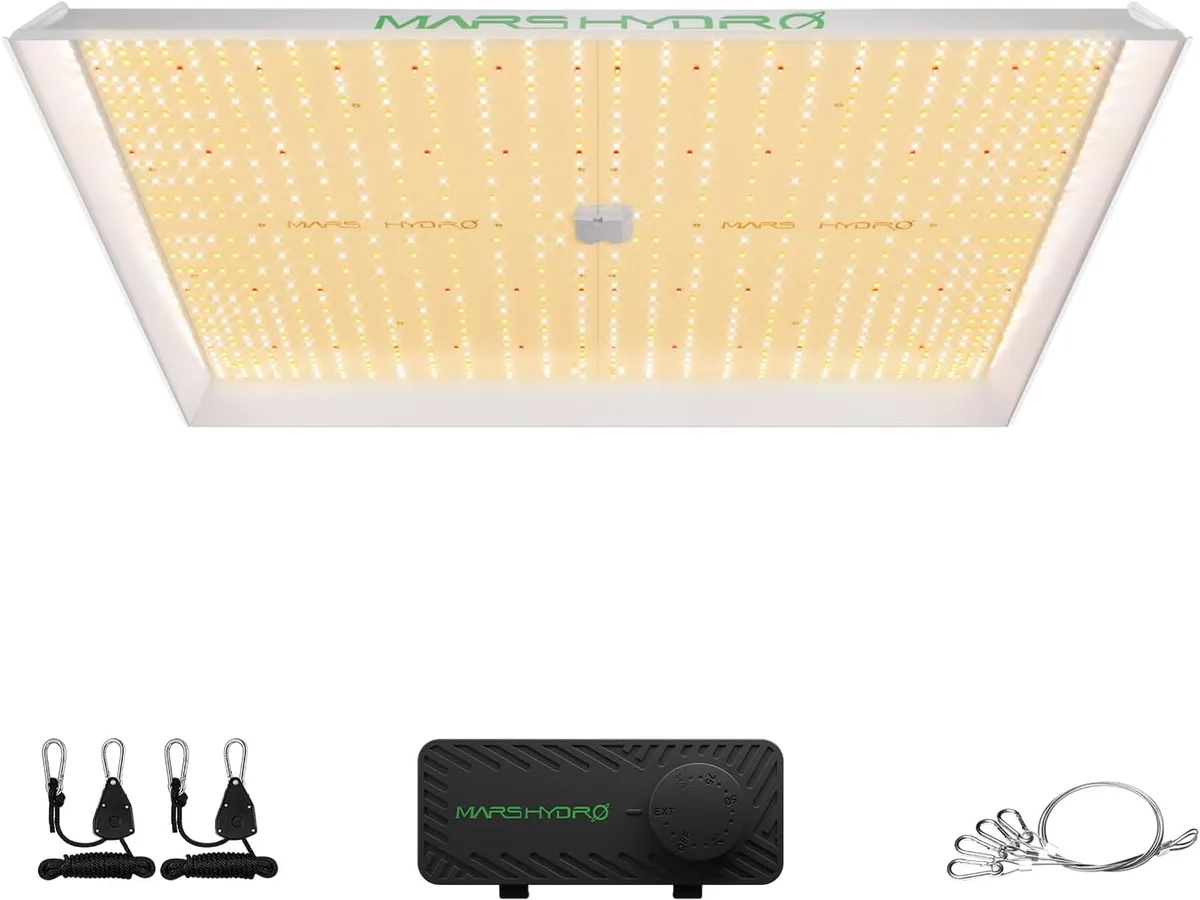
The Mars Hydro TS3000 is the budget pick that actually covers a 4×4 - unlike smaller, cheaper panels that quietly downgrade to a 3×3 flowering footprint. At around $250 it draws 420W and pushes 1210 µmol/s of total PPF at 2.7 µmol/J, enough to handle a full 4×4 bloom and a 5×5 veg. It's one of the most popular grow lights on Amazon, with a 4.6-star average across more than 20,000 reviews and an Amazon's Choice badge, and Mars Hydro positions it as a direct replacement for a 600W HPS at roughly 40% less power draw.
For the money, the feature set is generous. The patented reflective aluminum hood with a 120° refraction angle widens coverage and lifts intensity, the power supply is removable on a 2-meter cord so you can keep its heat outside the tent, and the dimmer runs 0-100%. You can daisy-chain up to 30 units, and the upgraded 2-in-1 dimmer box accepts a separately sold Mars Hydro controller for WiFi/Bluetooth app scheduling and sunrise/sunset dimming when you're ready. It's a proven, no-drama workhorse for first builds and cost-conscious grows.
Why It's a Smart Buy: True 4×4 Coverage on a Budget
Most cheap lights fail the 4×4 test because they're really 3×3 flowering panels with optimistic marketing. The TS3000 is the exception - it genuinely fills a 4×4 bloom canopy while costing far less than the premium picks. You give up the ultra-even bar layout and the top-bin EVO diodes, but you get a reflector hood that boosts intensity, full 0-100% dimming, daisy-chaining, and an upgrade path to app control. Backed by tens of thousands of reviews, it's the safest low-cost entry point into a properly lit 4×4.
Pros | Cons |
|---|---|
True 4×4 bloom coverage at a budget price (~$250) | Older board-style design - less edge-even than premium bar lights |
1210 µmol/s PPF at 2.7 µmol/J; replaces a 600W HPS for ~40% less power | WiFi/app control requires a separately sold Mars Hydro controller |
Dimmable 0-100% and daisy-chainable up to 30 lights | 420W is plenty for 4×4 bloom but not a max-yield/CO2 light |
Removable power supply with 2m cord keeps heat out of the tent | |
4.6-star average across 20,000+ reviews, Amazon's Choice |
VIVOSUN VS4000 LED Grow Light
Pick #4 - Best for Beginners
400W | 2.9 µmol/J | Full Spectrum | 4×4 (5×5 Max) | Dimmable 25-100% | Fanless | 5-Year Warranty
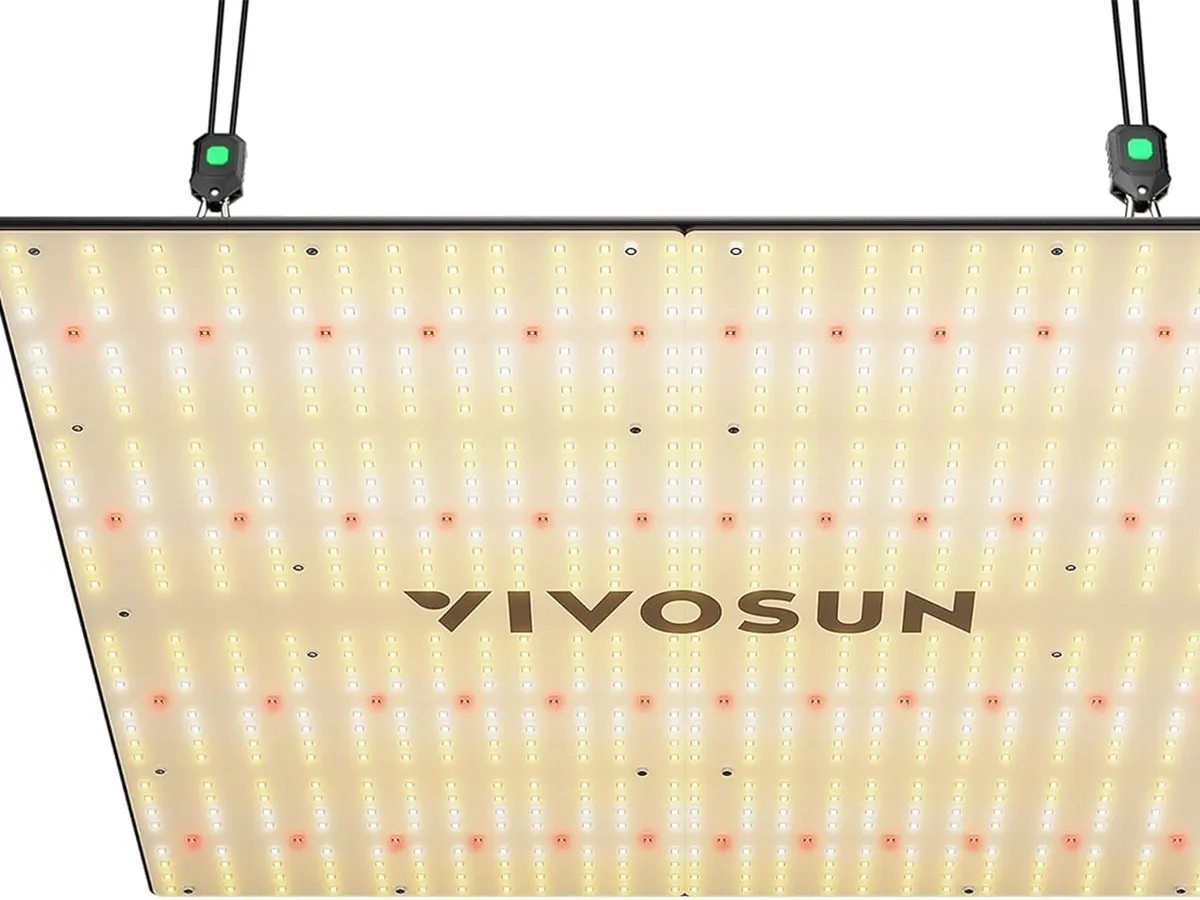
The VIVOSUN VS4000 is the easiest light here to get growing with, which makes it the pick for first-time 4×4 owners. It's a fanless full-spectrum board that draws just 400W at 2.9 µmol/J efficiency and covers a 4×4 (5×5 max), with a simple dimming knob and ballast that adjusts output from 25% to 100% as your plants move from seedling to flower. There's nothing to configure and nothing to learn - hang it, plug it in, set the dimmer. It carries a 4.5-star average, an Amazon's Choice badge, and frequently sells around $256, down from a $360 list.
The beginner-friendly details add up. Because it's fanless, it runs silent and produces very little ambient heat, so there's no fan to clog or fail and less risk of cooking young plants. VIVOSUN includes its US-patented rope hangers for quick mounting and backs the light with a 5-year after-sales service. It skips the smart controllers and app scheduling of the pricier picks, but that's the point - it's a clean, reliable, low-maintenance way to light a 4×4 without a learning curve.
Why It's Great for First-Time Growers: Plug In, Dim, Grow
New growers don't need 80-light daisy chains or app recipes - they need a dependable light that covers the tent and won't overheat the plants. The VS4000 delivers exactly that: solid 2.9 µmol/J efficiency, full-spectrum coverage across a 4×4, silent fanless operation, and a single dimmer to dial in intensity. Add the frequent discount and a 5-year warranty, and it's a low-risk, low-stress entry point. Step up to a bar light later if you catch the upgrade bug.
Pros | Cons |
|---|---|
Simple plug-and-dim design ideal for first-time 4×4 growers | No built-in smart/app control or scheduling |
2.9 µmol/J efficiency at only 400W draw | 400W suits 4×4 better than pushing a full 5×5 hard |
Fanless: silent, low heat, nothing mechanical to fail | Listing naming varies (VS4000 / "LumaLight") - confirm the 4×4 400W variant |
Often discounted (~$256, down from $360) with a 5-year warranty | |
Full-spectrum coverage across a 4×4 (5×5 max), 4.5-star average |
VIVOSUN VSFL6450 Bar LED Grow Light
Pick #5 - Best High-Output / Max Yield
645W | 2.8 µmol/J | 6-Bar Foldable | Full Spectrum 380-780nm + UV/FR | Daisy Chain (up to 160) | GrowHub Compatible
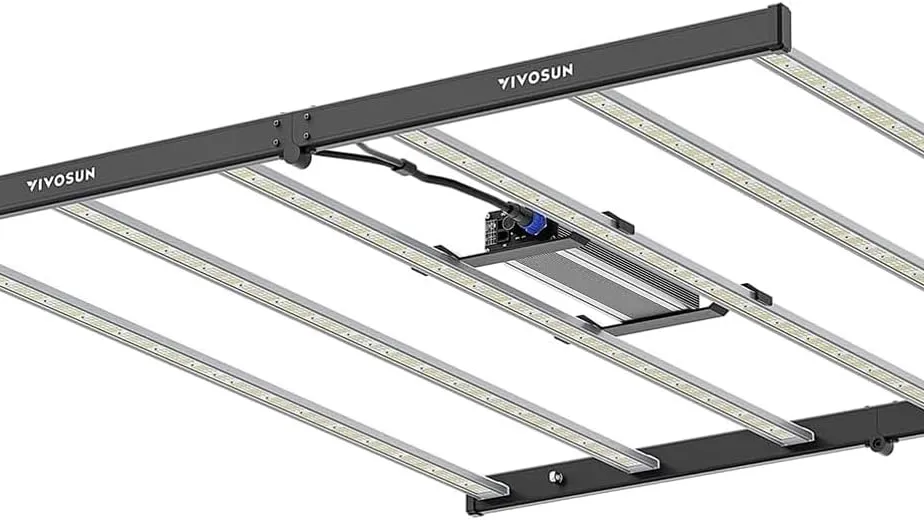
For growers chasing maximum yield - especially with CO2 supplementation - the VIVOSUN VSFL6450 is the high-output option. It's a 6-bar fixture pushing 645W at 2.8 µmol/J with a dense, uniform PAR map and a true full spectrum spanning 380-780nm, including 450nm blue, 660nm deep red, 730nm far-red, and supplemental UVA. That UV/FR coverage is what separates a yield-focused light from a basic panel: blue and UVA support compact, healthy growth, while deep red and far-red push flowering and potency. At around $300 it's an aggressive price for this much output.
The flagship version is rated for 5×5, so for a strict 4×4 you can run it dialed back or step down to one of the same listing's 4×4 variants (430W, 450W, and 500W options). Practical touches include a foldable frame and detachable power supply for easy install, storage, and cooler running, six dimming modes (40/50/60/80/100% plus EXT) via knob or the GrowHub controller, and daisy-chaining up to 160 lights. It's the newest light here with fewer reviews, but its spec sheet is built for serious output.
Why It's the Yield Pick: Big, Even Output with a Full Spectrum
When light is no longer your limiting factor - meaning you've added CO2 and dialed in your environment - extra, even PPFD is what drives bigger harvests, and that's where the VSFL6450 shines. The 6-bar layout spreads 645W evenly with deep penetration, the 380-780nm spectrum with UV and far-red targets flowering and quality, and the foldable, detachable-driver design keeps it manageable. For a 4×4 specifically, grab a 4×4-rated variant from the listing or run the 645W version below full power; either way, it's the most output-oriented light in this roundup.
Pros | Cons |
|---|---|
High 645W output with a dense, uniform 6-bar PAR map for max yield | Flagship 645W version is rated 5×5 - size down to a 4×4 variant for a tight tent |
Full spectrum 380-780nm including UVA and far-red | High output really pays off only with CO2 supplementation |
Foldable design and detachable driver for easy install and cooler running | Newer listing with fewer reviews than the established picks |
6 dimming modes and daisy-chaining up to 160 lights; GrowHub app | |
Multiple sizes on one listing (4×4 430W / 450W / 500W variants) |
4×4 Grow Light Buying Guide: What to Look For
Wattage vs. Efficiency: Why µmol/J Matters More Than Watts
The common rule of thumb is 30-50 watts of actual LED power per square foot, which puts a 4×4 (16 sq ft) at roughly 480-800W. But raw wattage is the wrong thing to fixate on - efficiency matters more. A highly efficient light at 2.7+ µmol/J (like the SF-4000 or the EVO6) produces more usable photons than an inefficient light pulling 600W. Always check the actual wattage at the wall, not the inflated "HID equivalent" number, and use efficiency (µmol/J) as your real comparison metric. A 400-500W light from a reputable brand is the sweet spot for most 4×4 grows without CO2.
PPFD and Coverage: How Much Light a 4×4 Actually Needs
PPFD - the photon density hitting your canopy - is what your plants actually respond to. Target roughly 400-600 µmol/m²/s during vegetative growth and 800-1200 µmol/m²/s during flowering. Once you push past about 1000 µmol/m²/s, you generally need CO2 supplementation to see further gains; without CO2, diminishing returns set in around 800 µmol/m²/s, which is why a 400-500W high-efficiency light is ideal for most non-CO2 setups. Just as important is where that light lands: a light that reads 1200 in the center but only 400 in the corners underperforms an even 800 across the whole tent.
Uniformity: Even Light Beats a Bright Center
Plants at the edges of a 4×4 receive whatever light reaches the corners, and weak corners drag down your total yield. Check the manufacturer's PPFD map - a grid of readings across the footprint - and look at the ratio between the center and the corners. A 3:1 ratio is the worst you'd want to accept; premium lights hit 2:1 or better. This is where bar-style fixtures (like the EVO6 and VSFL6450) and wide edge-weighted boards (like the SF-4000) earn their keep: spreading diodes over a larger area produces flatter, more even coverage than a compact panel that concentrates output in the middle.
Dimming, Daisy-Chaining, and Smart Control
Dimming isn't a luxury - it's how you match intensity to growth stage, lower output for seedlings and clones, and tune PPFD to your environment. Every light here dims; the difference is whether control is a simple knob (SF-4000, TS3000, VS4000) or a full controller with scheduling, sunrise/sunset ramps, and app access (the EVO6 ships with one; Mars Hydro and VIVOSUN offer add-on controllers). Daisy-chaining lets one master light control several at once - useful if you expand beyond a single tent. Decide whether knob-simple or app-automated fits how you grow.
Hanging Height and Avoiding Light Burn
Most 400-500W LEDs hang about 18-24 inches above the canopy in flower and 24-30 inches in veg. Start at the manufacturer's recommended height and watch the plants: if leaf tips curl up ("tacoing") or bleach white, the light is too close - raise it 2-4 inches. If plants stretch with long gaps between nodes, lower it. Raising a light improves uniformity (wider spread) but reduces peak intensity, so use the dimmer to fine-tune intensity at your preferred height rather than parking the fixture too close.
Heat, Noise, and Build Quality
Fanless lights (the SF-4000 and VS4000) run silent with no fan to fail or clog, relying on an aluminum heatsink - ideal for tents where noise and dust matter. A removable or detachable driver (found on the EVO6, TS3000, and VSFL6450) lets you mount the hottest component outside the tent to keep canopy temperatures down. Look for solid aluminum construction, branded drivers (MeanWell, Inventronics, Sosen), proper certification (ETL), and a multi-year warranty - the small things that separate a light that lasts many cycles from one that quietly degrades.
Conclusion:
Choosing the right LED for your 4x4 tent is a balancing act between raw power and light distribution. While it is tempting to chase the highest wattage available, the real victory in a 16-square-foot space comes from achieving uniform coverage. A light that maintains consistent intensity from the center to the very edges of the tent will always outperform a high-wattage panel that creates a single hot spot.
Before making your final choice, consider your long-term goals for the space. If you plan to scale up or want maximum control, investing in a bar-style light with an integrated smart controller offers the most flexibility. However, for most home growers, a high-quality quantum board provides the perfect middle ground of efficiency and ease of use. Focus on reliable brands with proven warranties to ensure your investment keeps your canopy thriving for many seasons to come.
Frequently Asked Questions:
Q1: How many watts do I need for a 4×4 grow tent?
A: The rule of thumb is 30-50 watts of actual LED power per square foot, so a 4×4 (16 sq ft) lands around 480-800W on paper. In practice, efficiency matters more than raw wattage: a 400-500W light at 2.7+ µmol/J (like the SF-4000 or EVO6) outperforms an inefficient 600W panel. Use the actual wall wattage and µmol/J for comparison, not the inflated "HID equivalent" figure, and aim for 400-500W for a non-CO2 grow.
Q2: What PPFD should a 4×4 tent have?
A: Target roughly 400-600 µmol/m²/s during vegetative growth and 800-1200 µmol/m²/s during flowering. Above about 1000 µmol/m²/s you'll generally need CO2 to keep seeing gains; without CO2, returns taper off around 800. Just as important, check the maker's PPFD map so the corners aren't starved - even 800 across the whole tent beats 1200 in the center with weak edges.
Q3: Should I use one big light or two smaller lights for a 4×4?
A: One quality light is simpler and usually cheaper. Two smaller lights (for example, two 2×4 fixtures) overlap in the middle to fill what would be a single panel's weakest zone, and they add redundancy plus independent dimming - if one fails, the tent isn't dark. The trade-off is typically 10-20% more cost and a bit more wiring. For most growers, one well-chosen 4×4 light is the easier path.
Q4: How high should I hang my LED in a 4×4 tent?
A: Around 18-24 inches above the canopy during flowering and 24-30 inches during veg, then adjust based on the plants. If leaf tips curl up or bleach white, raise the light 2-4 inches; if plants stretch with long internodes, lower it. Raising the light improves uniformity but lowers peak intensity, so use the dimmer to fine-tune intensity at your chosen height.
Q5: Do I need CO2 for a 4×4 tent?
A: It's optional and only worth it if your light delivers more than about 800-1000 µmol/m²/s at canopy level. Below that, plants can't use extra CO2 because light is the limiting factor. Above it, supplementing CO2 to roughly 1200-1500 ppm can add 20-30% to yields - which is when a high-output light like the VSFL6450 starts to pay off. CO2 systems add cost and complexity, so most hobby growers do fine without one.