Commercial cultivators, greenhouse operators, and serious vertical farming setups have very different lighting needs than weekend hobbyists. You're not optimizing a 2x2 herb corner - you're calculating fixture-to-canopy ratios across hundreds of square feet, projecting electricity costs over multi-year ROI windows, and looking for commercial LED horticulture lighting that scales by the dozen. We spent weeks researching the top horticultural LED fixtures on Amazon - evaluating photon output, system efficacy, build quality, smart fleet management features, and total cost of ownership at scale - so you can equip your operation with the best LED horticulture lights that actually deliver a return.
Modern LED horticulture lighting has surpassed legacy HPS fixtures across every metric that matters at commercial scale: 30-50% lower electricity consumption per photon delivered, 50,000+ hour lifespans versus 10,000 for HPS bulbs, dramatically less radiant heat to cool, and tunable spectra that legacy lighting simply can't match. Every horticultural LED fixture on this list is built for serious indoor cultivation lighting work - purpose-engineered for greenhouses, vertical farms, and commercial cultivation cells.
Light | Best For | Power | Coverage | Efficiency | Price | |
|---|---|---|---|---|---|---|
AC Infinity IONFRAME EVO6 | Pro 4×4 Cultivation | 500W | 4×4 ft | 3.14 µmol/J* | $579 | |
Spider Farmer G8600 | Cost-Effective Commercial | 800W | 5×5 ft | 2.85 µmol/J | $419 | |
VIVOSUN VSFL6450 | Best Value Commercial 5×5 | 645W | 5×5 ft | 2.8 µmol/J | $379 | |
Spider Farmer SE3000 | Vertical Farming Cells | 300W | 3×3 ft | 2.85 µmol/J | $249 | |
Mars Hydro FC-E8000 | High-Density Commercial | 800W | 5×5 ft | 2.8 µmol/J | $579 |
*Per-diode efficiency rating
AC Infinity IONFRAME EVO6
Pick #1 - Best Professional 4×4 LED Horticulture Light
500W | 4×4 ft Coverage | 1,680 Samsung LM301H EVO Diodes | 1,991 PPFD | UIS Smart Ecosystem Compatible
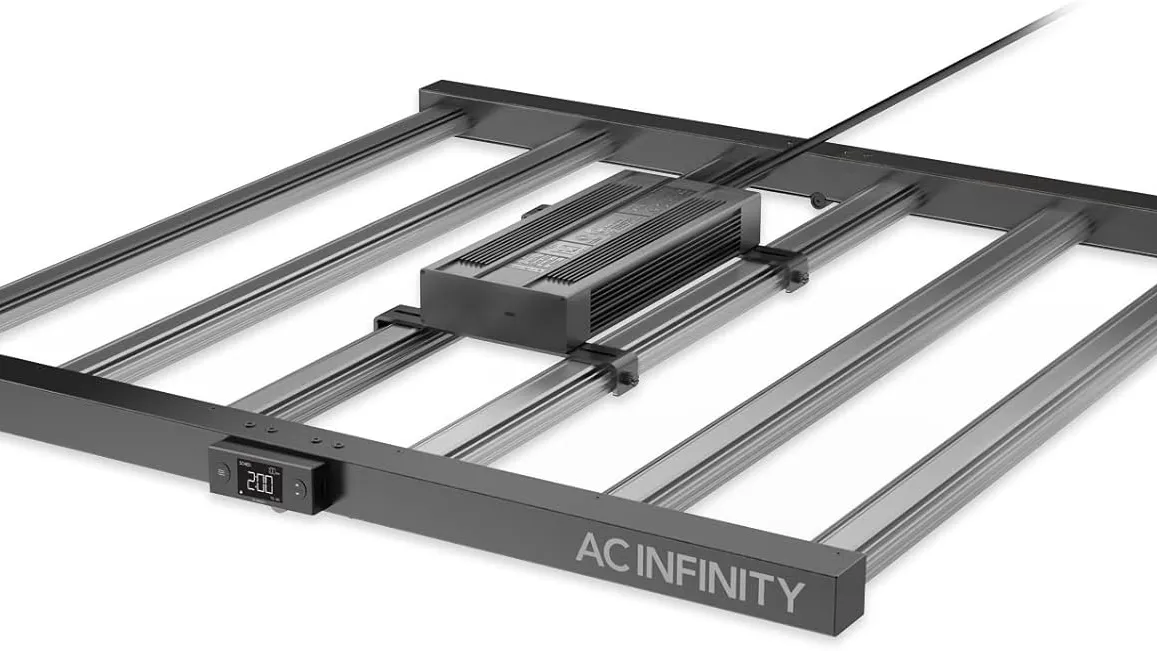
The AC Infinity IONFRAME EVO6 is the commercial-grade horticultural LED fixture for cultivators who run multiple 4×4 cultivation chambers and demand the highest diode efficiency money can buy. It packs 1,680 genuine Samsung LM301H EVO diodes - each rated at 3.14 µmol/J PPE, the highest efficacy available in horticultural lighting today - into an algorithmically spaced six-bar layout that delivers 1,991 PPFD evenly across a full 4×4 ft canopy. The complete horticulture spectrum is rounded out with 395nm UV diodes, OSRAM 660nm deep red, and 730nm far-red diodes that promote flowering and dense bud development.
The included schedule controller adds sunrise and sunset dimming, ten brightness levels, and automatic on/off cycling - features usually reserved for horticulture fixtures costing twice as much. Pair it with AC Infinity's UIS Controller 69 Pro (sold separately) and you unlock full WiFi app control, custom cultivation recipes, and integration with the rest of the AC Infinity smart cultivation ecosystem. The driver is removable and can be mounted outside the cultivation cell to keep heat away from your canopy - a critical feature for commercial operators managing tight VPD windows.
Why It's Famous: Premium Samsung EVO Tech in a Professional 4×4 Fixture
Most horticultural LED fixtures in the 4×4 category use older LM301B or LM301H diodes that top out around 2.7 µmol/J. The IONFRAME EVO6 uses the newer EVO version with a 16% efficiency bump per diode, which translates directly to more biomass per watt of electricity over a multi-year cultivation cycle. Combined with AC Infinity's reputation for build quality, the IP-65 rating, magnetic mounting, and ETL safety certification, it's the most polished professional 4×4 horticulture light available on Amazon today.
The trade-off is the price - at $579 it's not cheap, and the schedule controller still requires the upgraded UIS Controller 69 Pro for full app control. The 500W power draw is also on the higher side for a 4×4 commercial fixture, but that wattage is what delivers the high PPFD numbers professional cultivators want for heavy-yielding flower runs.
Pros | Cons |
|---|---|
Genuine Samsung LM301H EVO diodes at 3.14 µmol/J per diode | Premium price at $579 |
1,991 PPFD across a full 4×4 ft commercial canopy | WiFi app control requires separate Controller 69 Pro |
Includes schedule controller with sunrise/sunset dimming | 500W draws more than budget 4×4 horticulture fixtures |
Removable driver for better heat management in cultivation cells | 4×4 coverage only - operators needing 5×5 require the EVO8 |
Daisy-chains up to 80 fixtures for fleet scaling | |
UIS smart cultivation ecosystem compatibility |
Spider Farmer G8600
Pick #2 - Best Cost-Effective Commercial LED Horticulture Light
800W | 5×5 ft Coverage | 2,968 Bridgelux Diodes | 2,283 µmol/s PPF | WiFi App Control
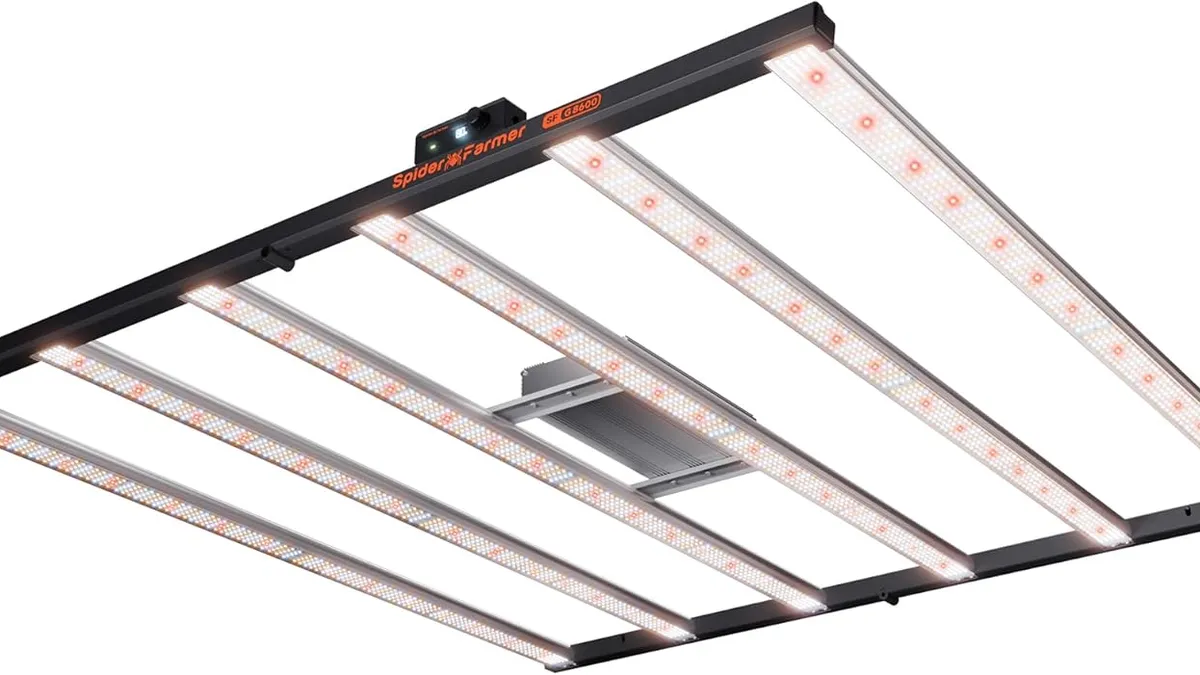
The Spider Farmer G8600 is built for commercial cultivators who need pro-grade horticultural output without paying premium-brand prices. It pumps out 2,283 µmol/s of PPF from 2,968 Bridgelux diodes spread across six bars, achieving an impressive 2.85 µmol/J system efficiency at 800W. That covers a full 5×5 ft cultivation footprint with uniform PPFD, or a tighter 4×4 ft commercial vertical farming rack with intense edge-to-edge photon penetration.
The G8600 includes Bluetooth and WiFi connectivity through the Spider Farmer app, which lets you customize lighting schedules, simulate sunrise and sunset, dim from 10-100%, and control up to 50 daisy-chained units from a single master fixture - exactly what commercial cultivation managers need to run a multi-cell facility from one device. The foldable plug-and-play design means no on-site assembly required. Spider Farmer backs every G-series horticulture fixture with a 5-year warranty serviced through US-based repair centers.
Why It's Famous: Commercial Performance at a Cost-Effective Price
Spider Farmer's G-series uses Bridgelux diodes instead of premium Samsung LM301H EVO chips, which is how they hit a sub-$420 price tag while still delivering 2.85 µmol/J efficiency - within a hair of the most expensive horticultural LED fixtures on this list. For commercial operators running multiple 5×5 cultivation racks or anyone scaling beyond a single cell, the G8600 hits the sweet spot of professional features (smart app, daisy-chain, foldable design, 5-year warranty) at a price that lets you outfit two or three rooms for what one premium fixture costs.
The trade-off is the diode brand - Bridgelux is reliable and US-manufactured, but operators who insist on Samsung diodes will want to step up to Spider Farmer's SE-series. The 800W power draw is also significant, so factor in commercial electricity rates and ventilation infrastructure before committing to a fleet purchase.
Pros | Cons |
|---|---|
800W output covers full 5×5 ft commercial canopy with high PPFD | Uses Bridgelux diodes instead of premium Samsung LM301H EVO |
2.85 µmol/J efficiency competes with premium horticulture fixtures | 800W power draw requires solid commercial ventilation |
Bluetooth and WiFi app control via Spider Farmer app | Larger physical footprint than 4×4 fixtures |
Foldable plug-and-play design - zero assembly required | App features require app download and account setup |
Daisy-chains up to 50 units for commercial fleet scaling | |
5-year warranty with US-based service centers |
VIVOSUN VSFL6450
Pick #3 - Best Value Commercial 5×5 LED Horticulture Light
645W | 4×4 / 5×5 ft Coverage | 2.8 µmol/J | Full Spectrum with UV/FR | 6 Dimming Modes
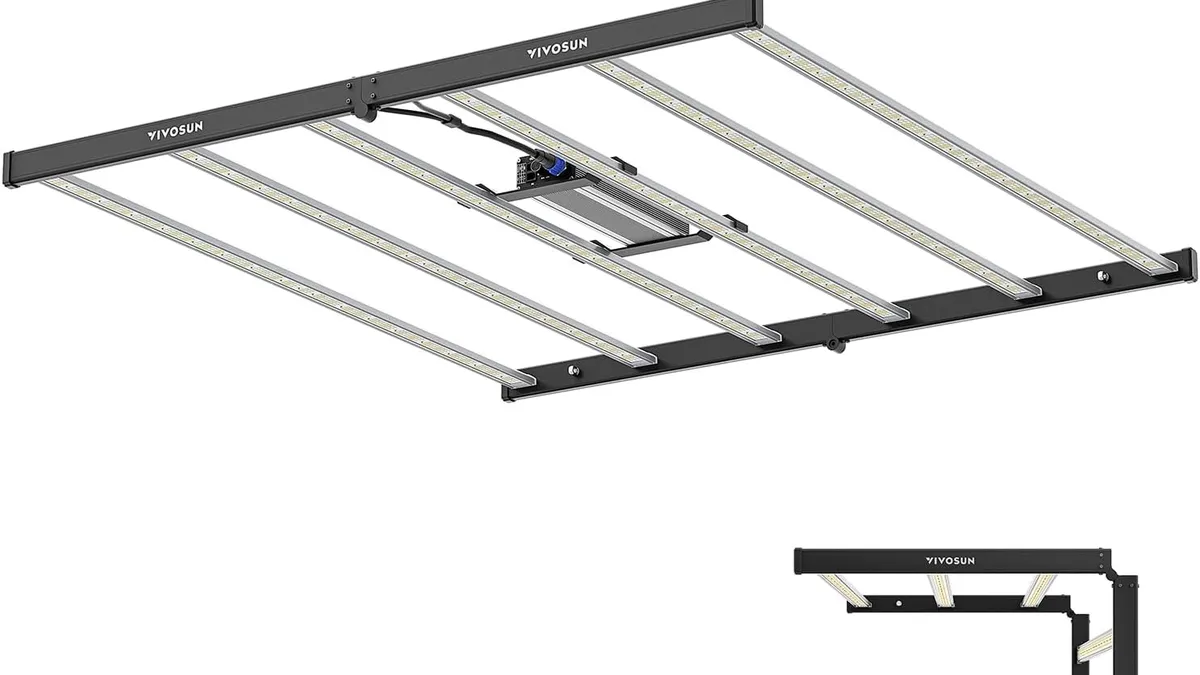
The VIVOSUN VSFL6450 stands out for offering true commercial 5×5 coverage at the lowest price of any premium horticulture light on this list. With 645W of power and 2.8 µmol/J efficiency, it delivers the kind of PPFD numbers usually reserved for fixtures costing $500+, packed into a six-bar foldable horticultural design that fits seamlessly into 4×4 or 5×5 cultivation cells. The full horticulture spectrum spans 380-780nm and includes 450nm blue, 660nm deep red, 730nm far-red, and even photosynthetic UVA - a more complete spectrum than most fixtures in this price class.
VIVOSUN built the VSFL6450 with six dimming modes (40%, 50%, 60%, 80%, 100%, and EXT) controllable via the dimming knob or remotely through the GrowHub controller and VIVOSUN app. The detachable power supply can be mounted outside your cultivation cell to reduce ambient heat, and the foldable design makes large-scale deployment painless. Daisy-chain support extends up to 160 units, making it a viable horticultural lighting solution for both single-cell operations and large-scale commercial cultivation facilities.
Why It's Famous: Premium Specs at a Mid-Range Price
At $379, the VSFL6450 undercuts almost every other commercial 5×5 horticulture fixture on Amazon while matching their efficacy numbers and adding features competitors charge extra for - UVA and far-red diodes for advanced photomorphogenic control, GrowHub smart compatibility, and a 5-year warranty. For commercial cultivators who need premium horticultural output without paying premium prices, this is the most cost-effective 5×5 horticulture light on the market right now.
The main limitation is the discrete dimming steps - six fixed modes rather than the smooth 1-100% dimming you'd get on higher-end horticultural fixtures. For most commercial operations this is plenty, but if you need to dial in exact PPFD targets to the percentage point, you may prefer a fixture with continuous dimming. The bar-style design is also less compact than integrated panel fixtures, so confirm your cultivation cells have the headroom.
Pros | Cons |
|---|---|
True commercial 5×5 coverage at the lowest price in this class | Only 6 fixed dimming steps instead of smooth 1-100% |
Full horticulture spectrum 380-780nm including UVA and far-red | Larger six-bar footprint requires cultivation cell headroom |
Foldable design with detachable power supply | App features require separate GrowHub controller |
Daisy-chains up to 160 units for large-scale deployment | 645W still draws significant power at commercial scale |
Compatible with VIVOSUN GrowHub for app control | |
2.8 µmol/J efficacy matches premium horticulture fixtures |
Spider Farmer SE3000
Pick #4 - Best LED Horticulture Light for Vertical Farming Cells
300W | 3×3 ft Coverage | Samsung LM301H EVO Diodes | 856 µmol/s PPF | Bluetooth + WiFi App Control
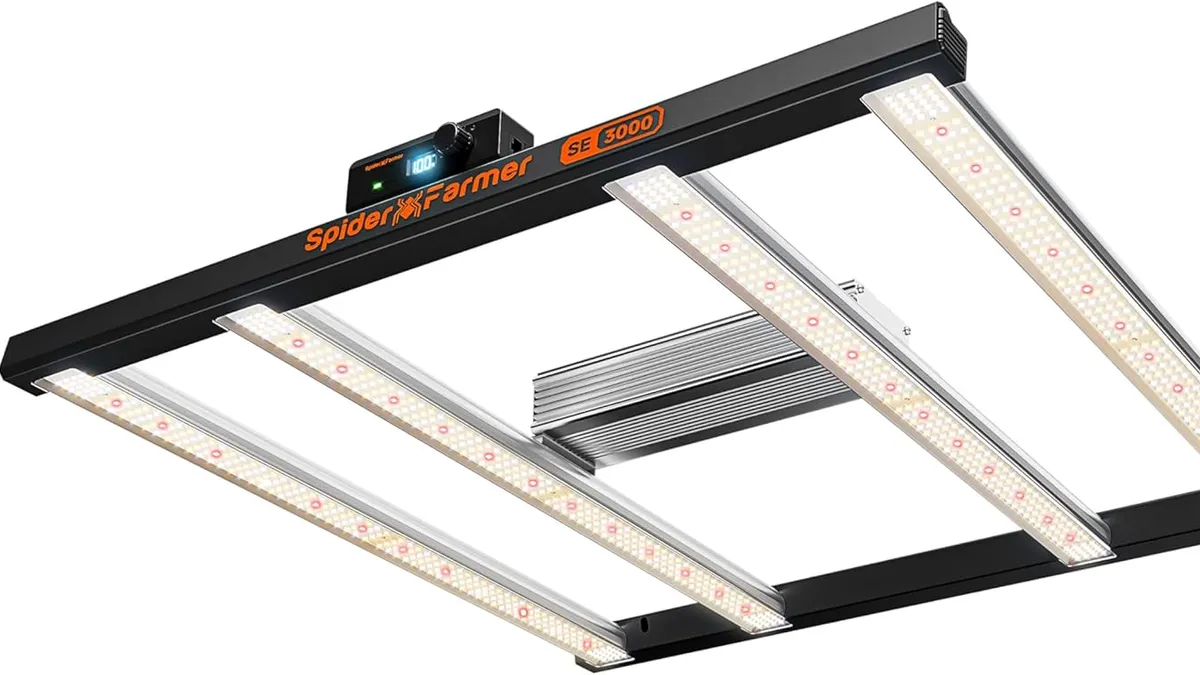
The Spider Farmer SE3000 is the smallest commercial horticulture light on this list - and that's exactly why vertical farming operators love it. At 300W with Samsung LM301H EVO diodes (3.14 µmol/J per diode), it packs premium horticultural diode technology into a compact 3×3 ft footprint that fits perfectly into multi-tier vertical cultivation racks. It delivers 856 µmol/s of PPF at 2.85 µmol/J system efficiency - competitive numbers for any horticultural LED fixture in this size class - through a four-bar design that distributes photons evenly across the canopy with edge-weighted diode placement.
What sets the SE3000 apart from competing small-format horticulture fixtures is the built-in Bluetooth and WiFi smart control. Unlike the Mars Hydro and AC Infinity options that require purchasing a separate controller, the SE3000 connects directly to the Spider Farmer app right out of the box. From your phone you get custom lighting schedules, sunrise/sunset simulation, dimming presets, PPFD-target mode, and unified control over up to 50 daisy-chained SE3000 fixtures - making it the easiest small-cell horticulture fixture to deploy across a multi-tier vertical farm without buying additional hardware.
Why It's Famous: Samsung EVO Tech in a Vertical Farming Footprint
Most 300W commercial horticulture fixtures in this price range use generic SMD diodes or older Samsung LM301B chips. The SE3000 uses the current-generation LM301H EVO - the same premium horticultural diode technology found in commercial fixtures three times the price. For vertical farming operators running stacked cultivation racks where each tier is 3×3, this means you don't have to compromise on photon efficacy just because your footprint is small. The 5-year warranty serviced through US/CA/UK/EU/AU repair centers is the longest support window available in the small-cell horticulture category.
The trade-off is raw output - at 856 µmol/s PPF, this is a small-cell horticulture fixture, not a flagship 5×5 commercial light. Operators with larger cultivation cells will need to either step up to the G8600 or daisy-chain multiple SE3000 units. The 4-bar layout is also more concentrated than the 6-bar layouts on bigger horticultural fixtures, so PPFD uniformity is best when the fixture is hung at the recommended height.
Pros | Cons |
|---|---|
Premium Samsung LM301H EVO diodes at 3.14 µmol/J per diode | 300W output limits use to small commercial cells |
Built-in Bluetooth + WiFi - no separate controller needed | Only 3×3 ft maximum coverage |
Perfect fit for multi-tier vertical farming racks | 4-bar layout less uniform than 6-bar fixtures |
Daisy-chains up to 50 units with unified app control | Requires precise hanging height for best PPFD distribution |
5-year warranty with global repair centers | |
PPFD-target dimming mode for precise commercial control |
Mars Hydro FC-E8000
Pick #5 - Best High-Density Commercial Horticulture LED Fixture
800W | 5×5 ft Coverage | 3,654 BridgeLux Diodes | 2.8 µmol/J | Foldable 2-in-1 Smart Design
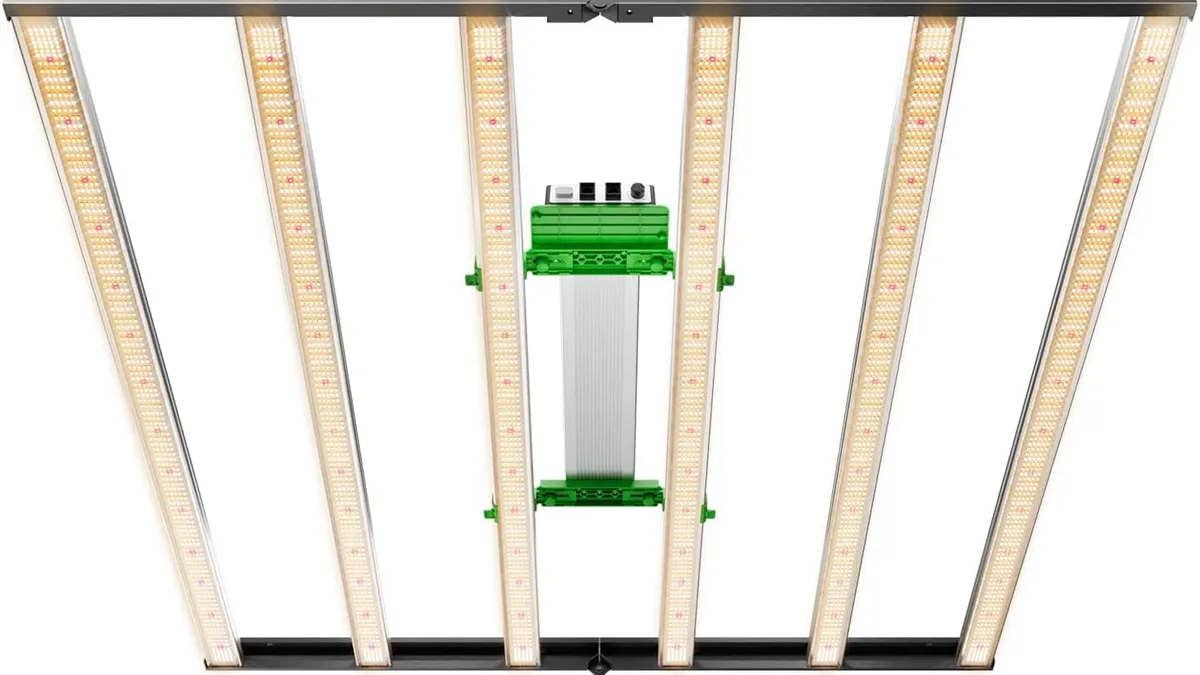
The Mars Hydro FC-E8000 is a high-density commercial horticulture fixture engineered to maximize PPFD across a full 5×5 ft canopy while keeping installation and operating costs low. It packs 3,654 BridgeLux diodes - the highest diode count on this list - across six slim bars, delivering 2.8 µmol/J PPE and a maximum claimed yield of 2.5g per watt with 30% higher average PPFD than competing 800W horticultural fixtures in its price range. That diode density is what makes it a favorite for vertical farming operators who need ultra-uniform light distribution from edge to edge.
The 2025 version uses a foldable 2-in-1 design that ships preassembled - just unfold it, hang it, and plug it in. It supports both smart and regular lighting modes: pair it with the optional iConnectu Controller for full WiFi/Bluetooth control through the Mars Hydro app (custom cultivation recipes, sunrise/sunset, remote dimming), or use the manual dimmer knob standalone. The detachable power supply mounts remotely on the side of your cultivation cell or rack to push heat away from the canopy, and the IP65 rating handles humid greenhouse environments without issue.
Why It's Famous: Maximum Diode Density at Commercial Scale
Mars Hydro built the FC-E series specifically to deliver commercial-grade horticultural output without commercial-grade pricing. By using BridgeLux diodes instead of Samsung LM301H EVO, they hit the same 2.8 µmol/J efficiency that premium horticulture fixtures achieve while keeping the price at $579. For commercial vertical farms running dozens of fixtures, that diode swap saves thousands in upfront costs without sacrificing meaningful yield. The 800W output and dense diode array also produce more even canopy coverage than lower-diode-count horticultural alternatives - a critical advantage when you're trying to maintain consistent crop quality across an entire facility.
The trade-off is that smart features require buying the iConnectu Controller separately - out of the box, you only get manual dimming. The 800W power draw also means you'll need solid ventilation infrastructure, and the bar-style design takes up more vertical space than integrated panel horticulture fixtures.
Pros | Cons |
|---|---|
3,654 BridgeLux diodes - highest density horticulture fixture on this list | Smart features require separate iConnectu Controller |
2.8 µmol/J efficacy at commercial scale | 800W requires robust commercial ventilation |
Foldable 2-in-1 design ships preassembled | BridgeLux diodes instead of premium Samsung EVO |
IP65 waterproof rating for humid greenhouse environments | Bar-style design takes up vertical cultivation space |
Detachable remote-mountable power supply | |
Daisy-chains up to 30 fixtures for fleet management |
Commercial LED Horticulture Lighting Buying Guide
Photon Efficacy (µmol/J): The Single Most Important Spec for Commercial Horticulture
Photon efficacy measures how efficiently a horticultural LED fixture converts electricity into photosynthetically active radiation. It's expressed in µmol/J - the higher the number, the more usable photons your plants receive per joule of electricity consumed. For commercial horticulture lighting, this single metric drives your entire operating cost equation. A 2.8 µmol/J fixture running 12 hours a day for a year will cost roughly 25% more in electricity than a 3.5 µmol/J fixture delivering the same photon output. Across a 50-fixture facility over a five-year ROI window, that efficacy difference translates to thousands of dollars. The best LED horticulture lights on the market today hit 2.7-3.1 µmol/J at the system level.
PPFD and Coverage Area: Match the Fixture to Your Cultivation Cell
PPFD (Photosynthetic Photon Flux Density) measures how many photons hit a specific point on your canopy per second. Commercial flowering canopies typically target 600-1,000+ µmol/m²/s PPFD, while vegetative cultivation runs at 400-600 µmol/m²/s. Always match your horticultural fixture's coverage rating to your actual cultivation cell footprint. A 300W horticulture light is engineered for 3×3 ft cells. A 500W fixture handles 4×4. An 800W fixture covers 5×5. Going under-spec means weak yields and inconsistent crop quality across your facility; going over-spec wastes electricity and creates light burn risk.
Diode Brand: Samsung LM301H EVO vs. Bridgelux for Horticulture
The two dominant LED chip brands in commercial horticulture lighting are Samsung (LM301H EVO is the current flagship at 3.14 µmol/J per diode) and Bridgelux (a US-based manufacturer producing reliable horticultural diodes typically rated around 2.8 µmol/J at the system level). Samsung diodes are the gold standard for premium horticultural fixtures but cost more. Bridgelux delivers nearly the same efficacy at a noticeably lower price, making it the go-to choice for cost-sensitive commercial operators who need to outfit large facilities. Both brands produce excellent results - the real difference is upfront capex versus long-term electricity savings.
Spectrum Quality: Why Full Spectrum Beats Targeted Wavelengths
Modern commercial LED horticulture lighting uses a full spectrum white light base (typically 3000K warm white + 5000K cool white) supplemented with deep red 660nm diodes for flowering and sometimes UV (395nm) and far-red (730nm) for advanced photomorphogenic control. Older "blurple" horticultural fixtures that only used red and blue diodes are obsolete - research has shown that plants use the entire visible spectrum for photosynthesis and morphological responses. Full spectrum white with red enhancement is the modern standard for every cultivation stage and every crop type, from leafy greens in vertical farms to cannabis in commercial flower rooms.
Smart Fleet Management for Commercial Horticulture
Smart horticultural fixtures add WiFi/Bluetooth app control, scheduled dimming, sunrise/sunset simulation, and integration with environmental controllers. For commercial operators running multiple fixtures across cultivation cells, smart features aren't a luxury - they save serious labor hours. Look for fixtures that support unified dimming across daisy-chained groups (the G8600 handles 50 units, the VSFL6450 handles 160), and that integrate with environmental sensors for VPD-responsive automation. Just know that on fixtures like the Mars Hydro FC-E8000 and AC Infinity IONFRAME EVO6, smart functionality often requires a separate controller purchase - factor that into your per-fixture cost when budgeting.
LED Horticulture Lighting vs HPS: The ROI Math
Every horticulture fixture on this list will pay for itself faster than a comparable HPS setup. Modern horticultural LEDs hit 2.7-3.1 µmol/J versus 1.7-1.9 µmol/J for the best HPS fixtures - that's 30-50% less electricity for the same photon output. LEDs also produce dramatically less radiant heat (reducing HVAC load), last 50,000+ hours instead of 10,000 (eliminating bulb replacement costs), and let you tailor the spectrum to your specific crop. The upfront cost is higher, but at commercial electricity rates the LED premium typically pays for itself within 1-3 cultivation cycles.
Conclusion:
When scaling a commercial operation, look beyond the initial purchase price and prioritize modularity. Standardizing your facility with a single lighting ecosystem simplifies maintenance schedules and allows for interchangeable components across different cultivation cells. This uniformity reduces the learning curve for staff and ensures consistent crop quality across the entire canopy.
Finally, remember that the move to high-efficiency LED lighting is as much about environmental control as it is about photons. Because these fixtures emit significantly less radiant heat than legacy systems, you may need to recalibrate your HVAC and dehumidification settings to maintain ideal vapor pressure deficit (VPD) levels. Investing in fixtures with removable drivers will give you the flexibility to manage these thermal loads more effectively as your facility grows.
Frequently Asked Questions
Q1: How many watts of LED horticulture lighting do I need per square foot?
A: For flowering crops, target 30-50 watts of high-efficacy horticultural LED per square foot. A 4×4 ft cultivation cell (16 sq ft) needs 480-800W. A 5×5 ft cell (25 sq ft) needs 750-1,250W. A 3×3 ft vertical farming tier (9 sq ft) needs 270-450W. For vegetative-only cultivation like leafy greens and herbs, 20-30 watts per square foot is sufficient. These figures assume modern horticultural fixtures at 2.5+ µmol/J efficacy - older or lower-efficacy fixtures need more wattage to hit the same PPFD targets.
Q2: Are LED horticulture lights better than HPS for commercial cultivation?
A: Yes. Modern horticultural LED fixtures hit 2.7-3.1 µmol/J versus 1.7-1.9 µmol/J for the best HPS fixtures - that's 30-50% less electricity for the same photon output. LEDs also produce significantly less radiant heat (reducing your HVAC load), last 50,000+ hours instead of 10,000, and offer tunable spectra you can match to specific crops. The upfront cost is higher but typically pays back within 1-3 cultivation cycles at commercial scale.
Q3: How far should LED horticulture lights hang above the canopy?
A: Typical hanging heights are 24-36 inches for seedlings and clones, 18-24 inches for vegetative cultivation, and 12-18 inches for flowering. Higher-wattage horticultural fixtures need to hang further away to avoid light burn and PPFD oversaturation. Always check the manufacturer's PPFD distribution map for your specific fixture and target 200-400 µmol/m²/s for seedlings, 400-600 for vegetative growth, and 600-1,000+ for flowering.
Q4: What's the difference between Samsung LM301H and LM301H EVO horticultural diodes?
A: The EVO is Samsung's newest generation, offering about 16% higher efficacy per diode (3.14 µmol/J vs ~2.7 µmol/J for older LM301H) along with improved blue spectrum output. Horticulture fixtures using LM301H EVO chips like the AC Infinity IONFRAME EVO6 and Spider Farmer SE3000 deliver more biomass per watt of electricity than older Samsung diodes, which directly impacts your operating cost and ROI on a multi-year cultivation cycle.
Affiliate Disclosure: This post contains affiliate links. If you purchase a product through one of these links, we may earn a small commission at no additional cost to you. All opinions expressed are our own.