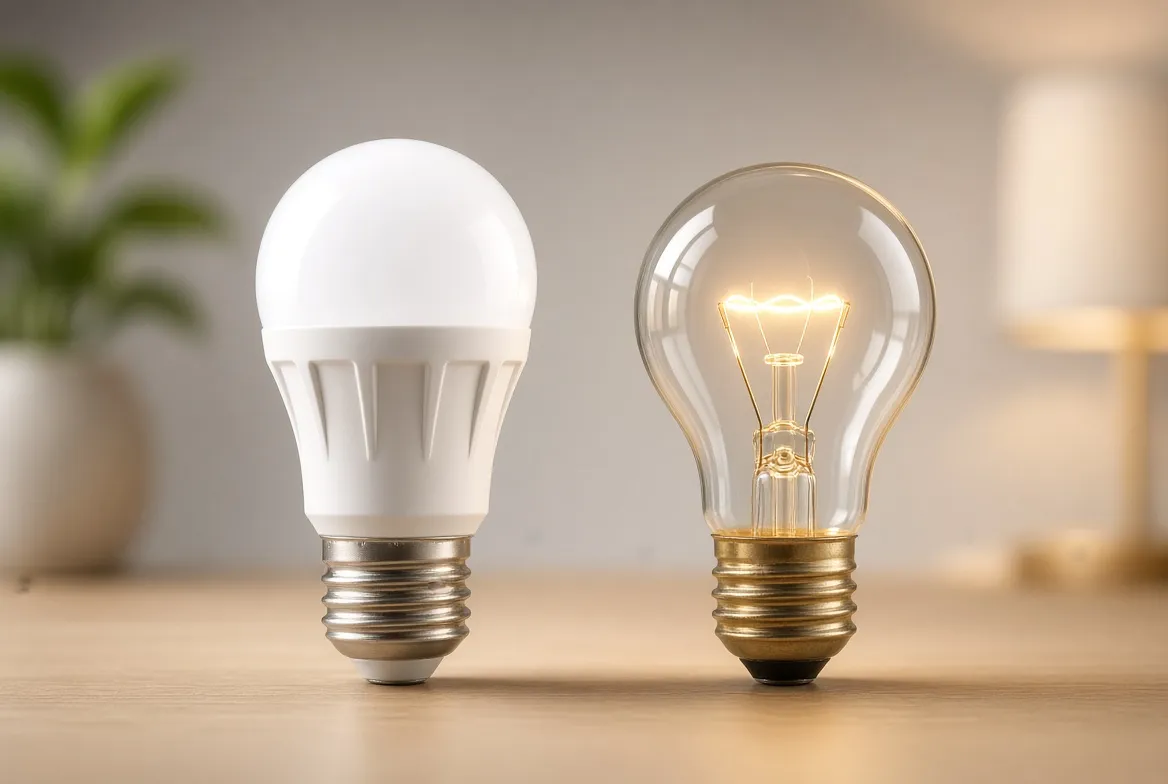
Look at two bulbs side by side on a store shelf, same brightness, same warm glow, and one of them is quietly costing you six times more to run every single day.
Swap a 60-watt incandescent for its LED equivalent and the new bulb uses just 8 to 10 watts, less than a sixth of the power for the exact same brightness.
LED lights use 2 to 20 watts depending on the product. A standard bulb runs 8-10W, strip lights draw 2-20W per meter by density, and LED Christmas mini lights use about 0.07W per bulb against 0.4W for incandescent. Across every category, LEDs consume 75 to 90% less power than what they replaced.
Wattage measures energy consumption, not brightness, lumens do. LEDs use fewer watts for the same light output because they convert far more of their electricity into visible light instead of wasted heat.
LED Wattage Equivalents:
Use this chart to match an old incandescent's brightness to the right LED wattage.
Incandescent Watts | LED Equivalent Watts | Lumens |
|---|---|---|
25W | 3-4W | ~250 |
40W | 5-7W | ~450 |
60W | 8-10W | ~800 |
75W | 11-13W | ~1,100 |
100W | 14-18W | ~1,600 |
150W | 20-25W | ~2,600 |
Values vary by manufacturer, always check the lumens rating on the packaging rather than relying on wattage alone.
LED Wattage by Product Type:
Wattage also varies a lot by product category, not just bulb size.
LED Product | Typical Wattage | Notes |
|---|---|---|
LED bulb (A19) | 8-15W | Replaces 60-100W incandescent |
LED strip (2835 SMD) | 4.8W/meter | Standard density, accent lighting |
LED strip (5050 SMD) | 14.4W/meter | High density, task/primary lighting |
LED recessed downlight | 8-18W | Replaces 65-100W BR30/BR40 |
LED tube (4ft T8) | 15-22W | Replaces 32W fluorescent tube |
LED high bay | 100-300W | Replaces 400-1,000W metal halide |
LED Christmas mini light | 0.07W/bulb | vs 0.4W per incandescent mini light |
How to Calculate Your Total LED Power Use:
Multiply each light's wattage by the number of lights, then by daily hours of use. Ten 10W LED bulbs running 5 hours a day use 500 watt-hours (0.5 kWh). At the U.S. average rate of $0.16/kWh, that's about $2.40 a month, against $14.40 for the same ten bulbs in incandescent.
For strips, multiply wattage-per-meter by total length. A 5-meter run of 5050 SMD at 14.4W/m draws 72 watts total, about $2.07/month at 6 hours daily. Size your power supply to at least 120% of total strip wattage to avoid overheating. See how hot LED lights actually get for more on that margin.
Why Watts Matter Less Than Lumens:
Two 10W bulbs from different brands can produce very different brightness, the difference comes down to chip efficiency, driver design, and optics. Always compare lumens, not watts, when judging brightness. Most modern LEDs deliver 80 to 100 lumens per watt, premium bulbs reach 120+. For the full picture on where the rest of that energy goes, see how much electricity LED lights waste.
Conclusion:
Compare brightness by lumens, not watts, and the low wattage takes care of itself. The gap between incandescent and LED is large enough that even a handful of bulb swaps adds up to real monthly savings.
(FAQs):
Q1. How many amps does an LED light draw?
A: A 10W bulb on 120V draws about 0.083 amps (watts ÷ volts). A standard 15-amp circuit can power over 100 LED bulbs before approaching capacity. See how many LED lights fit on a 15-amp circuit for the full math.
Q2. Do LED lights use less electricity when dimmed?
A: Yes, dimming to 50% cuts power roughly 40-50%, not perfectly linear since the driver still draws a small baseline amount.
Q3. How many watts do LED Christmas lights use?
A: A 100-count LED string uses about 7 watts total, against 40 watts for the same incandescent string. You can run 25+ LED strings on one 15-amp circuit versus just 4-5 incandescent.