Flip on an HID fixture and you'll wait 5 to 15 minutes for it to reach full brightness, and if the power ever cuts out, you wait again, HID lamps need to cool before they'll restrike. LED skips both waits entirely.
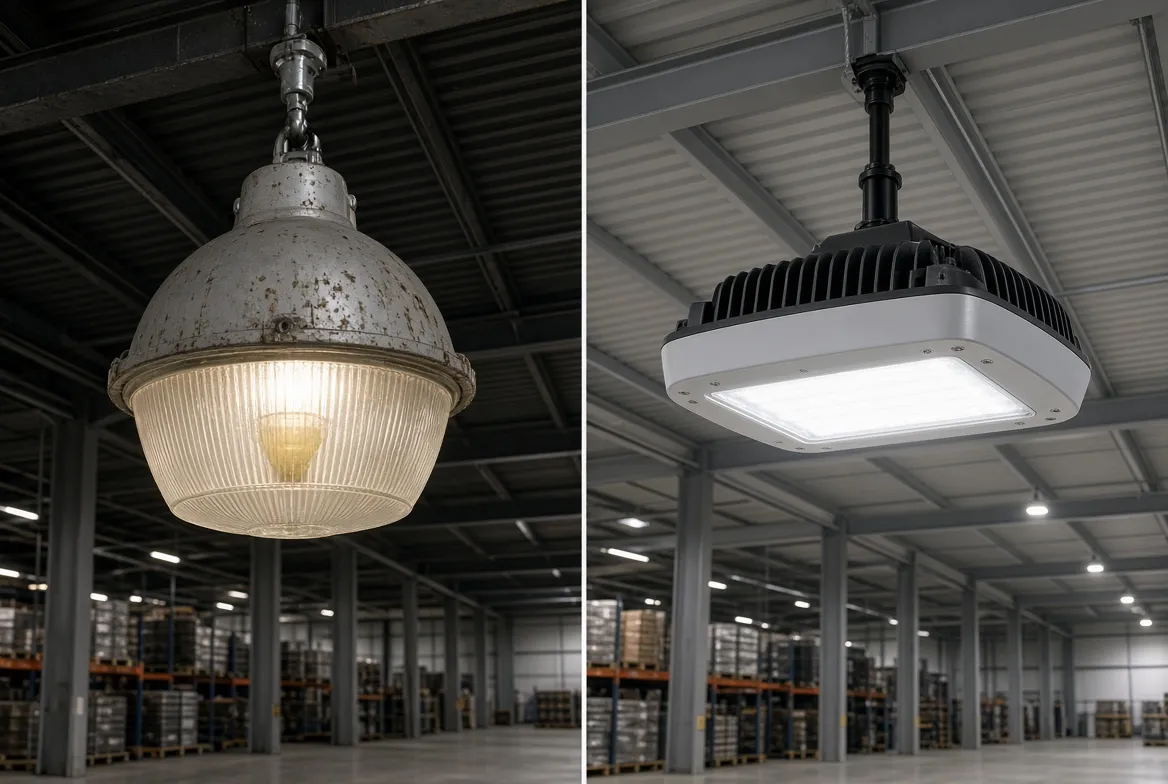
LED beats HID in most applications: it turns on instantly, lasts 2 to 4 times longer (50,000-100,000 hours vs 10,000-25,000), uses 40 to 60% less energy for comparable output, and needs virtually no maintenance. HID still holds an edge in raw lumen output per fixture for very high-power uses like stadium lighting, but that gap is closing fast.
Side-by-Side Comparison:
Feature | HID | LED |
|---|---|---|
Lifespan | 10,000-25,000 hours | 50,000-100,000 hours |
Efficacy | 75-115 lm/W | 120-200 lm/W |
Warm-up time | 5-15 minutes to full brightness | Instant on |
Restrike time | 5-20 minutes, must cool first | None, instant restart |
CRI | 65-93, varies by type | 70-98 |
Maintenance | Bulb + ballast replacement | Minimal, no bulb changes for years |
Dimming | Limited, needs special ballast | Full range, 0-100% |
Mercury content | Yes, special disposal required | None |
Where LED Wins:
Instant On and Restrike;
HID takes 5 to 15 minutes to reach full brightness from cold, and another 5 to 20 minutes to restrike after any power interruption. LED reaches full brightness in under a second and restarts instantly. For security lighting and parking structures, this alone settles it.
Maintenance Reduction:
HID has multiple failure points, the lamp, ballast, ignitor, and capacitor, each degrading independently. A warehouse HID lamp typically needs its first bulb change at 15,000 hours and a ballast swap at 40,000. An LED fixture runs 50,000 to 100,000 hours with no interim maintenance at all. On high ceilings needing lift equipment for every lamp change, that savings adds up fast.
Real-World Energy Efficiency:
Modern LED fixtures hit 150 to 200 lumens per watt. Metal halide HID tops out around 115, and loses more to reflector absorption, HID emits in all directions, so 15 to 30% of total lumens get absorbed just redirecting the light downward. LED is directional by design, so nearly all its lumens reach the target. Accounting for that optical loss, LED's real-world advantage runs 50 to 60%. See best LED lights for warehouse for real fixture comparisons.
Where HID Still Competes:
Very High Lumen Output:
For extreme light levels from a single point source, stadium floodlights, large sports lighting, some industrial processes, HID fixtures at 1,000W to 2,000W can produce 100,000+ lumens from one source. Matching LEDs exist but remain expensive, though multiple smaller LED fixtures often beat one massive HID on uniformity and total efficiency anyway. See best LED parking lot lights for how LED shoebox fixtures compare on large outdoor areas.
Upfront Cost in Legacy Installations:
Replacing a single HID lamp costs $20 to $50. A full LED retrofit fixture runs $100 to $500 depending on wattage. For facilities with many HID fixtures, that upfront gap is real, even though payback typically lands in 1 to 3 years from energy savings.
HID to LED Conversion:
Two paths exist. A retrofit kit replaces the HID lamp and ballast inside the existing housing with an LED module and driver, preserving the original fixture body at lower install cost. A complete fixture replacement installs a new LED fixture in place of the old one, better optics and thermal management, higher upfront cost. See what an LED light driver does for how it replaces the HID ballast. Most commercial conversions pay for themselves in 1 to 3 years through combined energy and maintenance savings.
Conclusion:
LED beats HID on every metric that matters day-to-day: instant on, no restrike wait, longer life, and real energy savings. HID only still makes sense for extreme single-point output or when legacy fixtures make retrofit costs hard to justify right now. For new installs and most conversions, LED is the clear pick.
(FAQs):
Q1. Can I put an LED bulb in an HID fixture?
A: Not directly. HID ballasts run high voltage that's incompatible with LED drivers. You need an LED retrofit kit built for your fixture type, or a full replacement. Screwing an LED lamp into an HID socket won't work and risks a fire hazard.
Q2. Are LED headlights better than HID?
A: For most drivers, yes. LED headlights turn on instantly, produce a crisp white beam, and last the life of the vehicle (30,000-50,000 hours). HID produces slightly more raw lumens and a wider spread, but takes 5-10 seconds to reach full brightness and needs bulb replacement every 2,000-3,000 hours.
Q3. Which uses less electricity, HID or LED?
A: LED, significantly. A 150W LED fixture typically replaces a 400W metal halide HID at equal or better illumination. Savings run 50 to 65% depending on HID type, even high-pressure sodium, the most efficient HID type, still loses to LED by 30 to 40% in real-world installed efficiency.