An old light bulb makes light by getting something so hot it glows. An LED does something completely different, and that is the whole secret to why it sips power and stays cool: it turns electricity straight into light, with almost no heat step in between.
That process is called electroluminescence. Inside an LED, electricity flowing through a special material makes it release light directly, no burning filament, no gas, just power in and light out. Here is how that actually happens, and where the color comes from.
Light Without the Heat Step:
An old bulb wastes about 90% of its energy as heat and gives off light almost by accident. An LED skips that entirely, converting most of its power straight to light. That one difference is why LEDs run cool, last for years, and cut energy use so sharply.
What Actually Happens Inside a Diode:
An LED is a diode, a component that lets electricity flow one way only. It is built from a semiconductor, a material tuned between a conductor and an insulator, split into two layers: one with extra electrons (the n-type) and one with gaps where electrons are missing, called holes (the p-type).
When you apply power the right way, electrons rush from the n-side toward the holes on the p-side. Where they meet, at the junction, each electron drops into a hole. That is the moment light is born.
Why Electrons Release Light, Not Heat:
Here is the heart of it. An electron sitting in the n-layer holds more energy than one settled in a hole. When it drops into that hole, it has to shed the extra energy, and in the right material it releases that energy as a particle of light, a photon.
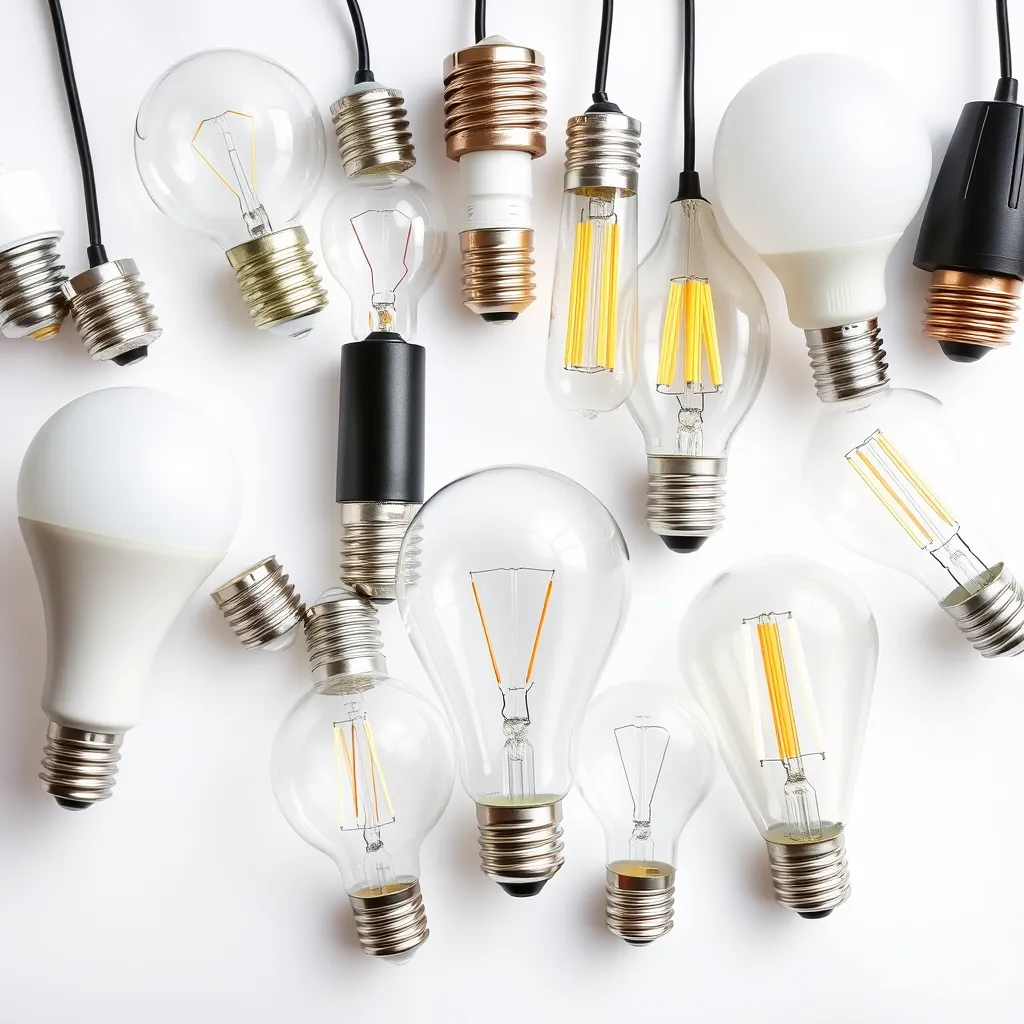
In a filament bulb, energy escapes mostly as heat, and light is the leftover. In an LED, the energy comes out as light first. That is the whole efficiency story in one sentence, and why an LED matching a 60-watt bulb runs on just 8 to 10 watts. See our comparison of LED vs incandescent bulbs for the full gap.
Where the Color Actually Comes From:
This surprises people: an LED's color is not from a coating or a colored lens. It comes from the semiconductor material itself. The energy gap the electron falls across, called the band gap, sets the exact energy of each photon, and that energy is the color.
A bigger gap makes a higher-energy blue photon, a smaller gap makes a lower-energy red one. So swapping the material changes the color at the source: gallium nitride for blue, aluminum gallium indium phosphide for red. The light is that color from the instant it is made. Our guide on how LED lights change color shows how RGB diodes mix these.
The Clever Trick Behind White LEDs:
Here is a detail most explainers skip: there is no such thing as a natural white LED. Since each diode makes one pure color, white has to be built.
The common method starts with a blue LED and coats it in a yellow phosphor. The phosphor absorbs some of the blue light and re-emits it as yellow, and blue plus yellow reads as white to your eye. More phosphor gives warmer 2700K white, less gives cooler 6500K. That thin yellow coating is why a switched-off white LED often looks faintly yellow.
The Supporting Parts That Make It Last:
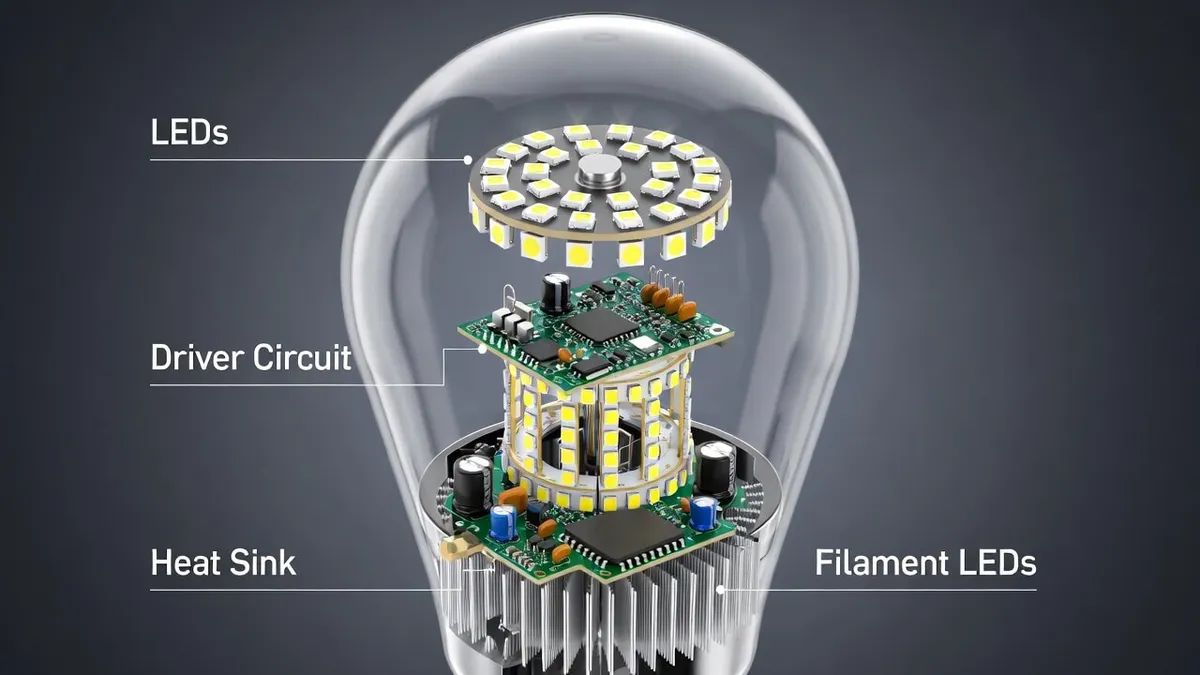
The diode makes the light, but a few other parts keep it working.
The driver. LEDs need low-voltage DC, so the driver converts your mains AC and holds the current steady. It is the part that most often fails, not the diode.
The heat sink. The small heat an LED does make must be pulled away from the chip, so the metal base and fins carry it off to keep the diode cool.
The lens or diffuser. A tiny diode is a harsh point of light, so the dome spreads it into an even, usable glow.
How LEDs Compare to Older Bulbs:
How It Makes Light | Bulb Type | Energy to Light |
|---|---|---|
Electroluminescence (direct) | LED | ~40 to 50% |
Incandescence (heat) | Incandescent | ~10% |
Gas discharge plus phosphor | CFL | ~20% |
Because the LED makes light directly instead of heating something up, it wastes the least energy and lasts far longer, since there is no filament to burn out.
Conclusion:
LEDs work by turning electricity straight into light: electrons drop into holes in a semiconductor and release the energy as photons, skipping the heat that old bulbs waste. The material sets the color, a phosphor makes white, and with no filament to fail, the LED runs cool and lasts for years.
(FAQs):
Q1. Do LEDs really make no heat at all?
A: They make some, just far less. Around 50 to 60% of an LED's power still becomes heat, but it exits backward through the base, not forward as the light. That is why the lens stays cool while the base gets warm, the opposite of a hot filament bulb.
Q2. Why do LEDs last so much longer than old bulbs?
A: There is no filament to burn out. An incandescent's thin wire slowly evaporates until it snaps, usually within 1,000 hours. A solid-state LED has no such part, so it runs 25,000 to 50,000 hours, fading slowly rather than failing suddenly.
Q3. What does LED stand for?
A: Light Emitting Diode. "Light Emitting" is the job, and "Diode" is the one-way electronic component that does it. Our guide on what LED stands for breaks down each word.
Q4. Why do LEDs need a driver and not just a plug?
A: LEDs run on low-voltage DC, but your outlet is high-voltage AC. The driver converts it and, just as importantly, holds the current steady, since feeding an LED raw power would let it overheat and burn out fast.