The concept of a "black light" is one of the most persistent misnomers in lighting technology. To understand why we cannot have an LED that projects darkness, we have to look past the marketing terms and into the fundamental laws of thermodynamics and quantum mechanics. In the world of physics, light is an additive property. You can add more of it to a space, or you can block it from entering, but you cannot "emit" its absence.
When people ask for a black LED, they are usually looking for one of two things: a light source that makes things glow in the dark, or a device that can actively darken a room. While the former exists in the form of ultraviolet (UV) technology, the latter remains a physical impossibility. Darkness is not a substance; it is a void. To create a "darkness beam," a device would need to actively delete photons from the air, a feat that contradicts everything we know about how energy moves through the universe.
The Fundamental Physics of Photon Emission

Light is electromagnetic radiation. It consists of photons, which are elementary particles that carry energy. When an LED is powered on, electrons move across a semiconductor material, dropping from a higher energy state to a lower one. This drop releases energy in the form of a photon. Because this process is inherently an energy-release mechanism, every LED ever manufactured is designed to add energy to its environment.
Darkness, by definition, is the absence of these photons. To "emit darkness," a light source would need to produce "negative photons" or "anti-light" that cancels out existing energy. While destructive interference (a phenomenon where two waves of the same frequency cancel each other out) is a real concept in optics, it requires incredibly precise, laboratory-controlled conditions. It cannot be packaged into a consumer-grade bulb to "shine" darkness onto a wall. If you turn on a light in a dark room, you are adding energy. There is no known mechanism in physics to "shine" a beam that removes energy from a surface to make it appear darker than it was before the beam hit it.
The Entropy Problem
The second law of thermodynamics states that the total entropy of an isolated system can never decrease over time. Generating light requires converting electrical energy into radiant energy. A "darkness emitter" would essentially be a device that sucks energy out of a localized area from a distance without a physical medium. While a refrigerator can remove heat from its interior, it requires a closed system and a heat exchanger to dump that energy elsewhere. A light bulb operates in an open system; it cannot "cool" the light levels of a room by projecting a vacuum.
What We Call "Black Lights" are Actually UV-A Sources
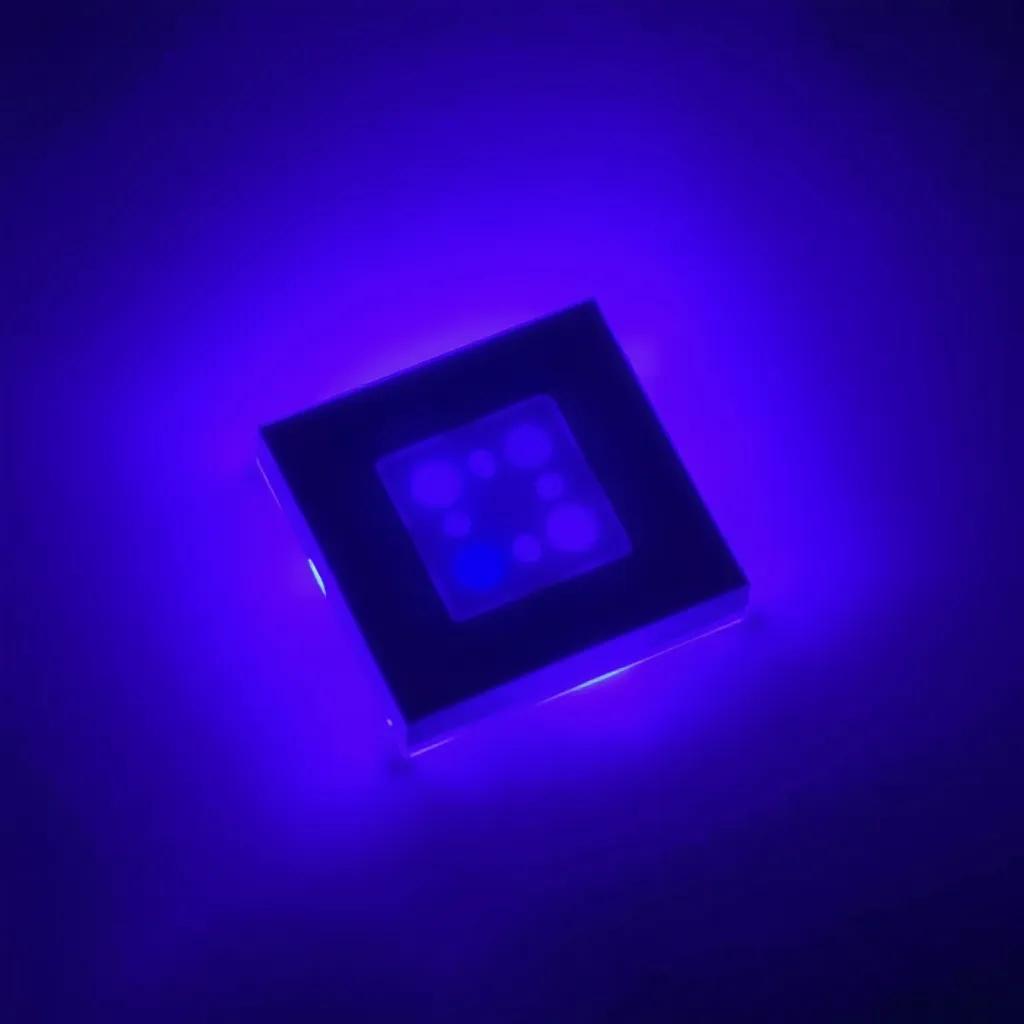
The devices sold as "black lights" in stores are not emitting darkness. They are LEDs specifically engineered to emit Ultraviolet-A (UV-A) radiation. This light exists on the electromagnetic spectrum just below the range that human eyes can perceive. Most humans can see wavelengths between 380 and 700 nanometers (nm). Standard "black light" LEDs typically peak at 365nm or 395nm.
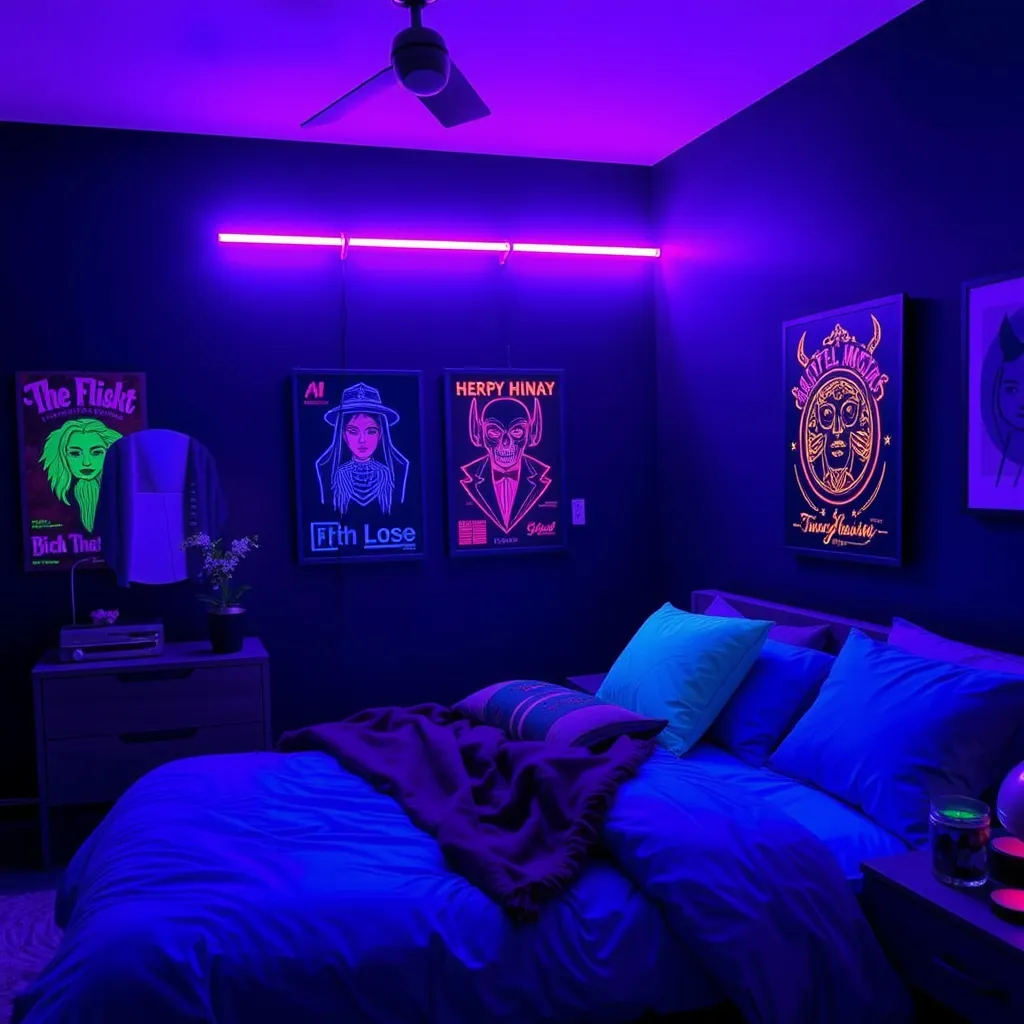
Because these wavelengths sit right on the edge of our visual threshold, we can't see the majority of the light they produce. However, no LED is a perfect single-wavelength emitter. They produce a "bell curve" of light. A 395nm LED will spill some of its energy into the 400-410nm range, which we perceive as a dim, deep violet glow. This is why "black lights" aren't actually black-they are faint purple.
Wavelength Comparison for UV LEDs
Wavelength | Classification | Common Uses | Visibility to Humans |
|---|---|---|---|
395nm - 405nm | Near-UV / Violet | Parties, posters, UV curing (resins) | Clearly visible as deep purple |
365nm | UV-A (Long wave) | Forensics, leak detection, mineralogy | Very faint, almost invisible glow |
315nm - 320nm | UV-B (Medium wave) | Medical treatment (psoriasis), tanning | Invisible (dangerous to eyes) |
254nm - 280nm | UV-C (Short wave) | Germicidal sterilization, water air purification | Invisible (highly hazardous) |
The Science of Fluorescence: Why Things "Glow"
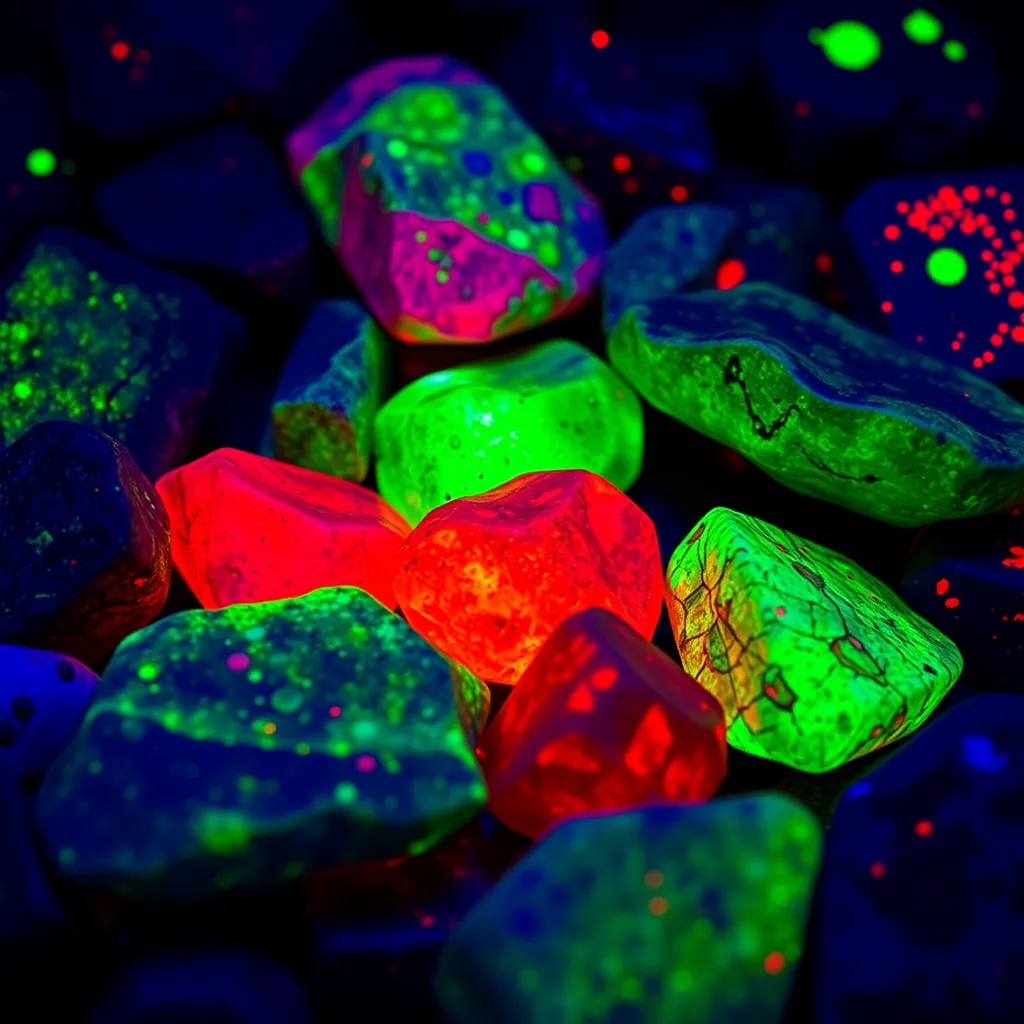
If the light coming from a UV LED is mostly invisible, why does it make white t-shirts and neon posters look so bright? This happens through a process called fluorescence. Certain materials contain "phosphors"-substances that can absorb high-energy, short-wavelength light (like UV) and immediately re-emit it as lower-energy, longer-wavelength light that falls within the visible spectrum.
When UV photons hit a white shirt, the optical brighteners in the fabric absorb that invisible energy. The electrons in these brighteners jump to a higher orbital and then fall back down, releasing the energy as visible blue light. This creates the illusion that the object is "glowing," but it is actually just converting invisible light into visible light. This is why a "black light" only works in a dark room; if the room were full of visible sunlight, the faint glow of fluorescence would be completely washed out.
Common Materials that Fluoresce
Optical Brighteners: Found in paper, laundry detergents, and plastics.
Biological Fluids: Many organic compounds, including chlorophyll and certain proteins, have natural fluorescent properties.
Tonic Water: Contains quinine, which glows a brilliant bright blue under 365nm light.
Currency: Most modern banknotes have hidden UV-reactive strips or fibers to prevent counterfeiting.
Vitamins: Vitamin B12 is highly fluorescent under the right wavelengths.
The Confusion with Vantablack and Light Absorption
There is a common misconception that materials like Vantablack or Musou Black are related to "black light" technology. Vantablack is a coating made of carbon nanotubes that absorbs 99.965% of visible light. When you look at an object coated in Vantablack, it looks like a two-dimensional hole in space because almost no photons are bouncing off it to reach your eyes.
However, Vantablack is the polar opposite of an LED. An LED is an emitter; Vantablack is an absorber. You cannot make a "Vantablack LED" because the moment the LED chip tried to emit light, the coating would trap it and convert it into heat. We can have "black" materials that create the appearance of a void, but we cannot have a "black" light source that projects that void onto other objects.
Engineering Challenges: 365nm vs. 395nm LEDs
When buying "black light" strips or bulbs, the wavelength matters significantly. Most cheap LED strips are 395nm. These are easier and cheaper to manufacture because the gallium nitride (GaN) chemistry required is very similar to standard blue LEDs. However, 395nm strips produce a lot of visible purple light, which can distract from the fluorescent effect.
Professional-grade UV LEDs peak at 365nm. These require a more complex semiconductor mix, often involving Aluminium Gallium Nitride (AlGaN). These LEDs are more expensive and slightly less efficient, but they are much better for "true" black light effects. Because 365nm is further from the visible spectrum, the room stays darker, and the fluorescence of objects appears more dramatic because there is less "purple wash" covering them.
Performance Metrics of UV LEDs
When evaluating these lights, look at the radiant flux (measured in milliwatts) rather than lumens. Lumens are a measure of how bright a light appears to the human eye. Since UV light is mostly invisible, a high-quality 365nm LED might have a very low lumen rating but a very high radiant flux, meaning it is pumping out a lot of invisible energy that will make objects glow intensely.
Safety Considerations for UV Emitters
Because UV LEDs emit high-energy radiation, they are not toys. While the UV-A found in most "black lights" is the least dangerous form of ultraviolet light, it is not without risks. Prolonged exposure to high-intensity UV-A can lead to photokeratitis (essentially a sunburn on the cornea) or contribute to the development of cataracts over many years.
Safety Tips for UV LED Use:
Avoid Direct Eye Contact: Never stare directly into a UV LED chip. Because your eyes don't perceive the light as "bright," your pupils won't contract to protect themselves, allowing more radiation to hit your retina.
Check the Wavelength: Ensure you are using UV-A (365-400nm) for entertainment. UV-B and UV-C lights are for industrial and medical use and can cause skin burns and eye damage in seconds.
Limit Skin Exposure: While the UV-A from a 10W LED strip is much weaker than the sun, you should still avoid placing high-power UV sources directly against your skin for long periods.
The Future: Can We Ever Have a "Darkness Projector"?
While we cannot emit darkness, technology is moving closer to simulating it. Active Noise Cancellation (ANC) works by emitting "anti-noise" waves that cancel out sound. In theory, you could do this with light using destructive interference, but the wavelength of light is so small (hundreds of nanometers) that the "dark spot" would only exist in a microscopic area. If you moved your head by even a fraction of a millimeter, the waves would no longer align, and the light would appear twice as bright instead of dark.
The closest we currently have to a "darkness projector" is the DMD (Digital Micromirror Device) found in high-end cinema projectors. These chips use millions of tiny mirrors to tilt light away from the lens, creating "black" pixels on the screen. But even here, the device is simply choosing not to send light to a specific area. It isn't projecting darkness; it is precisely managing the absence of light.
Summary of Key Differences
Feature | Standard LED | UV "Black Light" LED | Theoretical "Darkness" LED |
|---|---|---|---|
Action | Emits visible photons | Emits invisible UV-A photons | Removes/Cancels photons |
Energy | Adds energy to room | Adds energy to room | Would need to subtract energy |
Physics Status | Standard technology | Standard technology | Physically impossible |
Primary Effect | Illumination | Fluorescence | Shadow projection |
Conclusion:
Understanding the physics of light helps clarify why a 'black LED' remains a scientific impossibility. Since darkness is defined by the absence of photons rather than the presence of a specific particle, we must rely on absorption or ultraviolet trickery to achieve dark aesthetics. While we can't project shadows, the precision of modern LED technology allows us to manipulate the visible spectrum with incredible accuracy, using UV wavelengths to reveal hidden details in our environment.
For those looking to achieve the classic 'black light' look, the key is to focus on materials rather than just the light source. High-quality 365nm LEDs offer the cleanest effect by minimizing visible purple spill, making reactive surfaces appear to glow from within. Whether for security, art, or industrial inspection, choosing the right wavelength is the closest you will get to mastering the dark side of the light spectrum.
Frequently Asked Questions
Q1: Why are some UV LEDs more expensive than others?
A: The price difference usually comes down to the wavelength and build quality. 365nm LEDs require more specialized semiconductor materials and more precise manufacturing than 395nm LEDs. Additionally, high-end UV LEDs use quartz lenses instead of plastic, as standard plastic can degrade and turn yellow when exposed to constant UV radiation.
Q2: Can I use a UV LED to grow plants?
A: UV light is not a primary driver of photosynthesis (that's mostly blue and red light), but it does play a role in plant signaling. Small amounts of UV-A can encourage plants to produce more protective compounds, which can improve the flavor, color, and antioxidant levels in certain crops. However, a "black light" alone is not enough to keep a plant alive.
Q3: Are "black light" LEDs the same as tanning bed bulbs?
A: No. Tanning beds use a mix of UV-A and UV-B radiation at much higher intensities than consumer LEDs. Using a standard UV LED strip will not give you a tan, and attempting to use industrial UV LEDs for tanning is extremely dangerous and can cause severe skin damage and cancer.
Q4: Why do my teeth glow under black light?
A: Teeth naturally contain phosphorus and other minerals that are fluorescent. Additionally, many dental resins used for fillings or veneers are designed to mimic the natural fluorescence of teeth so that they look natural in sunlight, which contains a significant amount of UV radiation.