If you find yourself squinting, rubbing your temples, or experiencing a dull ache behind your eyes after a few hours under modern lighting, you are not imagining it. While light-emitting diodes (LEDs) have revolutionized energy efficiency, the transition from incandescent filaments to semiconductor-based lighting has introduced several biological and optical challenges. The discomfort many people report isn't a flaw of the technology itself, but rather a result of how specific, often lower-quality, products interact with human physiology.
Understanding why these lights cause irritation requires looking past the "energy-saving" label and into the physics of how light is produced, modulated, and diffused. By identifying the specific triggers-ranging from invisible flicker to spectral imbalances-you can modify your environment to enjoy the benefits of modern efficiency without the physical toll.
The Hidden Pulse: Temporal Light Modulation and Flicker
The most pervasive cause of eye strain is a phenomenon known as Temporal Light Modulation (TLM), or more commonly, flicker. Unlike an incandescent bulb, which has a glowing filament that retains heat (and thus light) between AC cycles, an LED is a semiconductor that can turn on and off almost instantaneously. If the internal driver-the component that converts your home's AC power to the DC power the light needs-is of poor quality, the light will actually pulse at a high frequency.
Most humans cannot "see" flicker above 50-60Hz as a flashing light. However, the human brain and retina can still detect these fluctuations up to 200Hz or even higher. This creates a stroboscopic effect. Even if you perceive the light as steady, your pupils are constantly dilating and constricting in a futile attempt to adjust to the rapid changes in brightness. This leads to ciliary muscle fatigue, which manifests as a heavy feeling in the eyes, blurred vision, or a "tension" headache.
Flicker Metrics to Watch
When evaluating lighting quality, two metrics are standard in the industry: Flicker Index and Percent Flicker. A Percent Flicker of less than 10% at 120Hz is generally considered safe for most people, while "flicker-free" drivers aim for less than 1%. High-quality drivers use large capacitors to smooth out the current, ensuring a steady stream of photons rather than a rapid-fire pulse.
| Flicker Level | Percent Flicker | Typical Physiological Impact |
|---|---|---|
| Low (Flicker-Free) | < 1% | Minimal; suitable for long-term task work. |
| Moderate | 10% - 20% | Possible eye strain after 2-4 hours of exposure. |
| High | > 30% | Rapid onset of headaches; high risk for migraine sufferers. |
High-Energy Visible Blue Light and Retinal Stress
Standard "cool white" LEDs (4000K to 6500K) produce white light by using a blue LED chip coated with a yellow phosphor. This results in a massive spike in the 440-460nm wavelength range-often referred to as High-Energy Visible (HEV) blue light. Because blue light has a shorter wavelength, it scatters more easily than warmer colors. This is known as Rayleigh scattering, and it happens inside the eye itself.
When blue light enters the eye, it doesn't focus exactly on the retina like longer wavelengths do. Instead, it focuses slightly in front of it, creating a subtle haze or "visual noise." To compensate for this lack of sharpness, your brain constantly forces the eye to adjust its focus (accommodation). This persistent micro-adjustment is a primary driver of digital eye strain.
Furthermore, HEV light suppresses the production of melatonin by stimulating melanopsin-containing retinal ganglion cells. This doesn't just ruin your sleep; it keeps your pupils more constricted than they would be under natural or incandescent light, leading to a sensation of "tightness" in the ocular region. Switching to warm-white (2700K) sources significantly reduces this blue spike, providing a spectrum that is much easier for the eye to process during evening hours.
The Problem of Luminance: Point Sources vs. Surface Area
A traditional 60-watt incandescent bulb has a relatively large filament housed in a frosted glass envelope, spreading the light over a significant surface area. In contrast, an LED is a point source. It generates a massive amount of light from a chip that is often no larger than a grain of rice. This creates extreme luminance-the amount of light emitted from a specific area.
If you look directly at a bare LED chip, the luminance can exceed 10,000,000 cd/m². For context, the threshold for visual comfort is generally around 2,500 cd/m². This disparity causes discomfort glare. Even if the light isn't in your direct line of sight, it can reflect off glossy surfaces like computer screens, tabletops, or polished floors, creating "hot spots" that the eye finds difficult to ignore.
How to Reduce Glare
- Use Deep Baffles: Choose recessed lighting where the LED chip is set deep into the ceiling, hidden from direct view.
- Opt for Frosted Covers: Never use "clear" LED bulbs in fixtures where the bulb is visible. Frosted polycarbonate or glass diffusers are essential for breaking up the point-source intensity.
- Indirect Lighting: Bounce light off the ceiling or walls. By using the wall as a giant reflector, you increase the surface area of the light source, which naturally drops the luminance to comfortable levels.
Pulse Width Modulation (PWM) and Dimming Issues
Many people find that their LED lights hurt their eyes only when the lights are dimmed. This is usually due to Pulse Width Modulation (PWM). Most dimmers don't actually "lower the power" to the LED; instead, they turn the LED off and on very quickly. To achieve 50% brightness, the light is "off" for 50% of the time and "on" for 50% of the time.
If the frequency of this switching is low (under 1,000Hz), the eye detects the rapid cycling as a series of micro-shocks. This is particularly noticeable when you move your eyes quickly across the room-you might see a "trail" of images, known as the phantom array effect. This is highly disruptive to the visual cortex and is a common trigger for vestibular issues and nausea.
The solution is to seek out Constant Current Reduction (CCR) dimming, also known as "analog dimming." CCR dimmers actually reduce the current flowing to the LED, meaning the light stays on continuously but glows less brightly. If you must use PWM, ensure the driver operates at a frequency above 3,000Hz, which is generally considered beyond the limit of biological detection.
Color Rendering and Visual Effort
Another overlooked factor is the Color Rendering Index (CRI). Standard, cheap LEDs often have a CRI of around 80. While this sounds high, it usually means the light is deficient in "R9," which is the deep red spectrum. Under low-CRI lighting, colors look muddy, and contrast is reduced.
When the spectrum is incomplete, the brain has to work harder to interpret shapes and textures. This increased cognitive load can lead to a sense of "brain fog" or visual fatigue. High-CRI lighting (CRI 95+) includes more of the full visible spectrum, allowing the eye to relax because it no longer has to "fill in the gaps" of what it's seeing. This is especially important in kitchens, home offices, and craft rooms where detail work is common.
| CRI Rating | Quality of Light | Best Use Case |
|---|---|---|
| 70 - 80 | Poor to Fair | Garages, outdoor security, warehouses. |
| 80 - 90 | Good | General hallways, bathrooms, basic residential. |
| 95 - 98 | Excellent | Art studios, kitchens, reading areas, home offices. |
Practical Steps to Protect Your Vision
If you are sensitive to modern lighting, you do not need to revert to inefficient bulbs. Instead, focus on the quality of the hardware. When shopping for replacements, look for "California Title 24" or "JA8" compliant bulbs; these standards have strict requirements for flicker and color quality that far exceed the federal minimums.
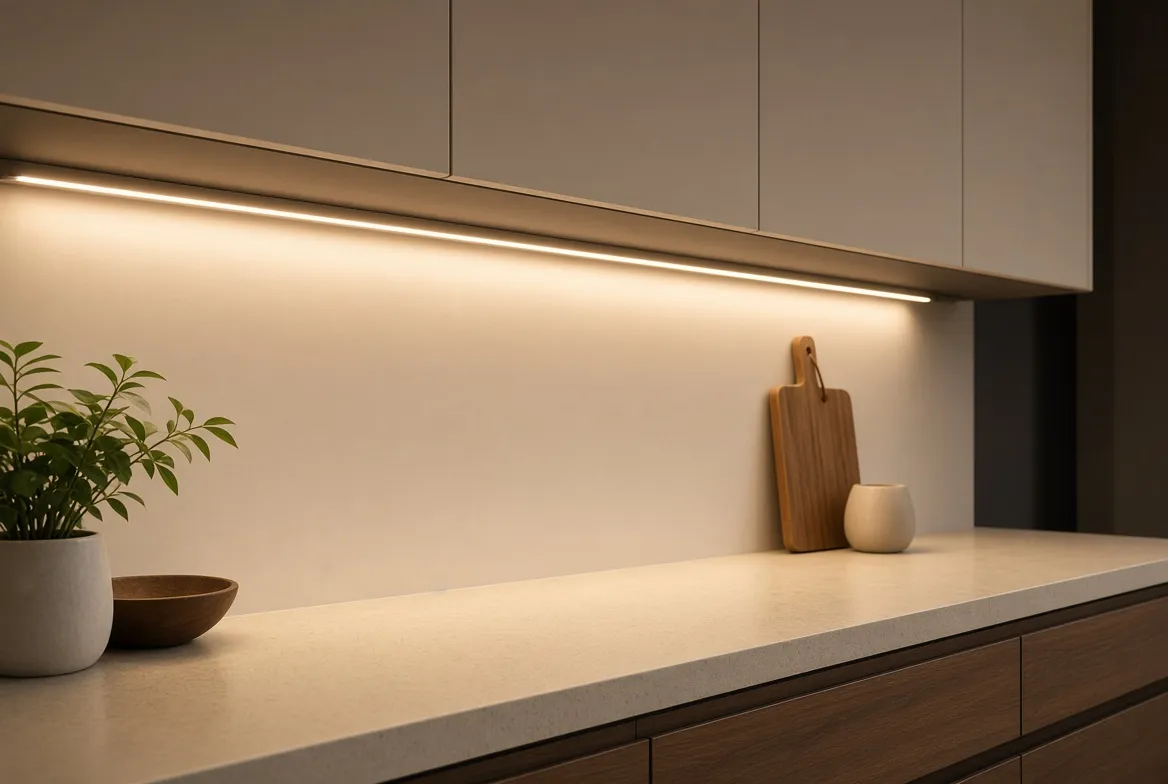
Layering your lighting is also vital. Avoid relying on a single, bright overhead source. Instead, use a combination of floor lamps with shades, under-cabinet strips with diffusers, and biased lighting behind your television or monitor. This reduces the contrast ratio in the room, meaning your eyes don't have to struggle with extreme differences between light and dark areas. By balancing the room's luminance, you create an environment where the ciliary muscles can remain relaxed.
Frequently Asked Questions
Can LED lights cause permanent eye damage?
For standard residential use, LEDs are not considered a risk for permanent retinal damage. The "blue light hazard" is primarily a concern for industrial workers staring at high-intensity bare chips at close range. However, the chronic eye strain and disrupted sleep patterns caused by poor-quality LEDs can have significant long-term impacts on your overall well-being and productivity.
How can I tell if an LED bulb has high flicker before buying?
Check the packaging for "Flicker-Free" or "Title 24 Compliant" labels. Brands like Philips (with their "EyeComfort" line) and Waveform Lighting are known for prioritizing low-flicker drivers. If the box doesn't mention flicker, it is often a sign that the manufacturer used a cheaper, high-flicker driver. You can also look for "Energy Star" certified bulbs, which have more stringent flicker requirements than non-certified options.
Why do some LEDs seem "too bright" even if they have low lumens?
This is usually due to discomfort glare caused by a lack of diffusion. If the LED chip is visible or the bulb uses a clear lens, the light is concentrated into a tiny point. Even a low-lumen bulb can feel "blinding" if all that light is hitting your retina from a single 1mm spot. Always choose frosted bulbs or fixtures with integrated diffusers to spread the light out.
Is it better to use "Cool White" or "Warm White" for reading?
For most people, a Neutral White (3000K to 4000K) with a high CRI (95+) is best for reading. It provides enough contrast to see the text clearly without the extreme blue-light spike of "Daylight" (5000K+) bulbs. If you read primarily before bed, stick to Warm White (2700K) to avoid suppressing melatonin, which helps your eyes and brain transition into sleep mode.