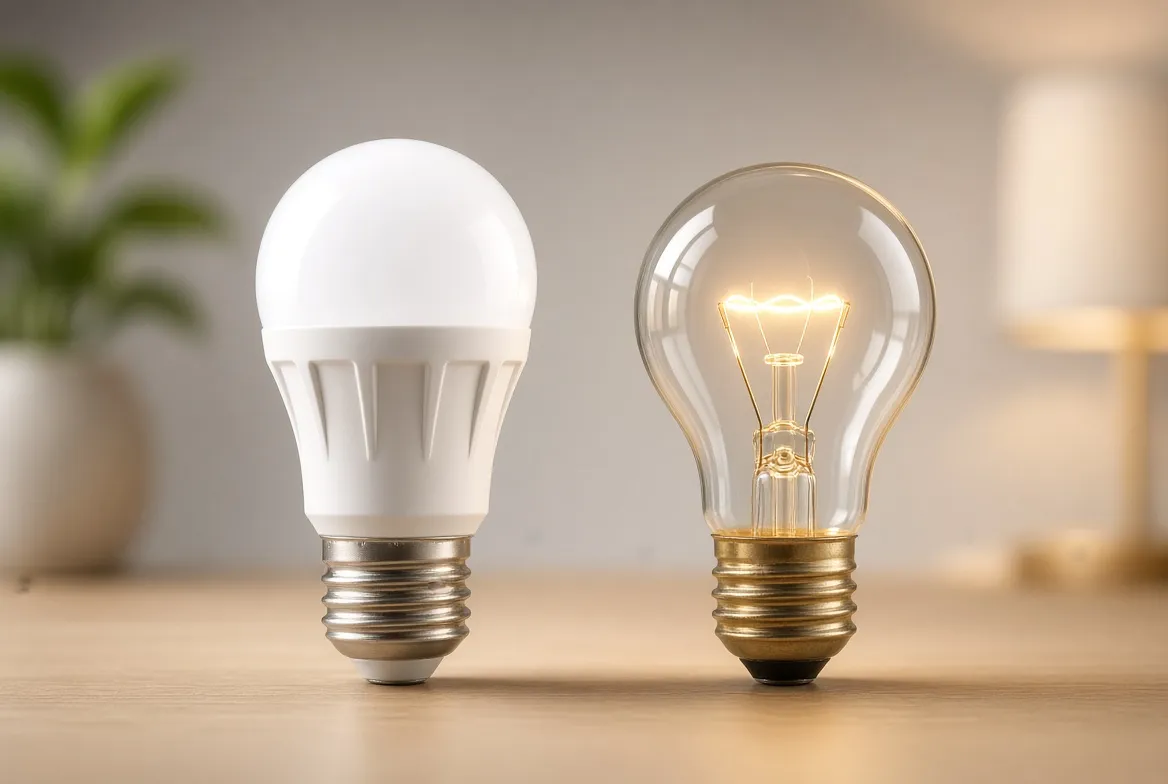
LED bulbs reach a surface temperature of 100 to 150°F [38 to 65°C], warm to the touch but nowhere near hot enough to burn you or start a fire. LED strips run cooler at 90 to 120°F [32 to 49°C]. For contrast, an incandescent hits 400 to 500°F [200 to 260°C], and halogen goes higher.
But the temperature you feel is not the one that matters most. Hidden inside every LED is a second, hotter temperature you never touch, and it quietly decides how many years the light lasts.
Surface Heat vs the Heat That Counts:
The number under your finger is the surface temperature. The one that governs lifespan is the junction temperature at the chip, running 30 to 80°F hotter. Manage that hidden heat well and an LED lasts for years, badly and it fades fast.
How Hot Does Each Type of LED Get?
Temperature depends on wattage and type. Here is what each runs at, surface and junction.
LED Product | Surface Temp | Junction Temp |
|---|---|---|
A19 bulb (10W) | 100 to 140°F [38 to 60°C] | 150 to 185°F [65 to 85°C] |
BR30 recessed (12W) | 110 to 150°F [43 to 65°C] | 160 to 200°F [70 to 93°C] |
Strip light (14W/m) | 90 to 120°F [32 to 49°C] | 120 to 150°F [49 to 65°C] |
High bay (150W) | 130 to 175°F [54 to 80°C] | 175 to 230°F [80 to 110°C] |
Flood light (50W) | 120 to 160°F [49 to 71°C] | 150 to 200°F [65 to 93°C] |
Why the Hidden Junction Temperature Decides Lifespan:
Here is the number that matters more than anything you can feel. The junction temperature at the semiconductor chip is the true heat source, and the heat sink's job is to pull it away to the surface and into the air.
Why care about a temperature you never touch? Because every 10°C rise in junction temperature roughly halves the LED's life. That is why a cheap bulb with a weak heat sink dims and dies years early, as our guide on how long LED lights last explains.
Do LED Lights Actually Produce Heat?
Yes, despite the "cool lighting" label. LEDs are only 40 to 50% efficient at turning electricity into light, so the other 50 to 60% becomes heat at the chip and driver.
A 10W LED makes roughly 5 to 6W of heat, against about 54W from a 60W incandescent. So an LED still makes heat, just a fraction as much, as our guide on how many watts LED lights use explains.
The Real Reason LEDs Are Safe Near Surfaces:
This point explains everything, and most articles bury it. It is not just that LEDs make less heat, it is that the heat goes a different direction. An incandescent radiates heat outward from its glass in all directions, including infrared aimed at nearby objects.
An LED does the opposite, conducting heat backward through its heat sink into the fixture behind it. So the heat pools at the base, not out front toward your shelf or ceiling. That backward path is why LED strips sit safely on wood and drywall, and why LEDs do not warm a room the way old bulbs did.
How Hot Are LEDs Compared to Other Bulbs?
Light Source | Surface Temp | Burn Risk |
|---|---|---|
LED | 100 to 150°F [38 to 65°C] | None, just warm |
CFL | 100 to 180°F [38 to 82°C] | Low, uncomfortable to hold |
Incandescent | 400 to 500°F [200 to 260°C] | Instant burn |
Halogen | 500 to 900°F [260 to 480°C] | Severe burn, fire risk |
HID / Metal Halide | 400 to 700°F [200 to 370°C] | Extreme heat |
Where LED Heat Actually Becomes a Problem: Enclosed Fixtures:
LEDs run cool in the open, but seal them in and the story changes. In a sealed glass globe, an airtight recessed can, or a closed pendant, the trapped air cannot shed heat, so the junction temperature climbs and the LED ages faster.
The fix is simple: buy bulbs marked for enclosed fixture use, which have upgraded thermal management for low airflow. Older recessed cans are the classic trouble spot, and you should never exceed the fixture's max wattage, even with LEDs.
Conclusion:
LED lights run a safe 90 to 150°F on the surface, cool enough to touch and to sit near wood, fabric, and drywall. The heat that matters is the hidden junction temperature, since it sets the lifespan. Give it a good heat sink and open airflow, and an LED stays cool where it counts.
(FAQs):
Q1. Can LED lights start a fire?
A: Under normal use, no. LED surfaces at 100 to 150°F sit far below the ignition point of paper (~450°F) or wood (~500°F). A faulty driver is a different risk, so use UL-listed products. See our guide on whether LED lights can cause a fire.
Q2. Can you touch an LED bulb while it's on?
A: Yes. The dome runs about 100 to 120°F, fine to touch briefly. The base is warmer at 120 to 150°F, uncomfortable to grip for long but not enough to burn. Let any bulb cool before handling.
Q3. Do LED strips get hot enough to damage wood or drywall?
A: No. At 90 to 120°F, strips are safe for wood, drywall, plastic, and fabric, which is why they mount straight onto shelves and ceilings. For high-power strips (24W/m and up), an aluminum channel adds cooling.
Q4. Why does my LED bulb feel hot at the base?
A: By design. LEDs push heat backward into the base and heat sink, not out the front, so a warm base means the heat sink is working. A base too hot to touch, though, can signal a poor-quality bulb or an enclosed fixture trapping heat.