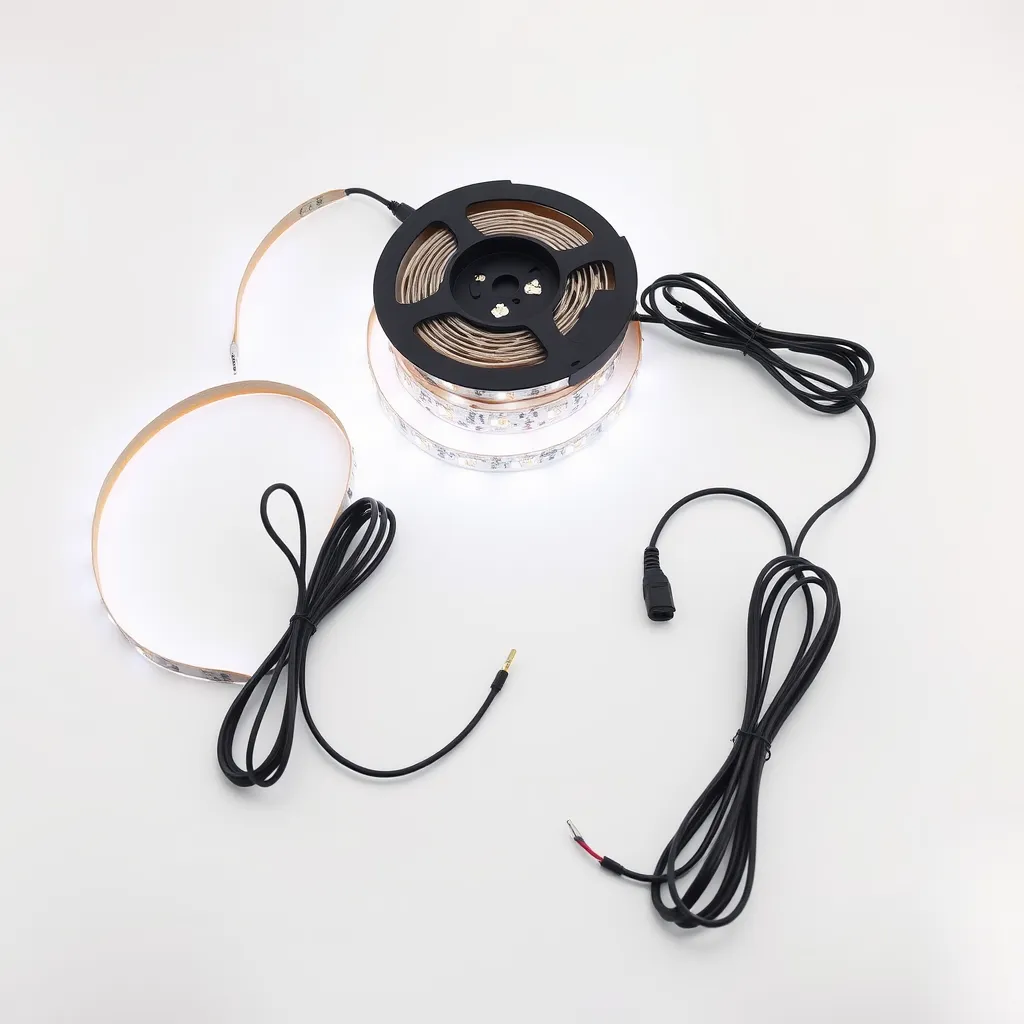
LED strip lights that glow blue after you switch them off are leaking a tiny residual current through the controller, dimmer, or smart switch. Often just 1 to 3V sneaks through, enough to faintly light the blue chips in an RGB strip. It is not a fault in the strip, it is the control circuit failing to fully cut power.
The strange part is the color. Your strip is not broken, and there is a specific reason it picks blue every time, one that also makes blue a useful early warning sign.
Blue Is the Canary, Not the Culprit:
Blue LEDs turn on at the lowest voltage of the three RGB colors. So when a small leak trickles through, blue lights up first while red and green stay dark. The strip is fine, blue is just showing you the leak that all three channels are getting.
Why Does Only the Blue Light Up?
Each pixel on an RGB strip has three separate chips: red, green, and blue. Each needs a different minimum voltage to switch on, called the forward voltage, and blue has the lowest threshold in most designs.
So when a trickle of residual current reaches the strip, only blue gets enough voltage to glow. Red and green need more and stay dark. It is more common with cheap controllers that use MOSFET transistors, since when they switch "off" a little gate voltage lingers, letting microamps slip through. It is the same effect that makes some LED bulbs glow faintly after a smart switch turns them off.
What's Actually Leaking the Current?
Four culprits cause the leak, and knowing which one you have points to the fix.
Smart controller standby. Wi-Fi and Bluetooth controllers keep their wireless radio powered in standby. In poorly designed budget units, some of that standby current leaks into the LED channels. This is the most common cause.
Dimmer ghosting. A wall dimmer, especially one built for incandescent bulbs, can leak a little current even at zero. That leftover trickle glows the strip, the same "ghosting" that makes dimmed bulbs faintly glow.
Capacitive coupling. Long parallel wire runs can induce a small voltage in the LED wire from the live wire beside it. Rare at home, but it happens in commercial conduit.
A failed controller. A blown MOSFET stuck partly on feeds constant low voltage to a channel. If the blue glow appeared suddenly after working fine, suspect this.
How Do You Stop the Blue Glow?
Five fixes, from a two-minute plug-in to a soldering job. Pick by how much effort you want.
Fix | Difficulty | Cost | Effectiveness |
|---|---|---|---|
Power strip with switch | Easy | $5 to $10 | 100%, cuts power fully |
Replace the controller | Easy | $15 to $30 | 90%+, better MOSFETs |
Add a relay module | Moderate | $5 to $15 | 100%, physically disconnects |
Bleeder resistor | Moderate | $1 to $3 | 80%+, drains residual voltage |
LED-rated dimmer | Moderate | $20 to $40 | 95%+, cuts cleanly to zero |
Easiest: A Switched Power Strip:
The simplest fix is to plug the strip's adapter into a power strip with an on/off switch. Flip it off and all power to the adapter and controller is physically cut, so nothing can leak. It costs $5 to $10 and needs zero electrical skill.
Best Long-Term: A Quality Controller:
To keep your smart features without the glow, swap in a better controller from a brand like BTF-Lighting or a dedicated Zigbee unit. Quality controllers use proper gate-discharge circuits that drop output to true zero. Match the replacement to your strip type (RGB, RGBW, or addressable WS2812B) and voltage (12V or 5V). Our guide on how to connect LED strip lights covers wiring it in.
Technical: A Bleeder Resistor:
A bleeder resistor (10kΩ to 47kΩ, 1/4W) across the blue channel gives the residual current a path to drain instead of lighting the LEDs, dropping the voltage below blue's threshold. Solder it between the blue output and the common line. It is a cheap, proven fix, but it needs basic soldering.
If a dimmer is the source, the clean fix is an LED-rated one. See our guide on how to dim LED lights for compatible dimmers that cut to true zero.
Conclusion:
A blue glow after switching off is residual current leaking through the controller, dimmer, or wiring, not a defect, and blue shows first only because it lights at the lowest voltage. Cut power fully with a switched strip or relay, upgrade a leaky controller or dimmer, or add a bleeder resistor, and the glow is gone.
(FAQs):
Q1. Is the blue glow a fire hazard?
A: No. The leaking current is tiny, microamps to low milliamps, so it makes almost no heat and draws a fraction of a watt. It is annoying but completely harmless to the strip, controller, and your wiring.
Q2. Does this happen with single-color strips too?
A: Yes, but it shows as a dim version of that strip's color, not blue. The blue glow is specific to RGB strips because blue is the channel that lights at the lowest leakage voltage. The fixes are the same for any strip type.
Q3. Will a new power supply fix it?
A: Usually not, since the leak is in the controller or dimmer, not the power supply. Replacing the supply only helps if it was faulty and outputting voltage when it should be at zero. A brief glow after unplugging is just capacitor discharge, not the real problem.
Q4. Can I just reset the controller to stop the glow?
A: A reset can help if a software glitch left a channel partly on, so it is worth trying first. If the glow returns, the cause is hardware leakage, not settings. Our guide on how to reset LED lights covers the steps.